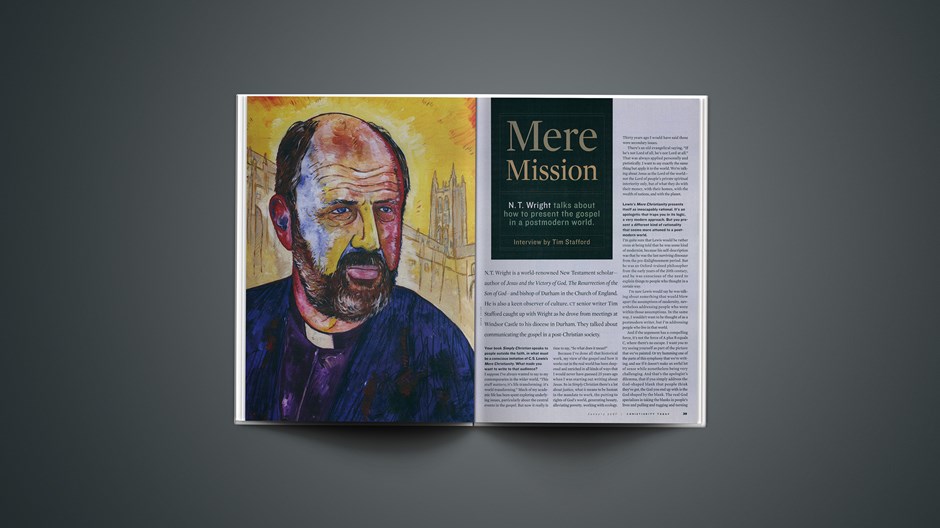
N.T. Wright is a world-renowned New Testament scholar—author of Jesus and the Victory of God, The Resurrection of the Son of God—and bishop of Durham in the Church of England. He is also a keen observer of culture. ct senior writer Tim Stafford caught up with Wright as he drove from meetings at Windsor Castle to his diocese in Durham. They talked about communicating the gospel in a post-Christian society.
Your book Simply Christian speaks to people outside the faith, in what must be a conscious imitation of C.S. Lewis's Mere Christianity. What made you want to write to that audience?
I suppose I've always wanted to say to my contemporaries in the wider world, "This stuff matters; it's life transforming; it's world transforming." Much of my academic life has been spent exploring underlying issues, particularly about the central events in the gospel. But now it really is time to say, "So what does it mean?"
Because I've done all that historical work, my view of the gospel and how it works out in the real world has been deepened and enriched in all kinds of ways that I would never have guessed 25 years ago when I was starting out writing about Jesus. So in Simply Christian there's a lot about justice, what it means to be human in the mandate to work, the putting to rights of God's world, generating beauty, alleviating poverty, working with ecology. Thirty years ago I would have said those were secondary issues.
There's an old evangelical saying, "If he's not Lord of all, he's not Lord at all." That was always applied personally and pietistically. I want to say exactly the same thing but apply it to the world. We're talking about Jesus as the Lord of the world—not the Lord of people's private spiritual interiority only, but of what they do with their money, with their homes, with the wealth of nations, and with the planet.
Lewis's Mere Christianity presents itself as inescapably rational. It's an apologetic that traps you in its logic, a very modern approach. But you present a different kind of rationality that seems more attuned to a postmodern world.
I'm quite sure that Lewis would be rather cross at being told that he was some kind of modernist, because his self-description was that he was the last surviving dinosaur from the pre-Enlightenment period. But he was an Oxford-trained philosopher from the early years of the 20th century, and he was conscious of the need to explain things to people who thought in a certain way.
I'm sure Lewis would say he was talking about something that would blow apart the assumptions of modernity, nevertheless addressing people who were within those assumptions. In the same way, I wouldn't want to be thought of as a postmodern writer, but I'm addressing people who live in that world.
And if the argument has a compelling force, it's not the force of A plus B equals C, where there's no escape. I want you to try seeing yourself as part of the picture that we've painted. Or try humming one of the parts of this symphony that we're writing, and see if it doesn't make an awful lot of sense while nonetheless being very challenging. And that's the apologist's dilemma, that if you simply address the God-shaped blank that people think they've got, the God you end up with is the God shaped by the blank. The real God specializes in taking the blanks in people's lives and pulling and tugging and turning them into a new shape.
One of Lewis's classic maneuvers is this: Jesus said he was God, and you either believe that or that he was a madman on the level of someone who thinks he is a poached egg. It's a powerful argument that has had a strong effect on a lot of people, but modern source criticism of the Bible has undermined the idea that Jesus claimed to be God.
My major work has been designed to refute the wilder claims made by some so-called historical critical scholarship. Because now we see only too clearly that the whole historical critical movement was not, as it tried to claim, a neutral, objective, scientific account of the Gospels. It had its own agendas that were heavily driven by the philosophy of the Enlightenment. The movement really started out with the assumption that if there is a God, this God does not intervene in human affairs. In other words, the Enlightenment has already settled Lewis's question one way. It has decided that any Jesus who said John 14:6, "I am the way, the truth, and the life," would be completely out of his skull. Therefore, Jesus couldn't have said it, because we know he was a good man and we want to follow him for other reasons. It becomes a circular argument. Lewis breaks into the circle by simply ignoring the critical possibility.
You put less emphasis on Jesus' claims to be God-come-to-earth, and more on his forceful activity, doing what only God can do.
It is possible to say more or less all the orthodox Christian affirmations, but to join them up in the wrong story. It's possible to tick the boxes that say Trinity, Incarnation, Atonement, Resurrection, Spirit, Second Coming, and yet it's like a child's follow-the-dots. The great story—and after all the Bible is fundamentally a story—we've got to pay attention to that, rather than abstracting dogmatic points from it. The dogmas matter, they are true, but you have to join them up the right way.
Article continues below
There's a certain kind of modernist would-be orthodoxy, which uses the word God in something like the old Deist sense. He's a distant, absentee landlord who suddenly decides to intervene in the world after all, and he looks like Jesus. But we already know who God is; now I want you to believe that this God became human in Jesus. The New Testament routinely puts it the other way around. We don't actually know who God is. We have some idea, the God of Israel, or of Abraham, Isaac, and Jacob, the Creator God. But until we look hard at Jesus, we really haven't understood who God is.
That's precisely what John says at the end of the prologue: No one has ever seen God; the only begotten God who is in the bosom of the father, he has made him known. John's provided an exegesis for who God is. And in Colossians 1 as well, he is the image of the invisible God. In other words, don't assume that you've got God taped, and fit Jesus into that. Do it the other way. We all come with some ideas of God. Allow those ideas to be shaped around Jesus. That is the real challenge of New Testament Christology.
What happened with the Enlightenment is the denarrativization of the Bible. And then within postmodernity, people have tried to pay attention to the narrative without paying attention to the fact that it's a true story. It's the story of Creator God with his world. The great biblical story is fundamentally not like a parable of Jesus, which is true whether or not there was a farmer who had two sons. The overarching story of who Jesus was, the story of God and Israel and the coming of Jesus, has to have a historical purchase on reality. Otherwise, it is colluding with the very Gnosticism it is opposing. This particular story is about the Creator and the real world; it's not about a God who is only interested in our interior reflections or our spiritual progress, the Gnostic worldview.
I've just written a book on the Gospel of Judas. I wanted to write the book because the people who published the Gospel of Judas make the most extraordinary and grandiose claims for it and for the whole worldview of Gnosticism that it represents. They're trying to claim that this worldview beats orthodox Christianity hands down. [They say] orthodox Christianity is boring and dull and miserable and restrictive, whereas Gnosticism is exciting and dynamic and vibrant and countercultural. I'm fascinated at why all sorts of people in America and elsewhere badly want this to be true.
Article continues below
What do you make of the popularity of this stuff?
The Gnostic conspiracy theory says that orthodoxy hushed up the really exciting thing and promoted this boring sterile thing with Matthew, Mark, Luke, and John. And of course there's a great lie underneath that. In the second and third centuries, the people being thrown to the lions and burned at the stake and sawed in two were not the ones reading Thomas and Judas and the Gospel of Philip and the Gospel of Mary. They were the ones reading Matthew, Mark, Luke, and John. Because the empire is perfectly happy with Gnosticism. Gnosticism poses no threat to the empire. Whereas Matthew, Mark, Luke, and John do. It's the church's shame that in the last 200 years, the church has muzzled Matthew, Mark, Luke, and John and turned them into instruments of a controlling, sterile orthodoxy. But the texts themselves are explosive.
But why has Gnosticism become so attractive just now? What is it about our times?
When does Gnosticism flourish? In the middle and late second century, what's just happened? The failure of the second Jewish revolt in A.D. 135. Jewish people who have clung fiercely to their Scriptures, as the desperate side of hope when everything seems to be going wrong, have lost. Then the failure of the Bar Kochba revolt, and Rabbi Akiba himself is killed, and what are you going to do? Well, you can go off and be a pagan. Or, in this wonderfully cynical way, you can take your own Bible and read it upside down. So Cain becomes the hero and Abel becomes the villain. And the God who made the world is a bad god, so you tell the story of the creation of the world as the Fall.
Jewish Gnosticism emerges out of that failure, and is sustained at a time when the imperial power of Rome has stamped on Judaism and is now doing its best to stamp on Christianity. So you say, there is no hope in the world, the world is a dark place run by evil, wicked forces who have no fear of God, no sense of spirituality. Therefore, the only thing is to turn inward.
Now, look at the rise of the great powers in the 20th century and situate the rise of Freudian and Jungian psychology within those movements. People are looking outside, and it's chaos. People are doing awful things. You say there must be very interesting things going on inside. One of Carl Jung's famous sayings was, "Who looks outside dreams; who looks inside awakens." That's 20th-century Gnosticism. When you get the rise of the modern American empire, the post-Holocaust world and all the anomie of modernity, people are asking, "What is it all about?" Gnosticism seems to many people like a place to find something good about oneself in the face of a hostile world.
Article continues below
[Like the second century,] we have neo-paganisms of the Right and the Left. On the Right you've got war and money, Mars and Mammon, calling the shots. If you oppose the necessity of going to war, you're not quite sane. And if you say you've just been offered a job at double the salary but you're going to stay with what you are doing, people will look at you as though you are mad, because the money imperative is just assumed to be all important. It's not just that they disagree or think you're stupid, they just cannot understand what you're talking about.
And the same paganism is on the Left. Obviously sex, the goddess Aphrodite, makes demands. To resist those demands for whatever reason is just assumed to be completely incomprehensible. Somebody falls in love with the wrong person, off they go, and it's just a shoulder-shrugging thing. Of course you've got to do that because this is the imperative, this is what our culture is all about.
How do you see the church's mission in this context?
For generations the church has been polarized between those who see the main task being the saving of souls for heaven and the nurturing of those souls through the valley of this dark world, on the one hand, and on the other hand those who see the task of improving the lot of human beings and the world, rescuing the poor from their misery.
The longer that I've gone on as a New Testament scholar and wrestled with what the early Christians were actually talking about, the more it's been borne in on me that that distinction is one that we modern Westerners bring to the text rather than finding in the text. Because the great emphasis in the New Testament is that the gospel is not how to escape the world; the gospel is that the crucified and risen Jesus is the Lord of the world. And that his death and Resurrection transform the world, and that transformation can happen to you. You, in turn, can be part of the transforming work. That draws together what we traditionally called evangelism, bringing people to the point where they come to know God in Christ for themselves, with working for God's kingdom on earth as it is in heaven. That has always been at the heart of the Lord's Prayer, and how we've managed for years to say the Lord's Prayer without realizing that Jesus really meant it is very curious. Our Western culture since the 18th century has made a virtue of separating out religion from real life, or faith from politics.When I lecture about this, people will pop up and say, "Surely Jesus said my kingdom is not of this world." And the answer is no, what Jesus said in John 18 is, "My kingdom is not from this world." That's
ek tou kosmoutoutou. It's quite clear in the text that Jesus' kingdom doesn't start with this world. It isn't a worldly kingdom, but it is for this world. It's from somewhere else, but it's for this world.
Article continues below
The key to mission is always worship. You can only be reflecting the love of God into the world if you are worshiping the true God who creates the world out of overflowing self-giving love. The more you look at that God and celebrate that love, the more you have to be reflecting that overflowing self-giving love into the world.
His newest book, Simply Christian, is available from ChristianBook.com and other retailers.
He will be speaking at Calvin College's January Series today, January 5.
Other Christianity Today articles by or about N.T. Wright include:
What Is This Word? | The incomprehensible, intimate Christmas story. (December 21, 2006)
Echoes and Voices from Beyond | N.T. Wright argues that Christianity better comprehends our deepest human longings. (September 1, 2006)
N.T. Wright: Anglican Report Is 'Fireproofing the House' | Top theologian on Lambeth Commission talks about what happened behind the scenes, whether the report should have been tougher, and why it's critical of some conservative bishops. (October 1, 2004)
Reconstructing Jesus | The rewards of N. T. Wright's historical recovery of Jesus are great—but he raises more questions than he answers. (April 27, 1998)
















 While we pray for peace, we need moral clarity about this war.
 As my doubts about his teachings grew, so did a secret fascination with Jesus.
 When I married into a Jewish family, antisemitism hit home. Now, the holy day reminds me of our future hope.






