






James Moore
Darwinism Gone to Seed
Disseminating Darwinism: The Role of Place, Race, Religion, and Gender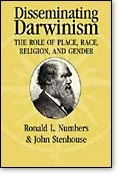
Disseminating Darwinism
Disseminating Darwinism: The Role of Place, Race, Religion, and Gender, edited by Ronald L. Numbers and John Stenhouse, Cambridge University Press, 1999, 300 pp.; $54.95
Isms multiply when ideologies collide. Strange though it may seem at "the end of history," words we smile or scoff at were once casus belli, fought over like territory, flung about like grenades. Nineteenth-century English first felt the impact of "evangelicalism" (1831), "socialism" (1837), "secularism" and "vegetarianism" (1851), "altruism" (1853), "positivism" (1854), "sacerdotalism" (1861), "agnosticism" (1869), "imperialism" (1870), and "pragmatism" (1898). Other isms, like ensigns, heralded the followers of great men: "Owenism" (1833), "New man ism" (1838), "Malthusianism" (1848), "Moody-and-Sankeyism" (1875), "Spencerism" (1880), and "Marxism" (1897). Coined in innocence or forged in anger, words like these became "calls to battle," not only in politics and religion, but—Ludwig Fleck reminds us—in Genesis and Development of a Scientific Fact. When their "logical meaning" was spent, they still retained a "magical power" to provoke or persuade "simply by being used."
The most durable of Victorian scientific isms is "Darwinism." It entered the ideological fray in 1856 when a clergyman damned the soft-porn poet Erasmus Darwin, grandfather of Charles. Four years later, Darwinism began to acquire its modern sense, referring to views ex pressed in the Origin of Species (1859). This was thanks to a rising sea-squirt specialist, Thomas Huxley, who in the same breath puffed an arms magnate by dubbing the Origin "a Whitworth gun in the armoury of liberalism." Huxley went on to target popular audiences with the ultimatum "it is either Darwinism or nothing," by which he promoted evolutionary naturalism with an anti-creationist edge. But his rhetoric proved divisive and made more enemies than friends. Too often, it seemed, Darwinism was used or abused by partisans rather than treated for what he believed it to be, bona fide science.
So Huxley back-pedaled, claiming to be agnostic about "lunar politics," and then Darwin himself stepped in. Under his auspices (with a little help from the Catholic anatomist St. George Mivart) Darwinism was born again in the 1870s as the theory of evolution by natural selection tout court, without metaphysical or ideological entailments. Huxley continued to shun the D-word (nor did he ever endorse natural selection) and lived to see the "want of unanimity among Darwinians in matters of Sociology and Politics" cited as happy proof that "the principles of the Master are perfectly neutral on such questions." By 1900 pundits were labeling the partisan use or abuse of Darwin's science "Social Darwinism."
All of which suggests that Darwinism has a history like that of other isms. No philosophical fancy footwork, no political jiggery-pokery can avoid this. Raymond Williams once remarked on "the isolation of isms" during the nineteenth century and their "transfer from theological to political controversy." He failed to see that science was just as involved. Here too isms multiplied as dogmas clashed, denominations splintered, and excommunications took place; here too were ideologues, guerrilla groups, and palace coups. At stake was the nature of science itself and its bearing on human progress. And at the center of conflict stood Darwinism, repeatedly defused and rearmed, its charge diluted but finally distilled as the "universal acid" with which to day Dan Dennett and others would dissolve all fundamentalisms except their own.
How then may Darwinism be most aptly studied? As military history, it would seem, and we still hear of Darwin's inflaming "the warfare of science with theology" or, more often, fomenting "the Darwinian revolution." Indeed, judging from historical literature, Darwinism has generated all sorts of excitement. It may "come to" a place like America and there have "impacts" as people "react" or "respond" to it. It may have "implications" independent of context, for "it"—Darwinism—is conceived as an essence hovering above (or seeping through) history's accidents, an idea or set of ideas that, like a chart-busting pop group, creates consternation wherever it goes. But pop artists are real, earthy; no one thinks the tried-and-tired methods of intellectual history are up to understanding them. The same cannot be said of Darwinism. Its historians have yet to discover the rich resources of media studies, material cultural studies, and ethnomethodology, now routinely exploited by interpreters of other protean subjects, like Madonna Ciccone.
Even so, Disseminating Darwinism marks a new departure. Here Darwinism is scrutinized, not science-by-science, country-by-country, or thinker-by-thinker, but according to an original set of canons—place, race, and gender—as well as the old-time favorite, religion. The editors have hit on a fresh guiding concept to boot. Not content with a static structuralist "introduction" (as in Yvette Conry's L'introduction du darwinisme en France au XIX siècle) or a threadbare "reception" (as in Thomas Glick's The Comparative Reception of Darwinism), Numbers and Stenhouse trot out a dynamic "disseminating." Whatever can it mean? A biological —indeed, seminal—metaphor seems peculiarly apt, but this one has deeper roots than Darwinism, harking most memorably (as the editors well know) to the Synoptic Gospels.
"Behold," Matthew 13 records,
a sower went forth to sow. And when he sowed, some seeds fell by the way side, and the fowls came and devoured them up. Some fell upon stony places, where they had not much earth: and forthwith they sprung up, because they had no deep ness of earth. And when the sun was up, they were scorched; and because they had no root, they withered away. And some fell among thorns; and the thorns sprung up, and choked them. But other fell into good ground, and brought forth fruit, some an hundredfold, some sixtyfold, some thirtyfold. Who hath ears to hear, let him hear.
In this parable, Jesus draws attention to the conditions under which his message—"the word of the kingdom"—may spread. He offers in fact a rudimentary sociology of knowledge. "Place" is paramount, as the text goes on to explain: first, the "way side" where one "heareth the word … and understandeth it not"; second, the "stony" ground where one "heareth the word, and anon with joy receiveth it," but "hath … not root in himself" and so "dureth for a time"; third, the plot of "thorns" where one "heareth the word" but it is choked and "becometh unfruitful"; and finally the "good ground" where one "heareth the word, and understandeth it," and "beareth fruit." In the three abortive cases, place is crucial but not the only factor. "Fowls" descend where there is no understanding—the word vanishes. The "sun" scorches where understanding is shallow—the word perishes under duress. "Thorns" choke where understanding is impeded—the word suffers from competition. Only where the word is both heard and understood does it catch on; only in prepared sites, with the right contingencies, will the seminal message spread.
How far then does Disseminating Darwinism live up to the promise of its title? How have "place" and other contingencies—race, gender, and religion—shaped the history of Darwinism? What indeed was reaped, and what sown?
The first five of the ten chapters focus on local, regional, and national terrains. David Livingstone's study of Presbyterian towns shows that Princeton and Edinburgh were full of nutrients, offering Darwinism rich theological soil, but in Belfast the muck was thrown instead as stern preachers defended their turf against fellow-Orangeman John Tyndall. The aftermath of Tyndall's "materialistic" Belfast address to the British Association for the Advancement of Science in 1874 suggests that, for Protestants and Catholics alike, Darwinism's manner of sowing could be more critical than its substance, and that the seed sown was not necessarily what flowered or even sprouted. Thanks to Livingstone, these phenomena may now be sought in places for which other contributors offer different insights.
Terra Australis is surveyed by Barry Butcher, a continent where, one might suppose, the fortunes of Darwinism were as distinctive as the flora and fauna. But no. The "tyranny of distance" failed to impose a significant "time lag" on de bates a world away; a "culturally connected" intelligentsia—church leaders, colonial governors, men of science—aired the same range of views on the same set of issues at roughly the same intervals as their British counterparts. And by the 1890s biology was bowing to Huxley-trained "new men" as much in Australia as at home. Butcher only hints at local conditions—gold fever, exotic wildlife, stone-age aboriginal cultures—that helped or hindered theories of progressive development, and he might have added the "convict stain" and republicanism among immigrant Celts and Catholics. Surely such factors affected the planting of Darwinism in the antipodes more than he allows.
New Zealand, analyzed admirably by John Stenhouse, is a case in point. The youngest of Britain's "white settler colonies," it had yet to come of age when the Origin of Species was published. Most of the immigrants were English, literate, and from "lower-middle-class or respectable working-class backgrounds." Their Christianty was moderate or nominal; no denomination had a majority and there was no state church. Nor was there a "pre-Darwinian scientific establishment" to overcome. Old World conditions for ideological conflict were absent in New Zealand. When controversy over evolution did break out, it was in the "far south," where Scots Free Churchmen predominated, and the main casualty was the Dunedin YMCA. For their part, men of science "favored Darwin from beginning to end," yet without ostracizing his sole opponent, a Catholic entomologist. Even freethinkers "got tolerated to death," Stenhouse claims, which is more than can be said for the Maori. The "most sustained period of racial warfare" in the colony's history began in 1860. Darwinism breathed new life into Pakeha (white) racism even as it augured the extermination of native tribes. Slogans like "the European rat … displaced the Maori rat" became knock-down arguments for humans' behaving like rats with a vengeance.
A similar Darwinian motif prevailed in Canada, where the "irresistible force of agricultural expansion" from a "vulnerable and relatively unstable" immigrant culture met the "immovable object" of the Precambrian Shield. "Darwin," says Susan Zeller, "offered a scientific framework within which to comprehend this predicament" and "strengthened the resolve" to defeat it. Evolutionary biogeography flourished on the arctic tundra according to the same principles of competition and dominance invoked by romantic nationalists to justify the spread of civilization at the expense of indigenes in the same regions. By the twentieth century, Canada's history itself was seen as a "progressive development" of the "best northern races" as they struggled to occupy their appointed environment. It took a die-hard creationist, McGill's geologist-principal J.W. Dawson, to see this expansionism as "the enemy of wild nature," the march of empire as "the westward march of exhaustion," both of land and resources. Zeller's essay, though largely descriptive, stands out for its fertile suggestions about the actual geological and geographical terrain on which Darwinism took root.
Ron Numbers and Lester Stephens's "Darwinism in the American South" is probably the most thorough piecemeal vindication of the region's hospitality to evolution ever published. Their case is weakened by its limitation to the "educated classes" and "scientific circles," and the essay all but ignores the aspects of "place" featured by Zeller and Stenhouse. In a land steeped in slavery and torn by sectionalism, it seems inconceivable that controversies over a theory that both unified mankind and united man kind with beasts were not, at some level, rooted in "racial concerns," even if the authors found this "difficult to document." After all, they show that James Woodrow fell from grace over man's bodily evolution, and Alexander Winchell over the descent of whites from pre-Adamic blacks. Both professors' monogenism, like Darwin's, threatened havoc by bestializing the cottonocracy, sanctioning miscegenation, and making mankind one. Is it any wonder then that in the "racially sensitive South" the "most ardent scientific opponent of Darwinism" (and perhaps many pundits on all sides) had been taught by Harvard's great anti-Darwinian polygenist, Louis Agassiz?
The latter chapters of Disseminating Darwinism remain focused on American soil, assessing how religion, race, and gender affected the planting and the harvest. To recover the "motivations" of Protestant clergymen and theologians, Jon Roberts shows himself an even more out-and-out empiricist than Numbers and Stephens. He sidelines "denomination" and "geography" as explanatory "variables" because they cannot "predict" responses to "the theory of organic evolution" (help fully quantified as 35 percent pro, 25 percent con, 40 percent "progressive creationist"), although he allows that historians might find significant "correlations" by using "the sophisticated instruments of statistical analysis." He then—predictably enough—rejects "social interest" explanations for being "largely driven by dogma rather than evidence" (thus as signing historians' motives while muddling ideology with intentionality). Explanations based on "cultural-psychological strain" are similarly found wanting be fore Roberts expounds his own "hypothesis." Taking the "theological stakes" identified by contemporaries as the key to their motivations, he boils the Darwinian debates down to one compelling issue: the relative authorities of Scripture and scientific expertise. "Thinkers" motivated by belief in "biblical literal ism" (or "in fallibility") rejected evolution; others compromised that belief by adopting a miracle-studded "progressive creation ism"; the rest—"Protestant evolutionists"—acknowledged a fallible Scripture while ceding authority in science to professionals.
This seems a little too familiar for comfort. Motives are not like billiard balls, banging men into action—so far Roberts and I agree. He clinches the point usefully by allowing for "layers of motivation." But "it makes sense," he adds, to understand the theological stratum first, "before burrowing deeper." After "six decades" of scholarship at this level, I wonder why. Why assume that nineteenth-century religious thinkers were the best judges of their motives? Why should we believe them anyway? Why not start at a more basic level (short of Jacques Barzun's jocular "nuclear biography") and ask where belief in the sacred authority of texts came from? Why was this particular doctrine thought to be at stake? Do the politics of hermeneutics shed light, now we understand (from today's neo-creationists) the ideological value of the early chapters of Genesis? What indeed was the non-cognitive function of Baconian do-it-yourself exegesis in a enlarging, diversifying, pluralistic republic?
My point is that just as the imputation of motives by historians is to be understood by reference to their communal concerns and modes of practice—mine in Britain, Roberts's in the United States—so the self-imputation of motives by historical actors must be considered in relation to the communal concerns and practices in the contexts where the utterances were made. (I owe this point to C. Wright Mills via Steve Shapin and Barry Barnes.) What holds for Protestants will apply to other believers in sacred texts—say, Mormons, Millerites, and Muslims. In each case, historians need to understand the actors' communal world—their "social interests," so to speak—to make sense of their declared motives in reckoning with science. Such declarations however do not open a window on anyone's soul.
Sociological insight of this sort distinguishes Scott Appleby's subtle analysis of the Roman Catholic church. With the clergy divided into ultramontane, neoscholastic conservatives and "Americanist" progressives, Appleby might have, Roberts-like, made beliefs about "Catholic tradition rather than biblical literalism" the crux of "responses to evolution." But instead he digs deeper, viewing the church's "internal politics" in cultural context, alongside the "external politics" of social reform as it affected the needs of a "polyglot, urbanizing, immigrant … community."
The issue has, to my mind, never been put so suggestively. Of all denominations, Catholics were overwhelmingly on the sharp end of what American intellectuals in 1897 first called "Social Darwinism." Those tired, hungry, genuflecting masses from southern and eastern Europe—petits-bourgeois, wage-slaves, syndicalists, anarchists, and all—became the "feeble" and "unfit" on whom Protestant xenophobes sought to impose Darwinian discipline. Big families in good stocks—well and good; Catholics endorsed the aims of positive eugenics. But birth control, sterilization, and other negations preached at them in Darwin's name were anathema, even apart from Natural Law. Theological gymnastics over evolution, Appleby argues, were "actually an occasion for American Catholics to work out a number of identity-defining issues facing the immigrant community." Neither Scripture nor tradition was finally at stake, but the church's place in the modern world.
Marc Swetlitz, in the book's longest and most original essay, reaches analogous conclusions about American Jews. Their immigrant community too was divided, struggling to accommodate an alien culture without losing its identity. Of Germanic origin mainly (Swetlitz leaves the East European and Russian diasporas for future research), with few scholars trained in science, the traditionalist and Reform parties had "long engaged in polemics regarding the proper direction of American Judaism." Matters came to a head in the 1870s and '80s just as Darwin was becoming a cultural force, and evolution entered the controversy, mobilized and bad-mouthed by both sides, as rabbis invoked it to sanction religious "progress" or spurned it as an ideology of assimilation. At root, Swetlitz shows, the evolution debate was "about the nature of Judaism"; and with communal life at stake, Scripture remained a vital but subordinate issue. I find his argument convincing with one reservation. If evolution became a "resource" for securing the "future of American Jewry," was it not also the stuff of pogroms? Didn't Jews eventually suffer with Catholics and other immigrants under the heel of nativism dressed up as Darwinism? As this story belongs to his future research, I trust Swetlitz will tell it in the same compelling detail.
Another fraught topic, "Black Responses to Darwinism," is covered in a ground-breaking chapter by Eric Anderson. The problem he confronts is the one Swetlitz puts on ice: Where was the cry of the oppressed? For there was "no strong, sustained black reaction either for or against Darwin and his theories." Even black religious leaders "seldom directly attacked Darwinism or competing theories of evolution." Responses ranging from "vague appropriation" and "sublime neglect" to "peremptory rejection" were "remarkably muted if Darwin's ideas were central to American racist thought"; and Anderson concludes that we may be wrong to expect that blacks should have "responded more strongly to Darwinism."
Indeed, it is difficult to see how the suggestion ever got started. Leaving aside whether Anderson's clutch of spokesmen, from Frederick Douglass in the 1850s to Francis Grimké in the 1920s, expressed typical African American views, it seems perfectly obvious why "what did not happen" happened. Ignorance, illiteracy, in articulacy, failure of nerve, and sheer canniness are each reason enough why any "poorly educated, largely rural" people would hesitate to sound off about science. Even their leaders would, no doubt, seldom invoke great names or discuss complex theories (let alone endorse them), though they might well express commonplace concepts in vivid glozing language. Anderson complains that "black Americans … used Darwinian terms and metaphors … casually, almost offhandedly—a fact that complicates the task of assessing the impact of Darwinism on this community." What? Would it be easier if language had not been used? Or should the language of African Americans at this period be judged by standards appropriate to philosophers and scientists? Who, for that matter, in any race or profession at any time has used "Darwinian" language so circumspectly that "assessing the impact of Darwinism" on their community is uncomplicated? Did Darwin himself?
Anderson is on firmer ground when explaining that blacks neglected Darwin because "polygenist theory" was their real enemy, because urgent practical concerns detained them (fighting racism on the ground, "like firemen in an arson-mad neighborhood"), and because "Darwin's ideas were not the primary impetus be hind racist thought." As for "measuring 'the impact of Darwinism,'" which Anderson finds a "difficulty," I hereby declare it (pace Roberts) a waste of time. Even if the results of data-crunching could be made plausible, historians don't have to quantify the "silence" of racism's victims to realize that "certain convenient, time-honored generalizations about evolution, race, and society" have to be overhauled. They have, for instance, Stenhouse, Zeller, and Swetlitz to remind them.
The last chapter of Disseminating Darwinism, on "women's responses to evolutionary ideology," is in respects the most salutary. Drawing widely on relevant literature, Sally Gregory Kohlstedt and Mark Jorgensen canvass the well-known views of Antoinette Brown Blackwell and Charlotte Perkins Gilman without overlooking remarks by Eliza Burt Gamble, Olive Schreiner, Louisa MacDonald, George Eliot, and Kate Chopin. The centrality of female experience, women's wariness in debate, their empirical one-upsmanship and efforts to co-opt Darwin are all suitably addressed.
The problem with the essay lies elsewhere. It is one that afflicts every chapter more or less, and Kohlstedt and Jorgensen are to be credited for acknowledging it. From their opening alert—"there was no simple, singular Darwinism"—to their parting advice—"there never was a simple or static Darwin"—they struggle to pin down the subject whose dissemination the editors expect them to treat. With less than 10,000 words to work in, they take the time-honored way out. As Darwinian terms are "used so variably," they say, and historical actors tended to "gloss over their distinction," the essay follows suit. It uses language "in a fairly general way that finds considerable continuities and similarities in argument among the scientists and their popularizers despite the sometimes heated debates among them."
Which is an understatement. Besides "Darwinism," Kohlsted and Jorgensen refer to their subject as "Darwinian science," "Darwinian theories," "Darwinian ideas," "Darwinian thinking," "Darwinian interpretations," "formulations," "explications," and "discourse." Sometimes "Darwin's own ideas," "arguments," and "descriptions" are in view, sometimes "Darwin's theory," "over all theory," or "theories on sexual difference." Occasionally the authors use "the evolutionary model," "the evolutionary framework," or just "this new scientific theory," and the farrago goes on. Other chapters refer aimlessly to "Darwin's hypothesis," "Darwinian approaches," and "Darwin's work," as well as to the old standbys "transmutation," "evolution," and "natural selection." One chapter with Darwinism in the title even admits that "virtually all" of its scientists "preferred non-Darwinian modes of evolutionary development"—which might lead one to wonder what was being disseminated.
This simply will not do. Language means nothing if so many terms can be used interchangeably. Most of them would not be in use anyway unless someone, somewhere, at some time thought the distinctions they represent worth making; so why do historians ignore the rich history of semantics? For instance, Darwin had myriad "ideas" on myriad subjects. His "science" took in earthworms, his "theories" included pangenesis, his "arguments" involved metaphysics, natural theology, and ethics. To speak in a few breaths of Darwin's ideas, science, theories, and arguments, throwing in for good measure Darwinian "interpretations," "formulations," "explications," and "discourse," without uttering distinctions and qualifications, as if everyone agreed in each case about what was being discussed, is to impoverish understanding. And it is no use pleading, with Kohlstedt and Jorgensen, that historical actors themselves used language loosely. We aren't writing for them, arguing with them.
Not that I think actors should be expected to make the distinctions historians do. Jon Roberts is right and my former self was wrong: it is "unnecessary and even misleading" to classify Victorians by their adherence to natural selection, hypothetico-deductively conceived, particularly since Ernst Mayr had not yet been born and Darwin hedged about the subject. "Darwinism" is not to be formally defined in this or any other ahistorical way and then traced through the past as a distinct idea or argument. What historians have to tackle instead is usage, the incidence and semantics of Darwinian language in various theaters of power—classrooms, laboratories, churches, hustings, the mass media. If actors lumped meanings that we split, fine; if they split what we lump, fine too. If words became weapons—yes, there were theaters of war—we need to find out why, who got caught in the crossfire, and, as Disseminating Darwinism amply suggests, where. Was it not, for instance, removal from Belfast to the New World, according to Livingstone, that enabled the moderates James McCosh and George Macloskie to achieve a "rhetorical liberation," one that "allowed them to express their reservations about Darwinism in a muted way, and to find evolution theologically congenial"?
Numbers and Stenhouse have edited a stimulating book, one that sets new horizons for researching Darwinian history. It is uneven, disjointed and undisciplined in places, with a glaring but entirely predictable blindspot: social class. (Six of the ten chapters are about the United States; two-thirds of the authors are based there. Stenhouse and Appleby alone broach the subject.) Here the only relevant study published by an American is Mark Pittenger's American Socialists and Evolutionary Thought, 1870-1920 (1993). Other wise scholars may consult works by Ted Royle and Bernie Lightman while looking forward to theses by their students, Suzanne Paylor and Erin McLaughlin-Jenkins, at Britain's and Canada's York Universities respectively.
As for sowing and reaping, the world is about to be electrified by Jim Secord's long-awaited Victorian Sensation: The Extraordinary Publication, Reception, and Secret Authorship of Vestiges of the Natural History of Creation (University of Chicago Press). With unexampled rigor, analyzing publishers, audiences, rhetorics, reviewers, markets, and epistemic geographies, Secord nails down a point that, mutatis mutandis, Numbers and Stenhouse's title only touches on. For what Darwin really scattered abroad, on stony, thorny, and fertile ground, was not ideas and arguments but books. "Who hath ears to hear, let him hear."
James Moore is Reader in History of Science and Technology at the Open University, Milton Keynes, United Kingdom. With Adrian Desmond he is the author of Darwin (Norton).
NOTE: For your convenience, the following product, which was mentioned above, is available for purchase:
• Disseminating Darwinism, edited by Ronald L. Numbers and John Stenhouse
Copyright © 2001 by the author or Christianity Today/Books & Culture Magazine.
Click here for reprint information on Books & Culture.
 Email Newsletter
No comments
See all comments
*