






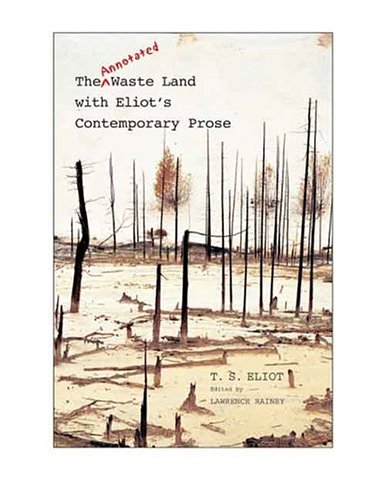
The Annotated Waste Land with Eliot s Contemporary Prose
T. S. Eliot
Yale University Press, 2005
304 pp., 37.00

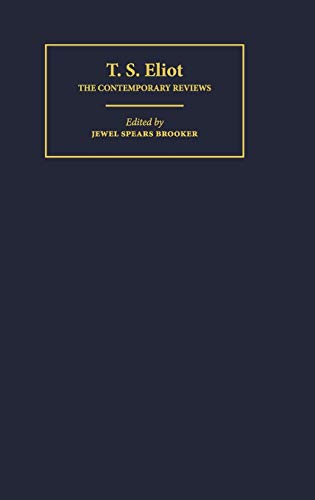
T. S. Eliot: The Contemporary Reviews (American Critical Archives, Series Number 14)
Cambridge University Press, 2004
644 pp., 258.55
Daniel Taylor
Living with a Big Poem
Reflections on The Waste Land.The revolutionary leaders of the modernist avant-garde have suffered the ultimate ignominy: they have become classics, another branch on the tree of Tradition. Prints of Picasso paintings, once shocking, now hang in dentist offices; Joyce, once banned, is now a fixture in the college syllabus. And T.S. Eliot's The Waste Land is now not only a big poem (still the big poem of the last 150 years) but an old poem. Not Odyssey-old of course, but generations old and no longer new, no longer sucking up the oxygen from other poets.
The Waste Land, in my estimation, has aged well. It's true that we don't feel the frisson of its apocalyptic manner the way early audiences did—as Frank Kermode has pointed out, we have been having "apocalypse for breakfast" for many decades now—but The Waste Land still speaks to us, because we still live in its wasted world.
More precisely, The Waste Land does not speak to us—as Tennyson or Wordsworth or Milton do, directly and authoritatively—so much as it invites us to participate in the making of meaning, allowing us to hear our own voice speaking along with Eliot's, both of them tentative and searching.
At least that's what I tell my students. I am, in the interest of full disclosure, a lit prof, and therefore a keeper of poetry, especially of difficult, even arcane modernist poetry. I am not much of a scholar, certainly not an Eliot expert, but I first read The Waste Land almost forty years ago and I have taught the poem every year, sometimes two or three times a year, for most of the last thirty. That is to say, I have lived with this big poem and have gone out of my way to introduce it to others.
And it is a poem that certainly needs introduction. Scholars have been trying to housebreak The Waste Land since its first appearance, but it still intimidates and befuddles first-time readers. It certainly did in 1922. Nothing even in avant-garde circles adequately prepared a reader (though one Ezra Pound poem and the newly appearing Ulysses might have helped) for a poem that in 433 lines, as David Perkins points out, alludes to dozens of other works of literature, art, and music (often obscure works themselves), quotes passages in six foreign languages (including Sanskrit), and encompasses much that was in the air in both the intellectual avant-garde (especially the humanities and social sciences) and the world at large (angst deriving from World War I, urbanization, collapse of old paradigms, and the like).
Pound, in fact, called The Waste Land "the longest poem in the English landwidge." It implicitly includes within itself everything it alludes to, and those works and events come from far and wide in time and place. (I have fantasized about organizing an entire course around this single poem and its allusions.) If Pound is right in defining an epic as "a poem which includes history," then The Waste Land is an epic indeed. And one of its important themes, conveyed by the many allusions, is that waste lands are not only a modern phenomena.
My students have patiently followed me not only line by line through the text but even to London, where I have rousted them early in the morning to get to London Bridge so they could experience Eliot's commute as he describes it in part 1 of the poem: "Sighs, short and infrequent, were exhaled, / And each man fixed his eyes before his feet." I wanted them to see people dressed in their dark winter clothes, echoing Dante's newly dead, plodding to their killing work in the City. Never mind that many of the commuters instead wore brightly colored synthetic jackets and seemed quite chatty (another failure of life to cooperate with art). I assured my students there was a tormented Eliot figure somewhere in the crowd.
If readers of The Waste Land have always been somewhat overwhelmed, there have also always been people around to help, especially the professor-priest. I tell my students they can understand large hunks of The Waste Land without laborious explanations—Eliot's or the scholars' or mine. And I mostly believe it. At the same time, fuller understanding requires a lot of digging.
Few have dug more furiously than Lawrence Rainey, whose two newest books—published together by Yale University Press this spring—are both devoted to Eliot's big poem. The Annotated "Waste Land" with Eliot's Contemporary Prose includes a history of the composition and publication of the poem; a new textual version of the poem, with a collation of variants (all minor to miniscule) from all versions printed up to 1936; all the essays Eliot wrote while composing the poem; the most extensive annotations yet of its allusions and quotations; and a helpful selected bibliography.
In short, this volume provides the raw material for a reader to make his or her own assessment of the poem's meaning and method. Most of this material can be found here or there in existing books or periodical collections, but Rainey has provided a significant service in pulling disparate information together in one place. He goes beyond the usual citation of a line or two from a source Eliot used, giving instead long passages from the original that make clearer the source's significance in The Waste Land. One finds, for instance, not only the title and date of "That Shakespearian Rag" that is running through the husband's head in part 2 of the poem but also the entire score with lyrics (making it possible to hum the tune to yourself next time you are in a stressful conversation with your own spouse).
I have sometimes required groups of students to track down allusions and to report to the rest of us how Eliot is making the allusion work in his own poem. Students, for all their groaning, seem to enjoy the riddle-solving quality of the assignment, something Rainey's book makes obsolete. And perhaps it's just as well. A great poem is not a riddle to be solved but an experience (intellectual, emotional, spiritual, and even physical) to be shared. Still, this holistic experience depends at least in part upon a minimum measure of understanding. Over the years readers of The Waste Land have needed help, and even though Rainey worries about teachers and written guides that make the poem "as tidy as a schoolboy's lunchbox," I, like Rainey, give my students what help I can without apology.
I have found that the most helpful approach is not to attempt an exhaustive account of Eliot's allusions but rather to explain the underlying poetic strategy of The Waste Land (and of much modernist literature and art), and then to show how that strategy gives rise to a handful of recurrent themes and moods in the poem. This strategy is essentially the one Pound later called the ideogrammic method, and it is central to The Waste Land in part because Eliot himself had been using a milder version of it since "The Love Song of J. Alfred Prufrock" and in part because Pound intensified the strategy during his famous editing of the poem.
The essence of the ideogrammic method is placing side-by-side significant but seemingly unrelated concrete details or scenes without explanation or transition in such a way that the reader is invited not to receive a predigested message but to participate in the creation of meaning. In part 2 of The Waste Land, for instance, we are given a scene of a distressing non-conversation between a husband and wife in an opulent London bedroom. It is followed, without transition or explanation, by a scene involving two working-class women discussing sex and abortion in a London pub. The reader is asked to decide what the relationship is between these two scenes and what light that relationship sheds on the poem as a whole.
Similarly in part 3 we are asked to establish the relationship, if any, between a description of polluted (physically and spiritually) contemporary London, the rape of Philomela in Ovid's tale, the courtship of Elizabeth I by Leicester, Tiresias of Greek legend, and two famous passages from Augustine and Buddha regarding lust (not to mention allusions to Spenser, Psalm 137, Marvell, The Tempest, John Day, Verlaine, the recent slaughter of Christians in Turkey, Homer, Goldsmith, Wagner, Dante, and Eliot's earlier poetry and private life).
On the most general level, what all of these scenes and references add up to is a picture of spiritual emptiness, paralysis, and disease, and their consequences in human lives and societies. Whether it is a rape in ancient myth playing off a soulless sexual encounter in contemporary London, or a warning from Eastern religion against the lusts of the flesh echoing against a confession from the Western church father Augustine of his own foolish lusts, or the collation of Israelites weeping in exile in Babylon with Eliot weeping beside the waters of Lake Leman where he finished his poem, all these disparate but significant fragments (Pound called such things "luminous details") vibrate against each other to create the possibility for meaning.
But it is only a possibility. The modernist strategy is dangerous. It increases the potential for personal engagement and multiple layers of meaning, but because it requires the active participation and continued patience of the audience, along with some timely help, it runs the risk of readers throwing up their hands in exasperation and turning to other things. And many do—in 1922 and in my classroom today.
The two big questions for the earliest readers of The Waste Land, in fact, were: did the poem have a recognizable and effective form, and what, if anything, did it mean? As we have seen, the two questions go together. Any answer to the question of meaning requires, as Eliot himself taught us, an answer to that of form.
These two issues are, if anything, more contested now than they were initially, as Rainey's second book, along with another by Jewel Spears Brooker, makes clear. In T.S. Eliot: The Contemporary Reviews, Brooker has helpfully collected the contemporary reviews of each of Eliot's books—poetry and prose—throughout his career. These reviews are often remarkably insightful at the same time that they reveal divergences that continue to the present.
The negative reviews of The Waste Land, as Brooker points out, had three recurring complaints: it was too allusive (requiring too much learning), it was incoherent and fragmented in form, and it was excessively negative in tone. Louis Untermeyer hit on all three, calling the poem "a pompous parade of erudition" lacking "an integrated design" and "cryptic in intention and dismal in effect." The Times Literary Supplement, in contrast, while admitting the poem was "a collection of flashes," argued that it still had a coherent form and discernible meaning: "there is no effect of heterogeneity, since all these flashes are relevant to the same thing and together give what seems to be a complete expression of this poet's vision of modern life" (which it described, presciently, as "purgatorial").
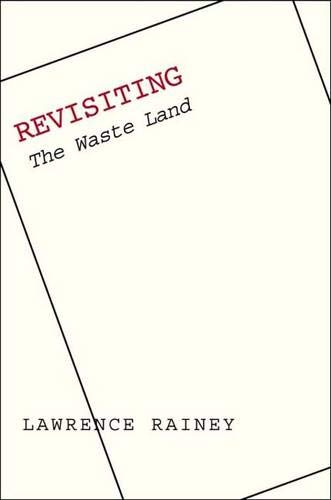
One is tempted to say that the anonymous reviewer for the TLS (and critics like Edmund Wilson and Gilbert Seldes) saw early what most everyone in time was to come to see. (Eliot said in 1956, "These things …. become easier to people with time. You get used to having The Waste Land, or Ulysses, about.") But in fact the argument over form and meaning in The Waste Land continues to the present, as Rainey's Revisiting "The Waste Land" illustrates.
In Revisiting, Rainey offers an even more thorough analysis of the chronology of composition of the poem (there is a disconcerting amount of repetition both within and between his two books), a detailed discussion of its publication, and an overview, using contemporary reviews of the kind collected in Brooker, of its initial reception. There is an impressive, one is tempted to say depressing, amount of scholarship in this book. Rainey consulted the originals of more than 1,200 pages of Eliot letters and pages of Waste Land manuscripts from many places, analyzed watermarks and other distinguishing characteristics of each page, compared the paper used to write dated letters with the paper used to create undated manuscripts, analyzed which of three different typewriters were used to type both letters and manuscript fragments (and solved the mystery of the disappearing typewriter—don't ask). He presents his findings in pages of achingly detailed tables and listings, all to arrive at his main conclusion: contrary to what some have believed, parts 1 and 2 of the poem were written before part 3. This is perhaps exciting news to a few dozen Eliot scholars, but one wonders if it is not an instance of diminishing returns.
Rainey's two books are actually good examples of the pros and cons of contemporary humanities scholarship. He illustrates the eclectic approach characteristic of our time, moving between textual, historical, biographical, cultural, feminist, deconstructive, and even New Critical criticism. He is most helpful when working with the raw material of annotation and chronology and biography and considerably less so when offering close readings and cultural analysis. He rides, for instance, through page after tedious page on a personal hobbyhorse involving his contention that typists are important figures in the literature of the period (suggesting moreover that only misogynists fail to see this figure in the carpet).
More significant is Rainey's aggressive but unconvincing attempt to demonstrate that The Waste Land has no coherent underlying form. He begins with the plausible, and not new, suggestion that the infamous notes Eliot provided for The Waste Land, largely in order to make it long enough to publish as a book, suggest a much clearer organizing "plan" to the poem than is apparent in the actual experience of reading the poem without the notes (which were not included in the first periodical publications). This, I think, is clearly true, and it reminds me of my early teaching experience of being asked where exactly are the Arthurian references in the poem and finding that I could only come up with a handful. But Rainey slides from arguing that Eliot didn't have a pre-established plan in mind as he composed the poem (few good poets do) to arguing that the poem, in its final form, is largely incoherent.
Rainey takes as his whipping boy Cleanth Brooks, the mid-century critic so important to the New Criticism and one who influentially argued in the late 1930s and after that The Waste Land was "a unified whole" in which myriad details contributed to a discernible meaning and effect. In an oddly ad hominem argument, Rainey contends that Brooks only believed this because he was Christian, Southern, and nostalgic, and hence particularly vulnerable to the recurring human temptation to impose order on an intractable reality. Rainey identifies himself, contrariwise, with "critical paradigms that stressed not the wholeness and unity of the text but its dividedness, the contradictory impulses at work beneath the surface of all language." He seems not to recognize that, following the logic of his critique of Brooks, this fashionable insistence on discontinuity and the "free play" of interpretation could be dismissed merely as a product of its time.
Rainey's postmodern skepticism carries over to his response to the ongoing question of whether there is any kind of progress or hopefulness by the end of the poem. He tacitly sides with F. R. Leavis' well-known assertion that "the thunder brings no rain to revive The Waste Land, and the poem ends where it begins," a position on the poem's ending that many still take. I find it hard to believe they are reading the same poem I am.
Clearly the emphasis of the poem is on decay, paralysis, fragmentation, and disintegration: of individuals, of whole societies (including post-World War I Europe), and of Eliot himself. In a kind of inversion of Pound's seminal call to Make It New, Eliot is searching throughout history and cultures, not for what is vital and helpful to the present, but for ever recurring waste lands of which the current one is just the latest example. He is much more convinced at this point in his life of the inevitability of decay than he is of the likelihood of renewal.
Having said that, how one can fail to see increasingly overt signs in the poem that at least allow for the possibility of a hopeful glimmer amidst the debris? Some of these signs are, by themselves, tenuous at best: the protective red rock offering shade in a parched land in part 1; Augustine's recognition, in part 3, that there is a higher power who can and does rescue him from his desperate circumstances. Some signs can be interpreted either negatively or positively. Is the drowning of Phlebas in part 4 simply another record of loss, or might it be an allusion to baptism and to a death to self that is necessary before a regenerative new birth?
If these and other clues are indirect at best, the positive references in part 5 are, it seems to me, almost undeniable. How can Leavis think it definitive to cite the line "dry sterile thunder without rain" when almost fifty lines later, after the quester finds the chapel empty, the cock crows and "Then a damp gust bringing rain." The empty chapel on the surface suggests failure in the quest, but in Arthurian legend the moment of greatest despair is the necessary moment that precedes the discovery of the Grail, and, of course, in the Easter story the despair of finding an empty tomb is followed immediately by the joy of discovered resurrection.
There is nothing as explicit as the joy of resurrection in The Waste Land, but there are three very significant words and a rather insistently positive ending. The three interpretations of the sound of thunder from the story in the Upanishads—give, sympathize, control—are signposts for a possible way out of the waste land. Not guarantees, not preachments or bromides, but signposts nonetheless. Each suggests a getting beyond the obsessions of self, something Eliot struggled with his entire life, as a first step toward personal and societal renewal.
And this momentum toward something at least mildly hopeful is completed by the "Shantih shantih shantih" that concludes the poem. This word, Eliot tells us, is feebly translated as "The Peace which passeth understanding," the latter a reference to God's shalom as manifested in Jesus Christ (Phil. 4:7). Bitterly ironic? Perhaps. But more likely a note of beleaguered yet genuine hopefulness, waste lands notwithstanding, for his own life and for ours.
Having lived with this big poem for forty years, I still find it strange and powerful and unsettling. I do not find it either incoherent or unrelievedly grim. When the speaker says in the conclusion, "These fragments I have shored against my ruins," many readers see an admission of defeat. I am not so sure. Eliot's life was horribly fragmented at this time. His poem too is a near-desperate collocation of fragments from all over the world and from contemporary London. But it is, nevertheless, a shoring, a building up of something for protection.
If the ideogrammic method is a craft strategy to wring meaning from disparate particulars, perhaps it can also teach us something about how to live in a hostile and broken world. Many of us find ourselves, like Eliot, shoring up our lives with bits and pieces from here and there, far and near (including with certain writers and poems). Within five years of the publication of this poem, Eliot would announce his conversion to Christianity. We should not read The Waste Land through that future event, but it is reasonable to suggest that even here Eliot was searching for a way to Make It New.
Daniel Taylor is professor of English at Bethel College in Saint Paul, Minnesota. He is the author most recently of In Search of Sacred Places: Looking for Wisdom on Celtic Holy Islands (Bog Walk Press).
Copyright © 2005 by the author or Christianity Today/Books & Culture magazine.
Click here for reprint information on Books & Culture.
 Email Newsletter
No comments
See all comments
*