






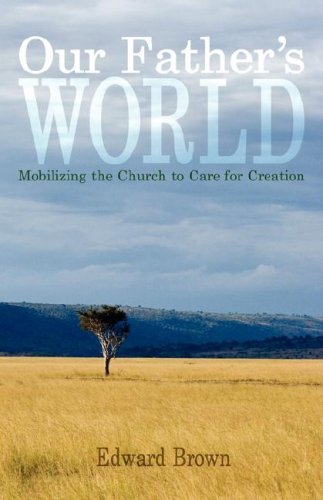
Our Father's World: Mobilizing the Church to Care for Creation
Edward R Brown
Doorlight Pubns, 2006
154 pp., 14.95

Andy Crouch
Rx for Excess
Serve God, save the planet.As our family sits together, eyes closed, we say grace. Today it's Timothy's turn. "God, thank you so much for all we have," he begins in what turns into a typically prolix nine-year-old's prayer. Eventually he is done—"in Jesus' name, Amen"—and I turn the key. We have just filled up our car with gasoline.
There is just one reason we are saying grace at the gas station: a few months ago I read J. Matthew Sleeth's book Serve God, Save the Planet, which very sensibly suggests that if Christians bless God for food, we also ought to bless him for fossil fuels. Those of us who say grace at restaurants know the discomfort one feels bringing a visible expression of religious gratitude into a public place. I can testify that it's stranger still in a gas station, where one becomes aware just how unprayerful the act of pumping gas normally is. Unlike a well-prepared meal, gasoline does not prompt gratitude unbidden. The stuff is smelly, dangerous, and not at all self-evidently good in itself. It is a means to my ends, juice for a momentary sense of power and control. It is surprisingly hard to remember to stop and say thanks before I pull out, a little too quickly, into traffic.
Yet, of course, thanks is due, if not overdue. I can reasonably expect that the food I eat today will be replaced by a fresh crop next season. But the gallon of gas I burn today is gone for good (though it does leave behind 19 pounds of carbon dioxide for the biosphere to absorb). In this fleeting historical moment that will be remembered as the petroleum era, saying grace seems like the least we can do.
Each of these three authors has done a great deal more. Tri Robinson, founding pastor of a megachurch in Boise, Idaho, has shepherded a conservative congregation in the reddest of states toward environmental awareness and responsibility. At the entrance to the church are large recycling bins, part of the church's "Tithe Your Trash" program. Church members shop with reusable shopping bags imprinted with the environmental ministry's logo. After Hurricane Katrina, the church raised most of the money necessary to send wave after wave of volunteers to New Orleans by collecting old cell phones from their neighbors. Robinson's book, Saving God's Green Earth, is a textbook case of evangelical activism at its best: one part biblically informed reflection on a neglected theme, one part memorable and practical steps for church leaders, and two parts inspiring anecdotes from Robinson's own experience.
It is not hard to see that Robinson is a natural leader. When he felt called to raise environmental stewardship as an issue for his congregation, he did not do what I would have done: draft a stem-winding "prophetic" sermon and preach it at the first opportunity. Instead he quietly gathered a task force from his congregation to identify local opportunities where church members could make a difference; talked with business leaders and representatives of the U.S. Fish and Wildlife Service; and prepared a four-week course about the environment. Only six months later did he preach a sermon—half afraid that he would be "thrown out on my ear." Instead he got a standing ovation. Would-be "change agents" should take note of the care with which Robinson shepherded his congregation rather than hectoring them.
Edward R. Brown's book, Our Father's World, brings an important international perspective from one who has spent a lifetime involved in evangelical missionary efforts (most recently, assisting on the ground after the 2005 Pakistan earthquake). Brown has seen firsthand the environmental devastation in countries like Kenya and Haiti—countries where Christian evangelism has had some of its greatest successes. Ninety-seven percent of the island of Haiti is now deforested. Crop yields in Kenya have plummeted in a few decades. These environmental disasters have direct consequences for the mission of the church; and Brown marshals arguments from Scripture to persuade Christian readers that environmental stewardship should have been part of the mission of the church all along. Like Robinson, he offers an array of practical ideas: how church leaders can make church building programs more environmentally responsible, expose youth and adults to the beauty of creation, and incorporate environmental stewardship into their mission efforts.
It must be said that Robinson's and Brown's efforts at consciousness-raising share many qualities with the flood of evangelical paperbacks with which they compete, from their folksy pragmatism to their perfunctory writing style. And this is what makes Sleeth's book, every bit as much a "call to action" as the others, so remarkable: elegantly written, theologically and scientifically acute, and not least, beautifully typeset and bound. (Christian publisher Zondervan has brought their mighty distribution power to the paperback edition, which is all to the good, but book lovers will go out of their way to reward environmental publishing house Chelsea Green for their loving production of a risky title.) Sleeth, former chief of medical staff at a New England hospital, has the most interesting back story of all. After he returned in mid-life to serious Christian faith, Sleeth and his family examined their lifestyle and made major changes:
We no longer live in our big house; instead we have one the exact size of our old garage. We use less than one-third of the fossil fuels and one-quarter of the electricity we once used. We've gone from leaving two barrels of trash by the curb each week to leaving one bag every few weeks. … Half of our possessions have found new homes. … When we stopped living a life dedicated to consumerism, our cup began to run over.
Serve God, Save the Planet is about much more than environmental activism. In Sleeth's stories of medical missions to Central America, anecdotes from the emergency room, and narration of determined progress toward reducing his environmental footprint, we glimpse a whole life formed by Christ. Sleeth tells candid stories of his family's effort to abandon an affluent lifestyle, and the results are tremendously attractive without ever seeming too good to be true. (His 16-year-old daughter Emma, a freshman at Asbury College, has a book of her own about environmental stewardship coming out this fall.) Indeed, what I took away from Sleeth's book had less to do with the specifics of energy use and recycling than the hope that there is a better way to live as families: that it is possible to detoxify our technologized and hypermediated homes, and that our children will thank us for it. My hope only increased when our son read the book from cover to cover, then started turning off lights whenever he left a room.
Sleeth, it seems to me, is the perfect missionary for the environmental cause to American evangelicals (indeed, he is now in great demand as a speaker to churches and colleges). Evangelicals trust doctors—many evangelicals are doctors. Doctors specialize in practical intelligence; evangelicals, no matter how intelligent, lean toward the pragmatic side. Sleeth's bedside manner is perfect. He sees the symptoms of too much in our lives—the stress on the environment, on our families, and on our own bodies. He wisely does not prescribe quick fixes, but he does offer disciplines that could restore health. He does not dwell on grand global debates over climate change and overpopulation (though he has opinions on both, and shares them with his readers); he recognizes, in time-honored evangelical style, that the most important battleground for any social change is the human heart.
And Sleeth understands the value of symbolic practices—grace at the gas pump, compact fluorescent bulbs in the sockets, clothes on the line rather than in the dryer. Compared to the vast global structures that just today have gobbled up 80 million barrels of oil, any single family's reduction of consumption seems pitifully small, however admirable. But the value of these small practices is the way they transform our vision—and Sleeth truly believes, as every Christian should, that repentance changes hearts. Fifty million Americans saying grace at the gas pump would not reduce America's consumption of oil one bit. Or would it? Perhaps we should try it, and see.
Andy Crouch is editorial director of the Christian Vision Project and executive producer of the documentary series intersect|culture.
Copyright © 2007 by the author or Christianity Today/Books & Culture magazine.
Click here for reprint information on Books & Culture.
 Email Newsletter
No comments
See all comments
*