






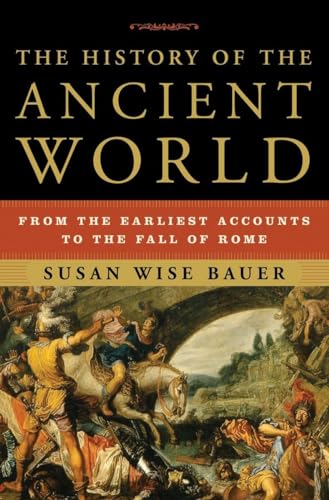
The History of the Ancient World: From the Earliest Accounts to the Fall of Rome
Susan Wise Bauer
W. W. Norton & Company, 2007
896 pp., 35.00

Jerry Pattengale
Writing History in Public
A fresh look at the ancient world."Public intellectual." If the term irritates you, get over it—or substitute your own coinage. What matters is the reality being pointed at, argued over, catalogued. Google the term and you'll find what at first appears to be a lively conversation. On closer inspection, you may be struck by the narrow boundaries of most of the talk. Who qualifies for the title, and what kind of work counts in the public conversation: those crucial matters get defined in very cramped ways.
And contrary to some widely circulated jeremiads, the species is thriving. Consider Susan Wise Bauer, whose books The Well-Educated Mind (2003, written with Jessie Wise) and The Well-Trained Mind (2004) found a ready audience among homeschooling families and intellectually curious souls more generally, and who now is engaged on nothing less than a history of the world in four volumes, intended for the common reader.
Writing history in public is a bold enterprise, even when your subject is relatively modest in scope, but Bauer is up to the challenge. In the first volume of the series, The Ancient World: From the Earliest Accounts to the Fall of Rome, she lightheartedly acknowledges the audacity of her project, clearly undaunted. Within the first few paragraphs she's briskly taking charge: "I understand why many historians choose to use bce and ce in an attempt to avoid seeing history entirely from a Judeo-Christian point of view, but using bce while still reckoning from Christ's birth seems, to me, fairly pointless."
Perhaps her four-volume children's series on world history was a necessary preparation for this text. In The Story of the World Series: History for the Classical Child (already in revised and second editions since 2003), she mastered the art of deciding "what to leave out." And writing for children, a historian learns how to hold her readers' attention. Pick up Bauer's new volume on the ancient world and compare her treatment of Peisistratus, the tyrant who ruled Athens for several decades in the 6th century bc, with the account given of him in the reputable world-civ standard, The Heritage of World Civilizations, by Albert Craig et al. [1] First from Craig's text:
Despite Solon's reforms, Athens succumbed to factional strife that ended when the leader of one faction, Pisistratus (605?—527 B.C.E.), a nobleman and military hero, seized power firmly in 546 b.c.e. with the help of mercenary soldiers and made himself the city's first tyrant.
And then from Bauer's book:
In 560, Peisistratus and his club-wielding bodyguards stormed into the Acropolis [and lost] … . Peisistratus regathered himself in exile. He had tried sheer force; now he would try strategy. He made a secret alliance with the aristocratic Megacles, leader of the Men of the Coast, promising to marry his daughter … . [After enjoying some success, Peisistratus] annoyed his wife by "not having sex with her in the usual way," as Herodutus puts it … . Megacles, informed of this development (and presumably already regretting his alliance with the rough and ready Men of the Hills), decided to switch sides again, and joined the Men of the Plain in driving Peisistratus back out.
Peisistratus had tried revolt; he had tried political alliance; his only path back into power was to buy it, and this path he took.
Writing a four-volume series rather than a single (if massive) volume, Bauer has the advantage of a larger canvas. But she also has a knack for narrative and an eye for human interest. Indeed, sprinkled liberally throughout the book are talking points that connect with readers in ways distinctive from many established texts.
Most of Bauer's hooks are created through historic leaders. Her preface invites us into the human story of Antiquity—and it is a story, not a bloodless text that drones endlessly on, not a barrage of disconnected facts. Listen in on the book's first sentences:
Sometime around 1770 bc, Zimri-Lim, king of the walled city of Mari on the banks of the Euphrates, got exasperated with his youngest daughter.
A decade earlier, Zimri-Lim had married his oldest daughter Shimatum to the king of another walled and sovereign city called Ilansura. It was a good match, celebrated with enormous feasts and heaps of presents (mostly from the bride's family to the groom).
Within the first page the tone is set for a public discourse. The obscure Zimri-Lim has a socio-political context, along with a human dimension. Bauer unfolds the story with an account of his wives, the birth of twins, a disowned second wife, and the otherwise trite story of royal succession. This scenario doesn't dispense geographic, economic, and cultural information in indigestible form, but neither does Bauer ignore these important aspects of her subject; rather, she works them into this prefatory case study, in which she lays out her approach for the entire volume.
Not one reader in a million will ponder the clay tablets that record the history of Mari. But being a public intellectual necessitates bringing such sources to the front while leaving the research-laden discussion to specialists. Whether in her discussion of Greek "Trading Posts and Colonies" (Chapter 49) or the Assyrian decline (Chapter 50), Bauer reaches into primaries like Homer, Herodotus, Livy, Dio Cassius, Plutarch, Tacitus, Josephus, I and II Kings, Xenophon, Hesiod, and a host of others. She also consults important secondary works like H. W. F. Saggs' Babylonians. And her text is strengthened by drawing on key works from archaeologists, such as C. L. Woolley's classic reports on Ur—and views on Akhenaton from that candid Canadian at Penn State, Donald Redford. Although she misses some important scholarly voices, especially Edwin Yamauchi's work on the Scythians and Persians (I'm rather biased since he's my mentor), she consults a host of others, such as Cyrus Gordon (Yamauchi's mentor), Kenneth Kitchen, A. Leo Oppenheim, and Thorkild Jacobsen. (However, she overlooks Jacobsen's wonderful Treasures of Darkness—a dialogue on the original Mesopotamian texts worthy of Bauer's insightful attention.)
Ancient history has a way of turning up in curious guises. Not long ago I entered a packed lecture hall in the Natural History Building at the University of Illinois, Urbana, and two history interns had welcomed me with the following phrase scribbled large across several chalkboards—"MENE, MENE, TEKEL, UPHARSIN, Creationism Is Death! Evolutionism Is Life!" Perhaps they knew a religious conference was renting their space, or that Edwin Yamauchi was my mentor. Nonetheless, they seemed unaware that this very passage describing Belshazzar's Feast (Daniel 5:1-4), once considered as evidence of a biblical error, actually supports its veracity. The History of the Ancient World reveals the strong corroboration of the biblical account with primary sources. What sounds counter-intuitive on the surface, since Belshazzar's father Nabonidus was the official king, is quite plausible in the light of the many intrigues Bauer creatively captures.
Indeed, the intermarriages, paranoia, and leadership styles among the 6th-century bc Persians and their kinfolk and neighbors, the Medes, Lydians, and Babylonians, could provide fodder for an HBO series. Herodotus, Bauer tells us, relates that the Median King Astyages, who also ruled over the Persians, became alarmed about a dream in which his daughter "urinated so much that she not only filled his city [Ecbatana], but even flooded the whole of Asia." Troubled by his wise men's interpretation, and in the light of no male heir, he chose Cambyses for his son-in law—mainly because he lacked ambition! Ten months later, Astyages thought he had disposed of his grandson, Cyrus, not knowing that the chief official tabbed to carry out the deed, his cousin Harpagus, had delegated the killing to a herdsman. (Harpagus felt it wouldn't be prudent to have the blood of a child in the royal line on his own hands.) But the herdsman's wife had just delivered a still-born child, which they exposed on a hillside (you see, we did as we were told), claiming the infant Cyrus as their own.
When Cyrus' true identity was discovered and made public, he was ten years old—Astyages had no choice but to accept it. But he wasn't pleased to learn that Harpagus had failed to do away with this potential rival ten years earlier. Pretending to accept his cousin's apology, Astyages exacted his revenge. He had Hapargus' son killed and then baked, to be served to his unsuspecting father as the main course at a feast. At the end of the meal, the king had the son's head, feet, and hands brought out on a platter—and Harpagus remained calm, ackowledging the king's prerogative. Bauer notes that "Harpagus, still serving his cousin quietly, was planning long-term revenge: a dish served cold."
Above all, the story as related by Herodotus (likely embellished) reflects the serious strife between the ruling Medes and their vassals. This intrigue set the backdrop for Babylon's fall. Bauer observes that when Medes turned to killing Medes, the struggle to maintain power had become irreversibly intense. And though Astyages still maintained an ally in Nabonidus, king of the vast Babylonian empire to the west and Belshazzar's father, that ally had been weakened amid recent political upheaval and power changes.
When Cyrus took over the Persian rule upon Cambyses' death in 559 bc, he remained loyal to Astyages and, in turn, his Babylonian allies. Nabonidus had strengthened his Babylonian network via a treaty with wealthy King Croessus of Lydia. But Cyrus began to shake the region's foundations when he marched against Ecbatana, avenging Astyages' attempt on his life during childhood. And perhaps the precursor to Marc Anthony's joining his foes in Egypt, Harpagus convinced his Median troops to switch sides to the Persians when they met on the battlefield—finally avenging that horrific taste of his son's death. Nabonidus seemed to have a false confidence in his allies when he put Belshazzar in charge—and left the city for ten years. (He went to the Arabian city of Tema, where he could freely worship the deity to which he was devoted, the moon-god, Sin.) Little wonder that, given the long ipso facto rule of Belshazzar, the Jews considered him the actual king—and had they been trying to forge the account, they would have ignored Belshazzar's role altogether.
Nabonidus finally returned to help protect the city against Cyrus' advance, but to little avail. After an initial defeat, Nabonidus retreated into Babylon. Bauer notes that the various texts overlap on this account, as it appears that the very night of Belshazzar's feast, Cyrus rerouted the Euphrates (which she confuses with the Tigris due to Herodotus) and marched into the city (539 bc). Cyrus immediately venerated Marduk, the chief god of Babylon, and thus endeared himself to the city—but he also won the gratitude of the Jews through his support of rebuilding the temple (Ezra) as corroborated on the famous Cyrus Cylinder.
Bauer's treatment of this episode—compelling, well paced, grounded in the sources—is characteristic of the book as a whole. Perhaps the most curious section of this first volume in her series is the very brief coverage of "a wandering prophet named Jesus," who "annoyed a large and powerful group of priests in Jerusalem by challenging their right to control the religious life of the Jews." I'm reminded of W. H. C. Frend's otherwise powerful text The Rise of Christianity. He spends parts of only a few pages (of nearly 1,100) on the fulcrum of Christianity's message, the resurrection. Likewise, Bauer spends less than a page on Jesus—whose life, regardless of one's belief in his divinity, changed world history. Though the subject is ripe with biblical and extra-biblical sources (such as Pliny and Josephus), not to mention the archaeological bonanza, none such are cited. The relationship between Pilate and Sejanus, and the latter's fall from Tiberius' favor, is one of many events having direct bearing on the story and offering considerable narrative appeal. The very next discussion affords twice the space to the obscure Gondophernes of Kush and the Gnostic Acts of Thomas—and includes various primary citations. Christianity itself is introduced in less than a page. Perhaps Bauer decided that in this case, less is more.
Certainly the next volume in the series, on the medieval era, will provide ample room for reckoning with the legacy of that "wandering prophet." We can be thankful that Susan Wise Bauer is on the job.
Jerry Pattengale is assistant vice president for scholarship and professor of history at Indiana Wesleyan University. His most recent book is Why I Teach (McGraw-Hill), with The Purpose-Guided Student (McGraw-Hill) among those in press.
1. Albert M. Craig, William A. Graham, Donald Kagan, Steven Ozment, and Frank M. Turner, The Heritage of World Civilizations, 5th ed. (Prentice Hall, 2000)
Copyright © 2008 by the author or Christianity Today/Books & Culture magazine.
Click here for reprint information on Books & Culture.
 Email Newsletter
No comments
See all comments
*