







Traveling Home: Sacred Harp Singing and American Pluralism (Music in American Life)
Kiri Miller
University of Illinois Press, 2007
272 pp., 111.76

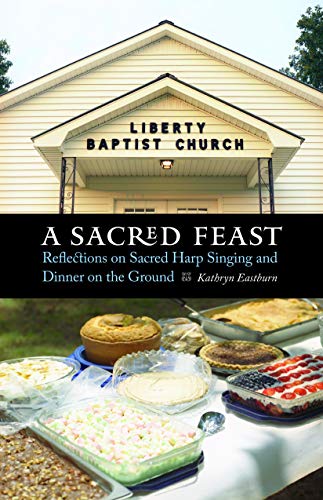
A Sacred Feast: Reflections on Sacred Harp Singing and Dinner on the Ground (At Table)
Kathryn Eastburn
University of Nebraska Press, 2008
212 pp., 39.3
Paul Harvey
Wondrous Love
The living tradition of Sacred Harp singing."Get enough people singing weird harmonies at the top of their voices and you start feeling a little sorry for the devil."
—From a review of the documentary Awake My Soul: The Story of the Sacred Harp, at awakemysoul.com
I have a relative in California who, although an atheist, once sang in the church choir at the Reverend Cecil Williams' Glide Memorial Methodist Church in San Francisco. At first, I thought he did so just because the music there rocked. For a time, he seemed almost consumed by his increasingly important role in the choir, and the community he found there. One day, he abruptly quit, saying he just couldn't be clapping and praising to "this Jesus thing" anymore. He felt like a hypocrite. I was sad to see that, all the more so now that he lacks a community that might help him while he struggles with depression.
At the same time, another friend in California, a gay man who long has been active in pacifist and other politically radical groups, took up the hobby of square dancing, and now has reached almost the highest rung of expertise in that "calling." I learned this when he came to Colorado to call for the International Federation of Gay Square Dance Clubs, an organization whose existence I had been unaware of previously, but one which took over Hyatt's convention center in Denver that weekend.
Kiri Miller and Kathryn Easturn have something to teach my relative, and they confirm much of what my gay square dance-calling friend seems to intuit: we all need someone, many someones, to lean on and sing (or do-se-do) with. Miller's Traveling Home is an academic study, an ethnography with occasional bouts of the heavy jargon usual for that genre, of the contemporary culture of Sacred Harp singing, while Eastburn's A Sacred Feast is a lighter series of personally reflective essays and anecdotes about her discovery of the Sacred Harp tradition, her use of it to reconnect with her Southern Baptist past, and the joy she finds feasting at the "dinner on the ground" that usually accompanies shape-note singings and conventions. Eastburn is almost a case study of the kind of participant-observer that Miller (herself a participant-observer, and a professor of music at Brown who leads a campus Sacred Harp singing group) discusses in Traveling Home:
Sacred Harp singers tend to be politically engaged, and they report that their Sacred Harp participation expresses their resistance to all sorts of things—among them, disintegration of community feeling, the pervasiveness of commercial broadcast media, the professionalization of music making, the destruction of distinctive local tradition, the failure to respect one's elders, the decline of family values, the strip-mall homogenization of the American landscape, the secularist (or fundamentalist) drift of American culture, and the polarized atmosphere of national politics.
Thus, Sacred Harp conventions and gatherings, as well as the vibrantly active website and listserv at fasola.org, draw together northerners and southerners, liberal folk music revivalists and southern family values voters, young and old, punk urbanites and rural families. The gatherings draw few non-whites, even though Sacred Harp singing has deep roots in African American church traditions as well. But African American shape noters have their own local church- and kin-based networks, without the national listservs, clubs, and organizations that have done much to keep the predominantly white versions of fasola singing alive and kicking.
Beyond that, Sacred Harp singing long since has been established as a "white ethnic"—southern, or Celtic—tradition, based largely on George Pullen Jackson's 1932 work White Spirituals in the Southern Uplands. A quintessential romanticizer of the southern folk (and, implicitly, an author who devalued the African and African American contributions to American music), Jackson made much of the association of "Sacred Harp Singing with white rural Southerners—and of these citizens with early American history," as Miller observes, establishing the practice as "indigenous American folksong." In this mythic narrative of American folksong, Sacred Harp singing came from the "presumed natural musicality and stubborn backwardness of rural Southerners," and especially from highland and mountain Southerners, viewed as "our contemporary ancestors." Jackson's interpretation contained a good deal of balderdash, but it's too late to change it now, for Sacred Harpers, even the liberal intellectual ones, have adopted it as their own story.
This invented tradition was carried forward and given currency by the folk recordings of Alan Lomax and others— and the romanticizing of the "authenticity" of those recordings by folkies. The reprintings and updatings of the Sacred Harp tunebook renders the imagined southern musical culture of the 19th century "duplicable by urban folk revivalists, reenactment hobbyists, and early music choirs," Miller writes, even while local practices and oral traditions of particular Sacred Harp conventions and communities "inscribe layered memories" in these books and act as a safeguard against "facile and superficial acquisition of Sacred Harp practice." In preserving their tradition, moreover, Sacred Harp participants privilege oral tradition and venerate Southern singers who intuitively hit the minor 6th and find the microtonal flattenings that lend the music its powerfully mournful minor cast.
Most of Miller's book traces what she calls the "Sacred Harp diaspora," a "dispersed landscape of singing communities" based on a "metaphorical claim of organic dispersal and reproduction." At its best, the fasola community brings together singers who remake "their own sense of alienation into membership in this musical community of the marginalized." This metaphorical diaspora includes "not only life-long Southern singers but also gay and lesbian singers, radical leftists, folk music enthusiasts, singers who have left or been expelled from Christian congregations," and numerous others. Southern singers, often venerated as the carriers of the tradition, confirm their own "authenticity" while also engaging in a kind of "performative" southernness, giving liberal singers the "twin pleasures of ethical community and retrospective guilt," even as these singers get "rejected by church brethren for singing with the known liberals, gays, and unbelievers who revere them as tradition-bearers."
At times, Miller teeters on the edge of letting the academic jargon of ethnography overwhelm the material. Of one venerated singer, who performs a parody of a southern mountain sermon and exaggerates "southern" traits in some internet postings, Miller writes: "Tollie Lee's postings do not merely hold up a mirror to an essentializing gaze." She means that Lee can poke fun (as an insider) at Southern religious practices even while reaffirming that "Southern traditional singers are in touch with the essence of Sacred Harp, while newcomers make laudable but imperfect attempts in that direction."
Academic theorizing directed at something so inherently enjoyable as singing your brains out with a community that becomes a deep part of your life can threaten to weigh down the subject. Fortunately, Miller's heavier passages are usually followed with concrete sentences and examples. Moreover, her academic analysis provides something that a charming, if occasionally naïve, set of reflections such as Eastburn's A Sacred Feast cannot: a richly complex survey of the meaning of Sacred Harp singing and communities when set in hypermodern contexts in Cambridge, Chicago, or Boulder. Miller's book is sure to become one of the standard references on the subject.
Eastburn's light collection of reflections, anecdotes, and recipes provides a nice counterpart to the excellent PBS documentary on shape-note singing, Awake My Soul: The Story of the Sacred Harp. [1] Like Eastburn, the documentary portrays the deeply emotional connection of Sacred Harp communities, shorn of the complex academic analysis Miller provides. And the film captures the haunting beauty of the music as no book can.
In the Sacred Harp hymnody, Eastburn find relief from the culture wars raging all around her. Here, readers should understand that Eastburn is a founding editor of the Colorado Springs Independent, a weekly paper that, in my community of Colorado Springs, a militarized haven for suburban warriors and conservative religious activists, is really the only publication with a political voice anywhere to the left of Rush Limbaugh. In Colorado Springs, choosing what church to attend can be an intensely political act. It's against this backdrop that Eastburn particularly savors the communal pleasures of Sacred Harp singing.
More than anything else, though, here is what you will feel after reading this book: hungry! Each chapter comes loaded with recipes that Eastburn has collected from Sacred Harp gatherings, and foodies will love the heavy dose of culinary Americana in her short and enjoyable book.
Not that Miller's more academic study is without its own lighter moments. Consider how a self-professed liberal folk music revivalist such as Miller deals with this lyric from "Stafford," a beloved Sacred Harp classic with lyrics by Isaac Watts:
See what a living stone
The builders did refuse Yet God hath built His church thereon, In spite of envious Jews.
Serious suggestions for replacing the embarrassing last line included "lest we salvation lose" or "in spite of envious few." But, Miller tells us, fasola class clowns came up with their own alternatives, such as "in spite of empty pews," "in spite of drugs and booze," and—my favorite— "in spite of envious dudes."
For the obvious pleasure and the emotional gratification Miller derives from her Sacred Harp experiences, I'm one envious dude. Watch Awake My Soul, and you may be, too.
Paul Harvey runs the blog "Religion in American History" at usreligion.blogspot.com
1. see thirdday.com/awake/mainindex.htm.
Copyright © 2009 by the author or Christianity Today/Books & Culture magazine.
Click here for reprint information on Books & Culture.
 Email Newsletter
No comments
See all comments
*