






Robert Kunzman
Home Room
What we don’t know about homeschooling.Despite homeschooling's growing popularity, almost everything we think we know about it is anecdotal or based on a nonrepresentative sample. This is due in large part to widely varying regulations among states: some mandate regular testing and/or curricular requirements, while others don't even know (or ask) how many families are homeschooling within their borders. The National Center for Education Statistics provides the most reliable nationwide data, drawn from a survey administered every four years. The 2003 results estimated 1.1 million homeschool students nationwide, a 29% increase since 1999.[1]
While this report caught the attention of policymakers and scholars, many predicted that homeschool numbers were ready to level off. The 2007 NCES data, however, suggested quite the opposite—homeschooling's growth is actually accelerating. Between 1999 and 2007, homeschooling increased 74 percent—more than twelve times the increase of public school enrollments. And even these figures are probably underestimates. The 2007 survey pegged the total number at 1.5 million, but homeschoolers typically aren't fond of answering questions from outsiders about their activity, particularly if it's the government on the phone. With this in mind, the total number of homeschoolers today is probably closer to two million students.[2]
As a result of this rapid growth, thousands of books and related resources on homeschooling have appeared in recent years, but almost all of these are "how to" products aimed at parents—the homeschool curriculum market does nearly a billion dollars in sales a year. By contrast, relatively little in the way of disinterested academic scholarship is available, and misinformation about homeschool research is widespread.
The most recent example of misleading data involves a study publicized this fall by the Home School Legal Defense Association, which compared the test scores of 11,739 homeschoolers to those of public school students.But as with earlier research, homeschoolers who responded to HSLDA's invitation aren't representative of the broader homeschool population: the sample only included the subset of homeschoolers who use standardized tests, and it drew almost entirely (95 percent) from those who self-identify as Christian. Furthermore, homeschool parents often administer these tests themselves, making it possible to create very different testing conditions from what public school students experience. The bottom line is that we still simply don't know how the "average homeschooler" performs, academically or otherwise.
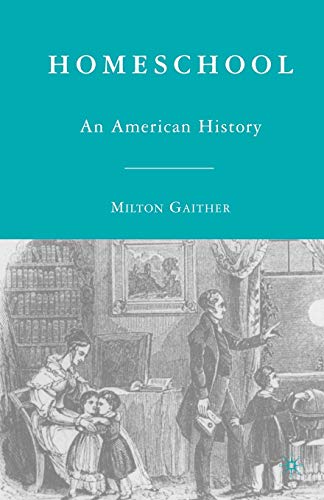
While compelling quantitative research on homeschooling remains rare, quality scholarship in this area does exist. The finest example of such work is Milton Gaither's Homeschool: An American History. Besides being the best historical analysis available, Gaither's text deserves recognition as the most thoroughly researched, comprehensive look at the topic altogether.
Gaither reminds us that homeschooling is certainly not new in American history. Through richly documented examples, he shows how, prior to the advent of common schools in the mid-nineteenth century, home and education overlapped far more than today. At the same time, Gaither observes, the social meaning of homeschooling has changed dramatically. Whereas education in the home was once both commonplace and actively encouraged by the government, it now represents an act of rebellion against societal norms and state oversight.
Against this historical backdrop, Gaither suggests four central reasons for modern homeschooling's emergence and growth over the past several decades: countercultural sensibilities, suburbanization, romantic ideals of child-centered education, and discontent with public schooling. Perhaps the most compelling storyline here focuses on this final theme, in particular conservative Christians' growing disenchantment with public schools.
The industrial capitalism of the early 20th century spurred cultural upheaval and a growing sense among social conservatives that government needed to step in and restore order. The family, ironically enough, couldn't be trusted. "Faced with large-scale breakdown of the stable two-parent family," Gaither writes, "Americans turned to their government to solve the problem." The state became the shaper of benighted citizens through a variety of programs and institutions—domestic education, manual arts, family courts, and reform schools. "Whereas past generations of Americans had looked to the family to keep the nation strong," Gaither observes, "it was now up to the nation to save the family through the interventions of professional expertise." Conservative Christians shared this embrace of government and its public schools, seeing them as vital enforcers of traditional morality and pan-Protestant religion.
Not surprisingly, then, public schools became hotly contested battlegrounds when cultural norms began to shift again in the 1960s—but this time the schools began to shift with them. More court cases were brought against public education, Gaither points out, between 1969 and 1978 than in the previous five decades combined. By 1980, conservative Christians had concluded that government and its schools were no longer the answer—now they were the enemy. The best alternative, they reasoned, was to establish a private universe of family-based education.
Interestingly, the countercultural Left had reached a similar conclusion, and so the modern homeschooling movement emerged on two related but distinct tracks. One track traced its origins to liberal critics of institutional schooling such as A. S. Neill and Ivan Illich, and especially the writings of former schoolteacher John Holt. Holt published Growing without Schooling, a magazine advocating a form of homeschooling commonly known as "unschooling." Unschooling eschews most traditional structures of formal schooling, instead letting children decide what to learn, when to learn it, and how. At its core, unschooling rests on the belief that children learn best when the course of study emerges in response to natural interests and needs.
The conservative Christian track was led initially by educational researcher Raymond Moore, who questioned the "race to the schoolhouse" and criticized institutional schooling for its standardization and impersonal nature. But whereas unschooling let the child and her interests determine the pace of her learning, Moore emphasized the importance and authority of parents in the educational process. Even as homeschooling practices have broadened and diversified in the past three decades, most conservative Christians—reflecting a belief in children's original sin nature and their need for direction and correction—tend toward the more structured approach.
Gaither has a discerning eye for the future as well as the past. He highlights the growing influence of technology, both in facilitating communication among homeschoolers as well as providing a vast array of curricular options. Homeschool parents can not only download free online materials and purchase stand-alone software packages for targeted subjects, but have multiple options for enrolling their child in online classes or even comprehensive "cyberschools." Some of these latter options effectively supplant the parent as instructor entirely. As one promoter boasted, cyberschooling "takes most of the homeschooling burden off parents' backs." Some homeschool advocates see this as a drawback, even with nonpublic cyberschools. Homeschooling, they argue, is fundamentally about parent control and oversight of their child's education.
When government funding enters the mix, the cyber-homeschool controversy gets even more heated. The prospect of governmental oversight gaining traction—however ancillary—in the homeschooling world sparks alarm and resistance. Both public charter schools and local public schools are increasingly turning to distance education as a way to draw more students and thus increase their state funding, without having to expand costly physical facilities. Other public charters are dispensing with the bricks-and-mortar approach altogether, and providing online classes for children throughout the state and beyond. Add to this the ongoing push by many homeschoolers to enroll in selected public school classes and participate in extracurricular activities (sports, music, drama, clubs, etc.), and the lines between public and private schooling blur even further.
As these relationships between public and private shift, the social meaning of homeschooling as rebellion against cultural norms and state oversight may shift as well. If the traditional structures of public education fade into a marketplace of customizable options, will the countercultural revolution of homeschooling simply become one more manifestation of those choices? Perhaps. But the core conviction at the heart of the homeschooling movement—whether animated by religious beliefs, pedagogical concerns, or any number of other reasons—is that parents should be able to determine the shape and content of their children's education. This seems unlikely to change for homeschoolers, no matter what changes around them.
Robert Kunzman is an associate professor of education at Indiana University. His most recent book, Write These Laws on Your Children: Inside the World of Conservative Christian Homeschooling, was published by Beacon Press earlier this year, and he maintains a website focused on homeschooling research and scholarship (indiana.edu/∼homeeduc).
1. National Center for Education Statistics, 1.1 Million Homeschooled Students in the United States in 2003 (National Center for Education Statistics, 2004).
2. National Center for Education Statistics, 1.5 Million Homeschooled Students in the United States in 2007 (National Center for Education Statistics, 2008).
Copyright © 2009 by the author or Christianity Today/Books & Culturemagazine.
Click here for reprint information on Books & Culture.
 Email Newsletter
No comments
See all comments
*