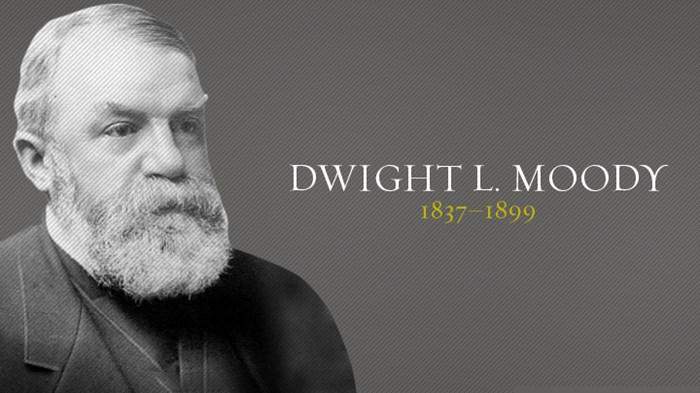
Dwight L. Moody


"If this world is going to be reached, I am convinced that it must be done by men and women of average talent."
With his boundless physical energy, natural shrewdness, self-confidence, and eternal optimism, Dwight Lyman Moody could have become a Gilded Age industrial giant like John D. Rockefeller or Jay Gould. Instead, he became one of the great evangelists of the nineteenth century.
Pony rides to the YMCA
He was born in Northfield, Massachusetts, to a Unitarian bricklayer's family. His father died when Moody was 4, leaving nine children for his mother, Betsey, to raise. His mother never encouraged Dwight to read the Bible, and he only acquired the equivalent of a fifth-grade education.
Timeline |
|
|
1819 |
Channing issues Unitarian Christianity |
|
1833 |
John Keble's sermon launches Oxford Movement |
|
1835 |
Charles Finney's Lectures on Revivals |
|
1837 |
Dwight L. Moody born |
|
1899 |
Dwight L. Moody dies |
|
1906 |
Schweitzer's The Quest of the Historical Jesus |
He struck out on his own at age 17 and sold shoes in his uncle's Boston store. He also attended YMCA and Sunday school classes, where he became a Christian at age 18. Shortly after that, he moved to Chicago, where he sold shoes and worked toward his goal of amassing a fortune of $100,000.
It slowly dawned on Moody that, in light of his new faith, his life should not be spent on amassing wealth as much as on helping the poor. In 1858 he established a mission Sunday school at North Market Hall in a slum of Chicago. It soon blossomed into a church (from which, six years later, was formed the Illinois Street Independent Church, precursor to the now famous Moody Memorial Church). By 1861 he had left his business to concentrate on social and evangelistic work. He drew the children of the German and Scandinavian immigrant underclass to his mission with candy and pony rides, and he drew the adults through evening prayer meetings and English classes. He was convinced, "If you can really make a man believe you love him, you have won him."
There he met and later married one of the Sunday school teachers, Emma C. Revell, with whom he had three children.
As president of the Chicago YMCA for four years, he championed evangelistic causes such as distributing tracts all over the city, and he held daily noon prayer meetings. During the Civil War, he refused to fight, saying, "In this respect I am a Quaker," but he worked through the YMCA and the United States Christian Commission to evangelize the Union troops. He relentlessly sought and received financial support for all his projects from rich Christian businessmen, such as Cyrus McCormick and John Wanamaker. In all this, he tried to mix effective social work with evangelism.
The Great Chicago Fire in October 1871 destroyed Moody's mission church, his home, and the YMCA. He traveled to New York to raise funds to rebuild the church and the YMCA, but while walking down Wall Street, he felt what he described as "a presence and power" as he had never known before, so much that he cried aloud, "Hold Lord, it is enough!" He returned to Chicago with a new vision: preaching the Kingdom of God, not social work, would change the world. He now devoted his immense energies solely to the "evangelization of the world in this generation."
Innovative evangelism
Moody believed music would be a valuable tool in his evangelistic campaigns, so when, in 1870, he heard Ira Sankey sing at a YMCA convention, he convinced Sankey to give up a well-paying government career to join him on the sawdust trail.
In the summer of 1873, Moody and Sankey were invited to the British Isles by evangelical Anglicans William Pennefather and Cuthbert Bainbridge, but both sponsors died before Moody and Sankey arrived. Without official endorsement, Moody and Sankey held campaigns in York, Sunderland, and Jarrow to minimal crowds. In Newcastle, their evangelistic efforts began to reap converts, and from then on their popularity escalated. After preaching for two years in England, Scotland, and Ireland, Moody returned to America as an internationally famous revivalist. Of his fame, Moody admitted, "I know perfectly well that, wherever I go and preach, there are many better preachers ... than I am; all that I can say about it is that the Lord uses me."
Immediately, calls for crusades poured in. During these crusades, Moody pioneered many techniques of evangelism: a house-to-house canvass of residents prior to a crusade; an ecumenical approach enlisting cooperation from all local churches and evangelical lay leaders regardless of denominational affiliations; philanthropic support by the business community; the rental of a large, central building; the showcasing of a gospel soloist; and the use of an inquiry room for those wanting to repent.
Alternating between Europe and America, Moody and Sankey held numerous evangelistic campaigns before more than 100 million people. At their 1883 Cambridge, England, meetings, seven leading university students, the famous "Cambridge Seven," committed themselves to become missionaries in China (under Hudson Taylor).
He used every opportunity to preach. When the managers of the 1893 World's Exhibition in Chicago decided to keep the Fair open on Sundays, many Christian leaders called for a boycott. Not Moody. He said, "Let us open so many preaching places and present the gospel so attractively that people will want to come and hear it." On one single day, over 130,000 people attended evangelistic meetings coordinated by Moody.
Training God's army
Through his revival work, he saw the need for an army of Bible-trained lay people to continue the work of inner-city evangelism. "If this world is going to be reached," he said, "I am convinced that it must be done by men and women of average talent. After all, there are comparatively few people in this world who have great talents." In 1879 he established Northfield Seminary for girls, followed two years later by Mount Hermon School for boys.
In 1880 Moody invited adults and college-age youth to the first of many summer Bible conferences at his home in Northfield. These conferences helped nurture dispensationalism and fundamentalism, both of which were just emerging. At one conference, the Student Volunteer Movement was founded by 100 collegians who pledged to work in foreign missions after their college education.
Finally, in 1886, Moody started the Bible-Work Institute of the Chicago Evangelization Society (renamed Moody Bible Institute shortly before his death), one of the first in the Bible school movement. From this work, he launched yet another work, the Colportage Association (later Moody Press), an organization using horse-drawn "Gospel wagons" from which students sold low-cost religious books and tracts throughout the nation.
Despite a tireless schedule (he preached six sermons a day just a month before he died), he loved to spend time with his children and grandchildren at their Northfield, Massachusetts farm, where he died.

Support Our Work
Subscribe to CT for less than $4.25/month