Blaise Pascal
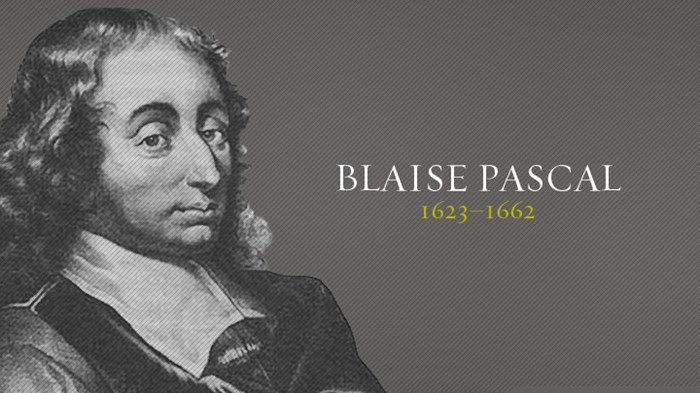


"The heart has its reasons, which reason does not know at all."
"Who needs God? Man can make it on his own." So claimed Reason, the philosophy that captured the imagination of seventeenth-century France. Its champions, Voltaire and Descartes, among others, tried to fashion a worldview ruled completely by reason.
French mathematician and physicist Blaise Pascal, though raised in the heyday of Enlightenment thought, found reason inadequate: "Reason's last step is the recognition that there are an infinite number of things which are beyond it." He concluded, "The heart has its reasons, which reason does not know at all"—a statement that soon became the chief critique of rationalism and the starting point for a defense of the Christian faith that still influences people today.
Scientific prodigy
Pascal's mother died when he was 3, and his father moved the family from Clermont-Ferrand, France, to Paris, where he homeschooled Blaise and his sister. By age 10, Pascal was doing original experiments in mathematics and physical science. To help his father, who was a tax collector, he invented the first calculating device (some call it the first "computer").
With this last invention, he had made a name for himself (at age 19!) and began his richly diverse scientific career. He tested the theories of Galileo and Torricelli (who discovered the principles of the barometer), culminating in his famous law of hydraulics, which states that pressure on the surface of a fluid is transmitted equally to every point in a fluid. He added important papers on the vacuum, on the weight and density of air, and the arithmetic triangle. He developed the theory of probability, which is still used today. He invented the syringe, the hydraulic lift, and is credited with inventing the wristwatch and mapping out the first bus route in Paris. It is said Pascal was embarrassed by his multiple talents.
"Night of fire"
All the while, Pascal was exploring the spiritual world, which was undergoing a revolution across Europe. While pietism flourished in Germany, and Wesleyan holiness spread through England, Catholic France was feeling the effects of Jansenism—a form of Augustinianism that taught predestination and divine grace, rather than good works, as vital for salvation.
Timeline |
|
|
1582 |
Mateo Ricci and colleague begin mission in China |
|
1609 |
John Smyth baptizes self and first Baptists |
|
1618 |
Thirty Years' War begins |
|
1623 |
Blaise Pascal born |
|
1662 |
Blaise Pascal dies |
|
1667 |
John Milton's Paradise Lost |
In 1646 Pascal came in contact with Jansenism and introduced it to his sister, Jacqueline, who eventually entered the convent of Port-Royal, a center of Jansenism. Pascal, however, continued to struggle spiritually: he wrestled with the dichotomy between the world and God.
Then on November 23, 1654, Pascal experienced a "definitive conversion" during a vision of the crucifixion:
"From about half-past ten in the evening until about half-past twelve … FIRE … God of Abraham, the God of Isaac, the God of Jacob, and not of the philosophers and savants. Certitude. Certitude. Feeling. Joy. Peace."
He recorded the experience (called the "Mé;morial") on a piece of parchment, which he carried with him the rest of his life, sewed inside his coat. He began a life-long association with Port-Royal—though he, unlike his sister, never became a "solitaire."
Passion for Christ
His greatest works are not only masterpieces of French prose but sterling defenses of the Christian faith.
Les Provinciales, 18 essays regarded as brilliant irony and satire, attacked the Jesuits and defended Jansenists' demand for a return to morality and Augustine's belief in divine grace. The Catholic church placed Les Provinciales on the Index, condemning it but failing to quell the controversy it stirred.
Pensé;es, a collection of Pascal's "thoughts" he intended to present as a Christian apology, was published after his death. In it, he portrayed humankind as suspended between wretchedness and happiness, and helpless without God. People try to avoid the abyss by engaging in distractions. Pascal denounced the idea that reason and science alone can lead a person to God. Only by experiencing Christ can people know God.
Belief comes through the "heart," which for Pascal was not merely feelings and sentiment but the intuition that understands without having to use reason. And God's grace makes it happen: "Do not be surprised at the sight of simple people who believe without argument. God makes them love him and hate themselves. He inclines their hearts to believe. We shall never believe with a vigorous and unquestioning faith unless God touches our hearts; and we shall believe as soon as he does so."
In the Pensées, Pascal also presents his famous argument for faith: the wager. Since reason cannot give one absolute certainty, he argued, every person must risk belief in something. When it comes to the Christian faith, he said, a wise person will gamble on it because, "If you win, you win everything; if you lose, you lose nothing."
Voltaire and other scholars denounced Pascal as a cheerless fanatic. Cheerless or not, he did live most of his life with a frail body, and his many illnesses finally took their toll at age 39.

Support Our Work
Subscribe to CT for less than $4.25/month