

















John of the Cross
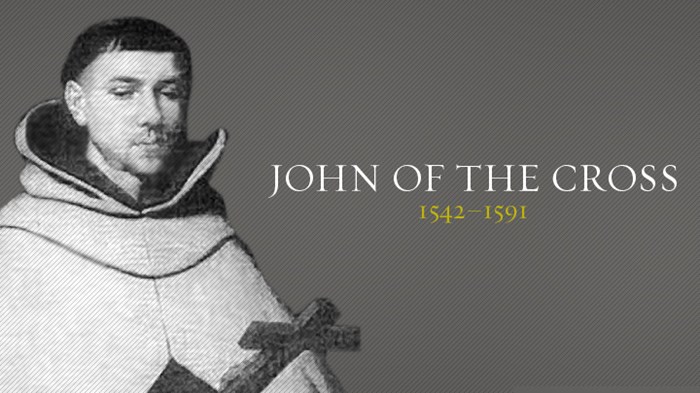


"Turn not to the easiest, but to the most difficult … not to the more, but to the less; not towards what is high and precious, but to what is low and despised; not towards desiring anything, but to desiring nothing."
Spain's Siglo de Oro was indeed a "golden century," a time remembered for its artists, playwrights, novelists, poets, and explorers—the names Cervantes, Vega, and Cortez are but three of the most famous. One undersized, narrow-minded friar who spent most of his energy on reforming yet another religious order could easily be overlooked. But today John of the Cross, as he came to be called, is remembered as one of history's most influential spiritual guides.
Taking the harder road
Juan de Yepes, his name at birth, failed at a variety of trades before entering first the local Jesuit school and then the University of Salamanca, where he pursued holy orders. There he met Teresa of Avila, who persuaded him to join her to reform the Carmelite order.
Timeline |
|
|
1534 |
Act of Supremacy; Henry VIII heads English church |
|
1536 |
Menno Simons baptized as Anabaptist |
|
1540 |
Ignatius Loyola gains approval for Society of Jesus |
|
1542 |
John of the Cross born |
|
1591 |
John of the Cross dies |
|
1598 |
Edict of Nantes (revoked 1685) |
Believing that struggle and suffering, which such reform would likely entail, were necessary for spiritual growth, Juan entered the Carmelite Order in 1568 as Fray Juan de la Cruz, Friar John of the Cross. And a life of the cross it was, as John intended: "Turn not to the easiest, but to the most difficult … not to the more, but to the less; not towards what is high and precious, but to what is low and despised; not towards desiring anything, but to desiring nothing."
John allowed himself no respite from suffering, but heaped it upon himself with long fasting and whippings. If that were not enough, he was also severely criticized and ignored when he exhorted his fellow friars to give up their comforts, freedoms, and pleasures.
Imprisonment and creativity
In 1577 church authorities, resentful of John, had him kidnapped, and he was imprisoned for nine months in a windowless six-by-ten-foot cell, with a ceiling so low he couldn't stand up. The stone cell was unheated in winter, unventilated in summer. Malnourished and flogged weekly, John was constantly ill.
Yet it was during this dark time that, by the light of a three-inch hole high in the wall, John wrote his two greatest poems, "Cantico Espiritual" (Spiritual Canticle, 1578) and "Noche Oscura del Alma" (Dark Night of the Soul). These two extraordinary pieces illumined both his own darkness and the mystery of his path, which many people since have followed.
After escaping, John spent eight months recuperating and writing Ascent of Mt. Carmel, the prose commentaries on his poetry that explained the mystic way.
Ascending to God
For John, the mystic path meant living with an all-consuming desire more fully to know and love God, abandoning everything that did not contribute to that communion. God illuminates the individual who, in consequence, has the desire and power to shed the illusions of this world. These illusions include the messages of the senses, which distort the reality of union with God.
In his poem "Dark Night," John extols the value of extinguishing everything but the desire for God:
One dark night, fired with love's urgent longings—ah, the sheer grace!—
I went out unseen, my house being now all stilled.
In darkness, and secure, by the secret ladder, disguised—ah, the sheer grace!—
in darkness and concealment, my house being now all stilled.
On that glad night, in secret, for no one saw me,
Nor did I look at anything, with no other light or guide than the one that burned in my heart
This guided me more surely than the light of noon
To where he was awaiting me—him I knew so well—there in a place where no one appeared
O guiding night! O night more lovely than the dawn!
O night that has united the Lover with his beloved, transforming the beloved in her Lover.
Upon my flowering breast, which I kept wholly for him alone,
There he lay sleeping, and I caressing him there in a breeze from the fanning cedars.
When the breeze blew from the turret, as I parted his hair,
It wounded my neck with its gentle hand, suspending all my senses.
I abandoned and forgot myself, laying my face on my Beloved.
All things ceased; I went out from myself, leaving my cares forgotten among the lilies.
This first step in knowing God is called purification: the speaker slips away from the silenced house—the passionate flesh. The soul is then readied for the second stage, illumination, a blissful state characterized by a heightened awareness of the presence of God and an enjoyment of his gifts. Nevertheless, as delightful as God's gifts are, they are not God himself, and anything short of the fullness of God is not enough.
To go further on the way requires another purification, one of the spirit; this process is what is called the "Dark Night of the Soul," or the "wounded neck" and "suspended senses." The mystic feels an absolute loss of God, a sense that the sun has been completely obliterated. Desolation and despair are the usual emotions. Yet no matter how long the emptiness continues, the soul clings to God, for this "spiritual crucifixion" is necessary: one must learn to seek God for God's sake, not for the sake of the happiness God brings. Only then can one enjoy perfect union with God.
John spent another decade championing reform before retiring to a small village whose prior disliked John and who treated him shamefully (it seems John chose this particular village deliberately). He finally succumbed to a severe infection in his right foot.

Support Our Work
Subscribe to CT for less than $4.25/month










