














Thomas Becket
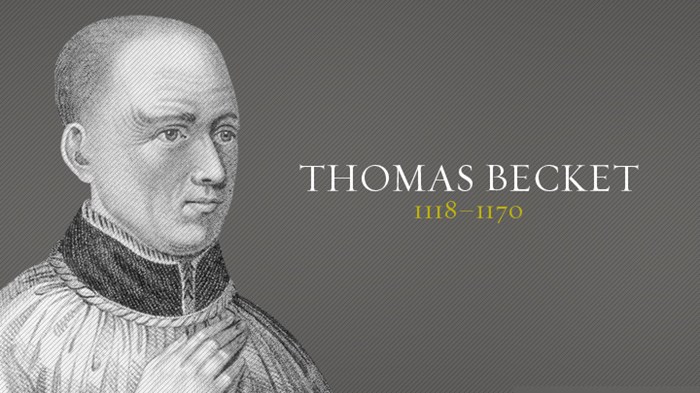


"For the name of Jesus and the protection of the church I am ready to embrace death."
In this century, the Nobel laureate T.S. Eliot dramatized Thomas Becket's martyrdom in his play Murder in the Cathedral, and Jean Anouilh's play Becket was turned into a an Oscar-winning film. In the Middle Ages, Becket's reputation was even more spectacular. His shrine in the Canterbury Cathedral was for centuries one of the most popular pilgrimage destinations in Europe (and the destination of poet Geoffrey Chaucer's pilgrims in his Canterbury Tales).
Timeline |
|
|
1093 |
Anselm becomes archbishop of Canterbury |
|
1095 |
First Crusade Launched By Council of Clermont |
|
1115 |
Bernard founds monastery at Clairvaux |
|
1118 |
Thomas Becket born |
|
1170 |
Thomas Becket dies |
|
1215 |
Magna Carta |
In spite of Becket's stature then and now, few people today know his story, a tale that bristles with ironies and reversals worthy of major plays and motion pictures.
One heart and one mind
Becket was the son of a French merchant who had settled in London. He studied for the priesthood in England and France and became archdeacon of Canterbury in 1154, where his administrative and leadership gifts became quickly evident. Contemporaries described Thomas as tall and thin, with dark hair and a pale face that flushed in excitement. His memory was tenacious, and he excelled in argument and repartee.
Such traits impressed Henry II, who in 1155 appointed Becket chancellor of England, and Becket immediately began employing his extraordinary gifts in the service of the king, solidifying the king's power throughout the land. In this work, the two became close friends. Contemporaries spoke with wonder of the relations between chancellor and sovereign, who was 12 years his junior, and people declared, "They had but one heart and one mind."
When the Canterbury archbishop Theobald died in 1161, Henry forced Becket's nomination as replacement. It was clear the king hoped to rely on his close ties with Becket to bring the church into submission with the rest of his realm. But Becket balked because, as he told Henry, "I know your plans for the church; you will assert claims which I, if I were archbishop, must needs oppose." But Henry had his way and Becket was installed.
When Becket became archbishop, he devoted himself to being the church's leader with the same energy he had shown working for Henry. As chancellor he had given himself to spiritual disciplines, but now as archbishop, he increased his devotion to fastings, use of hair shirts, protracted vigils, and prayer.
Soon the former friends were clashing as each sought to do his duty. A critical break came in the disputes over the Constitutions of Clarendon (1164), which specified the extent of state control over church and clergy, and tried to assure that clergy accused of serious crimes would be tried by the state, not by the church, as had been the custom. (The custom had also been to let clergy off with light sentences—reprimands or defrocking—even for such crimes as murder.) Under pressure, Becket at first submitted, but then he recanted, insisting on the right of the church to judge its own clergy. This led to a fierce struggle, and Becket was exiled in France for six years.
Meanwhile, Henry worried about who would succeed him and arranged for his son Henry to be crowned in 1170 by the archbishop of York. This was a violation of the rights of Canterbury to preside over the coronation. Eventually Henry had to yield, and a reconciliation with Becket was arranged.
Becket returned to England and at once began to excommunicate bishops who had executed the king's commands. This infuriated the quick-tempered king.
On December 29, 1170, four of the king's knights went to Canterbury and confronted the archbishop in his own cathedral during a Vespers service (but it is unclear whether they did so under Henry's direct orders or out of loyalty). To their angry question, "Where is the traitor?" Becket boldly replied, "Here I am, no traitor, but archbishop and priest of God."
They tried to drag him from the church but were unable, and in the end, they slew him where he stood. As he died, he said, "For the name of Jesus and the protection of the church, I am ready to embrace death."
Europe was shocked by the murder. The pope forced Henry to do penance at Becket's tomb, and Becket was canonized by Pope Alexander III in 1173, an extraordinarily brief space of time. Miracles were soon reported at the site, and devotion to the shrine swelled—until 1538, when Henry VIII destroyed it, with nearly all the other shrines in England.

Support Our Work
Subscribe to CT for less than $4.25/month










