C.S. Lewis


"The intellectual life is not the only road to God, nor the safest, but we find it to be a road, and it may be the appointed road for us. Of course, it will be so only so long as we keep the impulse pure and disinterested."
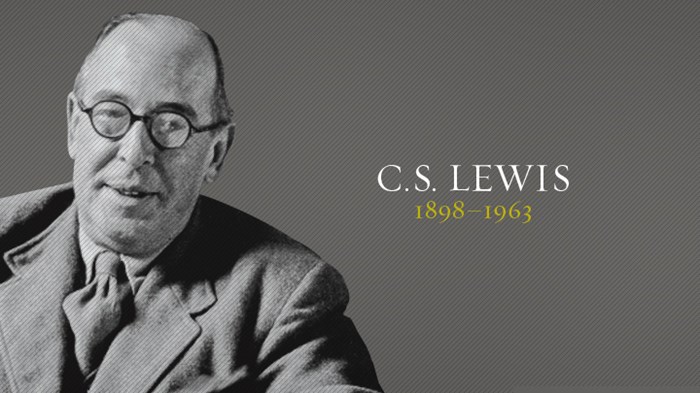
"I'm tall, fat, rather bald, red-faced, double-chinned, black-haired, have a deep voice, and wear glasses for reading," Clive Staples Lewis wrote to a young admirer in 1954. If the famous author had been prone to notice clothing, he might have added that his trousers were usually in dire need of pressing, his jackets threadbare and blemished by snags and food spots, and his shoes scuffed and worn at the heels.
Timeline |
|
|
1848 |
Marx publishes Communist Manifesto |
|
1859 |
Darwin publishes Origin of Species |
|
1895 |
Freud publishes first work on psychoanalysis |
|
1898 |
C.S. Lewis born |
|
1963 |
C.S. Lewis dies |
|
1966 |
Chinese Cultural Revolution |
But "Jack," as C.S. Lewis's friends knew him, was not bothered by fashion. He was meticulous about the precise use of words, the quality of evidence presented in arguments, and meter in verse. And it is for his books and ideas that the Oxford scholar is remembered as one of the greatest Christian writers of the twentieth century.
Raised in a library
Lewis was born into a bookish family of Protestants in Belfast, Ireland. Eclectic in their reading tastes, they purchased and read "endless" books. "There were books in the study, books in the dining room, books in the cloakroom, books (two deep) in the great bookcase on the landing, books in a bedroom, books piled as high as my shoulder in the cistern attic, books of all kinds," Lewis remembered, and none were off-limits to him. On rainy days—and there were many in northern Ireland—he pulled volumes off the shelves and entered into worlds created by authors such as Conan Doyle, E. Nesbit, Mark Twain, and Henry Wadsworth Longfellow.
After his only brother, Warren, was sent off to English boarding school in 1905, Jack became somewhat reclusive. He spent more time in books and an imaginary world of "dressed animals" and "knights in armor." But he did more than read books, he wrote and illustrated his own stories as well.
His mother's death from cancer in 1908 made him even more withdrawn. Mrs. Lewis's death came just three months before Jack's tenth birthday, and the young man was hurt deeply by her passing. Not only did he lose a mother, his father never fully recovered from her death. Both boys felt estranged from their father, and home life was never warm and satisfying again.
The death of Mrs. Lewis convinced young Jack that the God he encountered in the Bible his mother gave him was, if not cruel, at least a vague abstraction. By 1911 or 1912, with the additional influence of a spiritually unorthodox boarding school matron, Lewis rejected Christianity and became an avowed atheist.
A lifetime at Oxford
Lewis entered Oxford in 1917 as a student and never really left. Despite an interruption to fight in World War I (in which he was wounded by a bursting shell), he always maintained his home and friends in Oxford. His attachment to Oxford was so strong that when he taught at Cambridge from 1955 to 1963 he commuted back to Oxford on weekends so he could be close to familiar places and beloved friends.
In 1919 Lewis published his first book, a cycle of lyrics captioned Spirits in Bondage, which he wrote under the pseudonym Clive Hamilton. In 1924 he became a philosophy tutor at University College, and was the following year elected a Fellow of Magdalen College, where he tutored in English language and literature. His second volume of poetry, Dymer, was also published pseudonymously.
Spiritual Awakening
As Lewis continued to read, he especially enjoyed Christian author George MacDonald. One volume, Phantastes, powerfully challenged his atheism. "What it actually did to me," wrote Lewis, "was to convert, even to baptize … my imagination." G.K. Chesterton's books worked much the same way, especially The Everlasting Man, which raised serious questions about the young intellectual's materialism.
While MacDonald and Chesterton were stirring Lewis's thoughts, close friend Owen Barfield pounced on the logic of Lewis's atheism. Barfield had converted from atheism to theism, then finally Christianity, and frequently badgered Lewis about his materialism. So did Nevill Coghill, a brilliant fellow student and lifelong friend who to Lewis's amazement, was "a Christian and a thoroughgoing supernaturalist."
Soon after joining the English faculty at Magdalen College, Lewis met two more Christians, Hugo Dyson and J.R.R. Tolkien. These men became close friends of Lewis. He admired their brilliance and their logic. Soon Lewis recognized that most of his friends, like his favorite authors—MacDonald, Chesterton, Johnson, Spenser, and Milton—held to this Christianity.
In 1929 these roads met, and C.S. Lewis surrendered, admitting "God was God, and knelt and prayed." Within two years the reluctant convert also moved from theism to Christianity and joined the Church of England.
Almost immediately, Lewis set out in a new direction, most demonstrably in his writing. Earlier efforts to become a poet were laid to rest. The new Christian devoted his talent and energy to writing prose that reflected his recently found faith. Within two years of his conversion, Lewis published The Pilgrim's Regress: An Allegorical Apology for Christianity, Reason and Romanticism (1933). This little volume opened a 30-year stream of books on Christian apologetics and discipleship that became a lifelong avocation.
Lewis's 25 Christian books sold millions of copies, including The Screwtape Letters (1942), Mere Christianity (1952), the Chronicles of Narnia (1950–56), The Great Divorce (1946), and the Abolition of Man (1943), which Encyclopedia Britannica included in its collection of Great Books of the World. But though his books gained him worldwide fame, Lewis was always first a scholar. He continued to write literary history and criticism, such as The Allegory of Love (1936), considered a classic in its field, and English Literature in the Sixteenth Century (1954).
In spite of his intellectual accomplishments, he refused to be arrogant: "The intellectual life is not the only road to God, nor the safest, but we find it to be a road, and it may be the appointed road for us. Of course, it will be so only so long as we keep the impulse pure and disinterested."
Fame and fortune
Preaching sermons, giving talks, and expressing his theological views over the radio throughout the United Kingdom bolstered Lewis's reputation and increased his book sales. With these new circumstances came other changes—not the least being a marked upswing in annual income.
Throughout the 1920s Lewis had been getting by on little money. During his student years his father provided an allowance, and Jack supplemented that in various ways. Nevertheless, money was always scarce. And when the young academician took on the responsibility for a friend's family, finances were always tight even with the regular tutorial stipend.
Now, with money no longer an issue, Lewis refused to upgrade his standard of living, and instead established a charitable fund for his royalty earnings. He supported numerous impoverished families, underwrote education fees for orphans and poor seminarians, and put monies into scores of charities and church ministries.
During the last decade of his earthly pilgrimage, Lewis's world was invaded by an American woman and her two children. In 1952 Joy Davidman Gresham, who had become a Christian through reading The Great Divorce and The Screwtape Letters, visited her spiritual mentor in England. Soon thereafter her husband abandoned her for another woman, and she moved to London with her two adolescent boys, David and Douglas.
Gresham gradually fell into financial trouble. Her acquaintance with Lewis led to his underwriting the boarding school education of David and Douglas. From charity and common literary interests grew a deep friendship, and eventually love. They were married in 1956.
Joy was 16 years Lewis's junior, but that did not prevent a happy marriage. A savage case of cancer, however, cut their marriage short less than four years after the wedding. She was so ill even before the wedding that he called it a "deathbed marriage."
Still, Joy brought Lewis happiness. As he wrote to one friend soon after their marriage, "It's funny having at 59 the sort of happiness most men have in their twenties ... 'Thou hast kept the good wine till now.'" A writer in her own right, her influence on what Jack considered his best book, Till We Have Faces (1956), was so profound that he told one close friend she was actually its co-author.
Thus her death, like the death of his mother, dealt Lewis a severe blow. In his A Grief Observed, he expressed his grief, anger, and doubts that ensued for the next few years.
Attacks from friends
The esteemed professor not only married late in life, he married an American who was at once Jewish, divorced, a former Communist, and personally abrasive. In brief, the marriage did not set well with most of Lewis's friends and acquaintances.
Lewis was hurt by the disapproval of friends and colleagues, but it was by no means a new experience for him. although he enjoyed the conviviality of weekly get-togethers with fellow Inklings (intellectuals and writers who met regularly to exchange ideas), and the prodigious successes of his books, Lewis was frequently under attack for his decidedly Christian lifestyle. Even close Christian friends like Owen Barfield and J.R.R. Tolkien openly disapproved of Lewis's evangelistic speaking and writing.
In fact, Lewis's "Christian" books caused so much disapproval that he was more than once passed over for a professorship at Oxford, with the honors going to men of lesser reputation. It was Magdalene College at Cambridge University that finally honored Lewis with a chair in 1955 and thereby recognized his original and important contributions to English literary history and criticism.

Support Our Work
Subscribe to CT for less than $4.25/month