

















Lyman Beecher
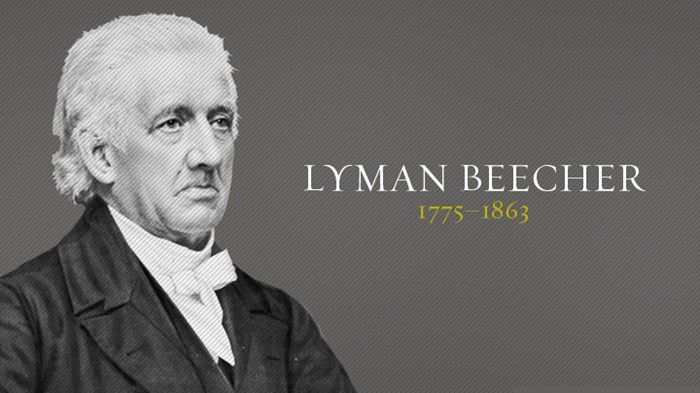


"Sin is black, grace abounds, the will is free."—one biographer's summary of Lyman Beecher's Theology
During Lyman Beecher's sophomore year at Yale, school president Timothy Dwight launched a preaching campaign against the school's pervading religious skepticism. After a debate titled "Is the Bible the Word of God?" Beecher noted, "all infidelity skulked and hid its head." When Dwight preached, "The harvest is past, the summer is ended, and we are not saved," Beecher felt as if "a whole avalanche rolled down" upon him, and he went home, "weeping every step."
This personal transformation foreshadowed changes that were taking place in American Christianity, many of which he became a part.
Timeline |
|
|
1735 |
George Whitefield converted |
|
1759 |
Voltaire's Candide |
|
1771 |
Francis Asbury sent to America |
|
1775 |
Lyman Beecher born |
|
1863 |
Lyman Beecher dies |
|
1865 |
J. Hudson Taylor founds China Inland Mission |
Pragmatic preaching
A native of Connecticut, Beecher was licensed as a Congregational clergyman—though his first pastorate was a Presbyterian church in East Hampton, Long Island. The young preacher was initially frustrated: "My preaching seems not to move," he complained. "I speak against a rock." But when he preached "The Remedy for Dueling," on the occasion of the Aaron Burr-Alexander Hamilton duel of 1806, a small revival broke out.
In 1810, he began pastoring a Congregationalist church in Litchfield, Connecticut, where his reputation as a revivalist and social reformer grew. He jealously defended the church's right to establishment (the state of Connecticut financed Congregationalism), but when Congregationalism was disestablished, he changed his mind: "It cut the churches loose from dependence on state support. It threw them wholly on their own resources and on God."
At his next church, Hanover Street Church, Boston, the great issue was unitarianism, which prevailed in the city. The revivalist quickly went to work with a strenuous campaign for orthodoxy.
Early on, Beecher's passion for saving souls drove his theology in a more pragmatic direction. He appealed to one seeker's intellect, to another's emotions. His sermons had a rationalistic bent and were peppered with words and phrases like "common sense," "honorable" repentance, meeting "all objections"—while he strutted around and waved his arms (a style his children would affectionately imitate in play). He was considered the archetypal Yankee—canny, waggish, relentless in logical argument, sinewy, and ungraceful.
Champion of free-will
In 1832 Beecher began concurrent terms as pastor of Second Presbyterian Church and Lane Seminary, both in Cincinnati, Ohio. As the abolitionist movement heated up in the city, Beecher discovered how voluntary groups could powerfully work toward healing social ills.
This, in turn, prompted him to reevaluate his Calvinist doctrine of sin and to put a greater emphasis on free will. His Calvinism was increasingly shaped by Arminians like Charles Finney, and what has been called New School theology, summarized by one Beecher biographer: "Sin is black, grace abounds, the will is free."
In the Calvinist-imbued Congregationalism of the time, this didn't sit well, and Beecher was charged with heresy, but he was eventually acquitted.
Beecher's greatest legacy may be the family he produced. He was said to be the "father of more brains than any man in America," for among his children were Harriet Beecher Stowe, author of Uncle Tom's Cabin, and Henry Ward Beecher, the most famous American preacher of his day.

Support Our Work
Subscribe to CT for less than $4.25/month










