Dante Alighieri
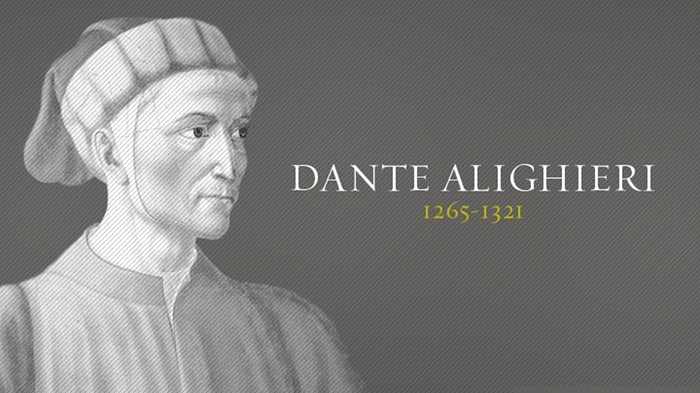


"O conscience, upright and stainless, how bitter a sting to thee is a little fault!"
By his early fifties, Dante had been exiled from his hometown, wrestled with the top authorities of the church, and taken up arms against his fellow countrymen. He had made plenty of enemies, and he was not pleased. So he did with his enemies what many have wished to do: he sent them all, even the pope, to hell—literarily, that is. But his damnatory writing was no screed; it was the finest poem of the Middle Ages, a summation of classical and medieval beliefs so profound that its critics labeled it "divine": The Divine Comedy.
Timeline |
|
|
1215 |
Innocent III assembles Fourth Lateran Council |
|
1220 |
Dominican Order established |
|
1232 |
Gregory IX appoints first "inquisitors" |
|
1265 |
Dante Alighieri born |
|
1321 |
Dante Alighieri dies |
|
1370 |
Catherine of Siena begins her Letters |
Papal power plays
Dante was born into a Florentine family of low aristocracy. They likely had some status but not much wealth. More importantly, they were supporters of the pope. All of Dante's life was shaped by the long conflict between the champions of papal power (the Guelfs) and those who supported German imperial control of Italy (the Ghibellines). One side would rise to power and severely punish the other, only to be overthrown a few years later. The see-saw had continued for over a century, but during Dante's early years the Guelfs (to which his family belonged) had secured ascendancy. He witnessed the acme of Florentine democracy and fought in the front ranks for the Guelf cavalry.
All participants in public life had to belong to a guild, so Dante joined the union of physicians and apothecaries. Soon, he was elected as a prior (chief magistrate) of the city. When the republic was again ripped apart by political turmoil, Dante chose the wrong side. His opponents gained control, and the poet-philosopher was charged (falsely) of hostility to the church, fraud, and corrupt practices; he was fined and barred from holding office ever again. When he refused to pay the fine, he was sentenced to death by burning. Dante fled the city.
Exile
Dante left behind a wife and children, and plunged again into his writing. He had penned his first book in Florence: a mix of blank verse and poetic prose called La Vita Nuova ("the new life"). It tells the story of his love for Beatrice, a woman he'd met briefly when they were both 9 years old—and whom he had loved ever since, even after her death and his marriage.
In exile he also wrote a defense of the ideal Italian language: the vernacular. The clerical Latin, he wrote, would be eclipsed by the urban Italian vernacular. History would prove him right.
In 1308 Henry of Luxembourg became the Holy Roman Emperor (supported by French pope Clement V), and Dante, believing him to be the renovator of Christendom, wrote his famous work De Monarchia. He acknowledged "that the Roman government is in [some ways] subject to the Roman pontificate, for in some ways our mortal happiness is ordered for the sake of immortal happiness," but generally, the emperor is supreme in temporal matters over the authority of the pope. An earthly monarch is necessary for creating a universal peace, and his authority comes directly from God, not through the pope. Unfortunately for Dante, Henry's monarchy never really got off the ground.
The felicitous comedy
After wandering from town to town, the exiled Dante finally settled in Ravenna in about 1317, where he set about completing his masterpiece, La Commedia, begun a decade earlier. In essence, it is an epic poem chronicling an allegorical journey through the afterlife, divided into three parts: Inferno, Purgatorio, and Paradiso. The purpose, Dante wrote, was to convert a corrupt society to righteousness, "to remove those living in this life from a state of misery and lead them to a state of felicity."
In Inferno, Dante is guided by the Roman poet Virgil through the nine concentric circles of hell ("Abandon all hope, ye who enter here"), where they meet various sinners from history, myth, and Dante's enemies list. Purgatory is a nine-tiered mountain where Dante must confront his own shortcomings and seek redemption ("O conscience, upright and stainless, how bitter a sting to thee is a little fault!"). Before he reaches Paradise, Virgil is replaced by Dante's long-lost Beatrice and Bernard of Clairvaux, and together they meet Dante's heroes as they journey through the nine concentric circles of heaven ("Like the lark that soars in the air, first singing, then silent, content with the last sweetness that satiates it, such seems to me that image, the imprint of Eternal Pleasure"). Dante finished the epic poem just before his death, and it was almost immediately recognized as brilliant. His epitaph begins: "Dante the theologian, skilled in every branch of knowledge that philosophy may cherish in her illustrious bosom."

Support Our Work
Subscribe to CT for less than $4.25/month