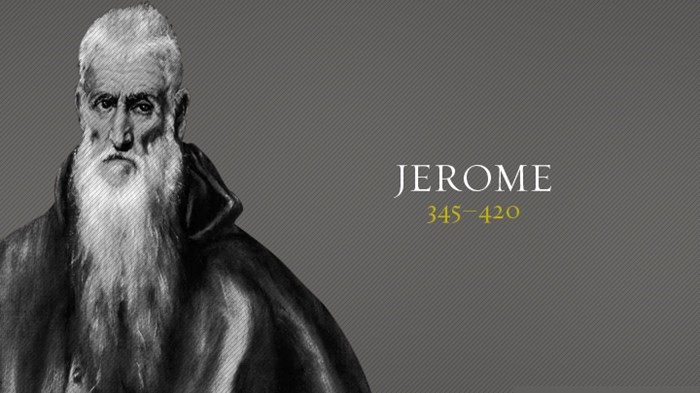
Jerome


"Make knowledge of the Scripture your love … Live with them, meditate on them, make them the sole object of your knowledge and inquiries."
Eusebius Hieronymus Sophronius, thankfully known as Jerome, was probably the greatest Christian scholar in the world by his mid-30s. Perhaps the greatest figure in the history of Bible translation, he spent three decades creating a Latin version that would be the standard for more than a millennium. But this was no bookish egghead. Jerome was also an extreme ascetic with a nasty disposition who showered his opponents with sarcasm and invective.
Timeline |
|
|
312 |
Conversion of Constantine |
|
323 |
Eusebius completes Ecclesiastical History |
|
325 |
First Council of Nicea |
|
345 |
Jerome born |
|
420 |
Jerome dies |
|
432 |
Patrick begins mission to Ireland |
From Cicero to scorpions
Jerome was born to wealthy Christian parents in Stridon, Dalmatia (near modern Ljubljana, Slovenia), and educated in Rome, where he studied grammar, rhetoric, and philosophy. There he was baptized at age 19.
Like other students, Jerome followed his studies with travel. But instead of discovering the sensuous pleasures of the empire, Jerome found himself drawn to the ascetics he met along the way, including those in Trier (now in southwest Germany) and Aquileia, Italy, where he joined a group of elite ascetics. Among them was Rufinius, famous for his translations of Origen's works. The group disbanded around 373, however, and Jerome resumed his travels, this time taking "an uncertain journey" to become a hermit in the Holy Land.
Exhausted, he only made it as far as Antioch, where he continued his studies of Greek. He even studied under Apollinarius of Laodicea (who was later condemned as a heretic for teaching Christ had only human flesh, not a human mind or will). But his Greek studies were interrupted by a dream—one of the most famous in church history—during Lent 375: dragged before a tribunal of God, he was found guilty of preferring classic pagan literature to Christian: "Ciceronianus es, non Christianus," (You are a follower of Cicero, not of Christ) said his judge.
Shaken, Jerome vowed never to read or own pagan literature again. (More than a decade later, however, Jerome downplayed the dream and again began reading classic literature.) He then shuffled off to the Syrian desert, rediscovering the joys of an ascetic "prison, with none but scorpions and wild beasts for companions." He settled in Chalcis, where the rigors of this life were exhausting. He begged for letters to stave off his loneliness, hated the harsh desert food, and could not find peace.
"Though I was protected by the rampart of the lonely desert, I could not endure against the promptings of sin and the ardent heat of my nature," he later wrote. "I tried to crush them by frequent fasting, but my mind was always in a turmoil of imagination."
Still, he learned Hebrew from a Jewish convert, prayed and fasted, copied manuscripts, and wrote countless letters. Despite his repeated assurances that he was happy in Chalcis, he returned to Antioch after a few years—shortly after other hermits began to suspect Jerome was a secret heretic (for his views on the Trinity, which, some argued, emphasized the unity of God at the expense of the three persons).
Sharp-tongued secretary
By then, Jerome was recognized as an important scholar and monk. Bishop Paulinus rushed to ordain him as priest, but the monk would only accept it on the condition that he would never be forced to carry out priestly functions. Instead, Jerome plunged himself into scholarship, especially that of the Bible. He attended exegetical lectures, examined Gospel parchments, and met other famous exegetes and theologians.
In 382 he was summoned to Rome to be secretary and one possible successor to Pope Damasus. But during his short three-year stint there, Jerome offended the pleasure-loving Romans with his sharp tongue and blunt criticism. As one historian put it, "He detested most of the Romans and did not apologize for detesting them." He mocked the clerics' lack of charity ("I have not faith and mercy, but such as I have, silver and gold—that I don't give to you either"), their vanity ("The only thought of such men is their clothes—are they pleasantly perfumed, do their shoes fit smoothly?"), their pride in their beards ("If there is any holiness in a beard, nobody is holier than a goat!"), and their ignorance of Scripture ("It is bad enough to teach what you do not know, but even worse ... not even to be aware that you do not know").
He even bragged of his influence, declaring, "Damasus is my mouth." Those who might have supported him, though already skeptical of his interest in "correcting" the Bible, were put off when one of his female disciples died during a severe fast. When Damasus died in 384, Jerome fled "Babylon" for the Holy Land.
Creator of the Vulgate
A wealthy student of Jerome's founded a monastery in Bethlehem for him to administer (it also included three cloisters for women and a hostel for pilgrims). Here he finished his greatest contribution (begun in 382 at Damasus's instruction): translating the Bible into everyday Latin (later to be called the Vulgate, meaning "common"). Though there were Latin versions available, they varied widely in accuracy.
"If we are to pin our faith to the Latin texts," Damasus had once written to him, "it is for our opponents to tell us which, for there are almost as many forms as there are copies. If, on the other hand, we are to glean the truth from a comparison of many, why not go back to the original Greek and correct the mistakes introduced by inaccurate translators, and the blundering alterations of confident but ignorant critics, and, further, all that has been inserted or changed by copyists more asleep than awake?"
At first Jerome worked from the Greek Old Testament, the Septuagint. But then he established a precedent for later translators: the Old Testament would have to be translated from the original Hebrew. In his quest for accuracy, he consulted Jewish rabbis and others.
One of the biggest differences he saw between the Septuagint and the original Hebrew was that the Jews did not include the books now known as the Apocrypha in their canon of Holy Scripture. Though he still felt obligated to include them, Jerome made it clear that he thought them to be church books, not fully inspired canonical books. (Reformation leaders would later remove them entirely from their Bibles.)
After 23 years, Jerome completed his translation, which Christians used for more than 1,000 years, and in 1546 the Council of Trent declared it the only authentic Latin text of the Scriptures. Sadly, the text of the Vulgate that circulated throughout the Middle Ages was a corrupt form of Jerome's work, encumbered by copyists' errors. (In the late sixteenth century, corrected editions were published.)
Jerome's work became so widely revered that until the Reformation, translators worked from the Vulgate; not for a thousand years did scholars again translate directly from the Greek New Testament. And ironically, Jerome's Bible added impetus to the use of Latin as the Western church's language, resulting centuries later in a liturgy and Bible lay people could not understand—precisely the opposite of Jerome's original intention.
For Jerome, however, his scholarship gave him an appreciation of the Word of God he carried for the rest of his life: "Make knowledge of the Scripture your love … Live with them, meditate on them, make them the sole object of your knowledge and inquiries."

Support Our Work
Subscribe to CT for less than $4.25/month