

















Anselm
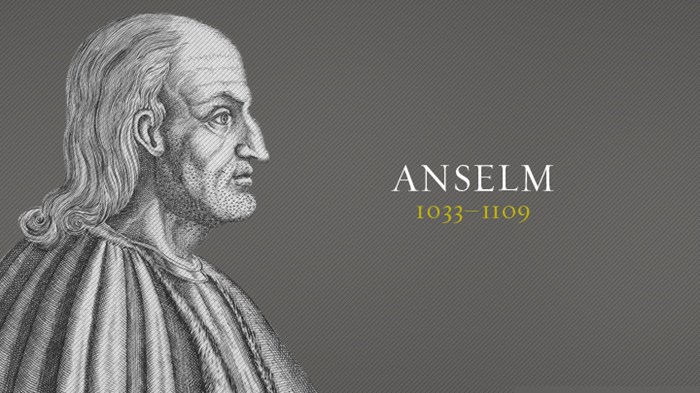


"No one but one who is God-man can make the satisfaction by which man is saved."
In the Middle Ages, it was customary for bishops-elect to make a show of protest to signify their modesty. When Anselm, an Italian monk from Normandy, was chosen to become archbishop of Canterbury, he protested too. The episcopal staff had to be held against his clenched fist. But his refusal was sincere: for Anselm, becoming the archbishop meant less time for his studies. His instincts, in fact, have proved correct: Anselm is remembered today not merely as a great archbishop but as one of the most profound thinkers of the Middle Ages.
Pulled to higher office
The struggle between the scholarly life and that of high office began in Anselm's earliest years. His father, Gundulf, wanted to see him in politics and forbade him from entering the local abbey. When the abbot refused to accept the 15-year-old without his father's consent, Anselm prayed to become ill: he reasoned he could enter if he was in danger of death. He actually became seriously ill but was still refused admission.
After wandering Europe for years, looking to stretch his mind, Anselm settled at Bec, Normandy, to study under Lanfranc, a renowned scholar. Anselm felt here he could live the monastic life in obscurity, since the fame of Lanfranc would outshine his possible accomplishments.
But Anselm shined nonetheless. After three years, Lanfranc left the abbey to become archbishop of Canterbury, and Anselm replaced him as prior. He spent his time reading and reflecting on theological mysteries. Under his leadership, the monastery became famous for its scholastic excellence. When administrative duties interfered with his desired calling, he begged the local bishop to relieve him of some of his duties. Instead, the bishop told Anselm to prepare himself for higher office.
A proof of God
At Bec, Anselm made his first great intellectual contribution: he attempted to prove the existence of God. He set out his famous ontological argument in his Proslogion. God is "that which nothing greater can be thought," he argued. We cannot think of this entity as anything but existing because a god who exists is greater than one who merely is an idea. The argument, though contested almost as soon as it was written, has influenced philosophers even into the twentieth century.
Anselm also thought deeply on the relationship of faith and reason. He concluded that faith is the precondition of knowledge (credo ut intelligam, "I believe in order to understand"). He didn't despise reason; in fact he employed it in all his writings. He simply believed knowledge cannot lead to faith, and knowledge gained outside of faith is untrustworthy.
Squaring off against the king
In 1066 the Normans invaded England, and William the Conqueror gave the monastery at Bec several tracts of English land. Following the invasion, Anselm was summoned across the channel three times, where he impressed the English clergy. When Lanfranc died in 1089, they pressed William II to appoint Anselm to the archbishopric (formally the prerogative of the pope, but in practice the archbishop of Canterbury was the king's appointee). Anselm was reluctant, as was William II for political reasons, and the position went unfilled for four years. Then, one day, the king fell seriously ill and, fearing hell, appointed Anselm against his repeated pleas.
Timeline |
|
|
862 |
Cyril and Methodius begin mission to Slavs |
|
909 |
Monastery at Cluny founded |
|
988 |
Christianization of "Russia" |
|
1033 |
Anselm born |
|
1109 |
Anselm dies |
|
1115 |
Bernard founds monastery at Clairvaux |
Anselm immediately exerted pressure on the king: he refused to do anything priestly for William until the king restored lands to Canterbury, recognized the archbishop as supreme in spiritual matters, and pledged his allegiance to Pope Urban II (who was embroiled in a power struggle with England). The king, also called William Rufus, agreed, but reneged on his promises when he recovered from his illness. In fact, he would not even let Anselm visit Rome. When Rufus denied permission the third time, Anselm blessed him and left England anyway.
Productive in exile
Anselm no doubt felt relieved. He had hated his position at Canterbury. He had avoided getting involved in disputes and often became ill when he was required to arbitrate disagreements. On the other hand, if one of his monks drew him aside and asked a theological question, he at once became enthralled and, as he explained his answer, his spirits rose. So while in exile, he again begged the pope to relieve him, but the pope replied that he needed Anselm's theological mind.
While in exile, Anselm wrote Why Did God Become Man?, which became the most influential treatise on the atonement in the Middle Ages. He argued for the "satisfaction theory." Early theologians, like Origen and Gregory of Nyssa, held to the "ransom theory": humankind was held captive to sin and death by Satan, at least until Christ paid the ransom through his death, and in the Resurrection, broke the power of Satan's chains. Anselm argued instead that it wasn't Satan who was owed something but God. In Adam, all human beings had sinned against divine holiness. Furthermore, being both finite and sinful, people were powerless to make proper restitution. That could only be accomplished by Christ: "No one but one who is God-man can make the satisfaction by which man is saved."
With the ascension of Henry I in 1100, Anselm was invited back to Canterbury. But when the king demanded homage from the bishops, Anselm refused and would not consecrate bishops who had done so. The controversy raged for six years, but Anselm eventually won.
For his last two years, he was able to study in relative peace. On his deathbed, Palm Sunday, 1109, Anselm told his monks he was ready to die, but before he did, he wanted to settle Augustine's question of the origin of the soul. "I do not know of anyone who will be able to do the work if I do not," he told them. But by Tuesday morning of Holy Week, he was dead.

Support Our Work
Subscribe to CT for less than $4.25/month










