The Rich Young Ruler Who Said Yes


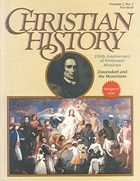
Nicolaus Ludwig von Zinzendorf, heir to one of Europe’s leading families, was destined for high duties in 18th Century Europe. Since 1662 all males in the Zinzendorf clan bore the title of count in the Holy Roman Empire; thus young Nicolaus Ludwig became at birth Count Zinzendorf.
His mother recorded his birth in the family Bible, noting on May 26, 1700 in Dresden the “gift of my first-born son, Nicolaus Ludwig,” asking “the Father of mercy” to “govern the heart of this child that he may walk blamelessly in the path of virtue … may his path be fortified in his Word.”
This child inherited, as is evident, a godly parentage within Lutheranism, and he would remain a Lutheran throughout his sixty years. But history would know him as a Moravian. Yet, if he were alive today he would probably be satisfied with neither. Perhaps the first churchman to use the term “ecumenism” in speaking of the church, this man-ahead-of-his-time had one obsession—the spiritual unity of Christian believers—Lutherans, Moravians, all.
Zinzendorf’s inheritance, spiritually speaking, was that particular brand of Lutheranism influenced by Pietism. The Pietists sought to know Christ in a personal way. For them, walking with the Savior meant being separate from the world, shunning the dance and theater and idle talk. It meant living in obedience to Christ in his Word and loving him with the heart in song and prayer. Their spiritual founder, Philip Jacob Spener, was the godfather of young Ludwig and a beloved friend of the count’s remarkable grandmother, Baroness Henriette Katherina van Gersdorf.
Six weeks after young Ludwig’s birth, his father died of tuberculosis, leaving him to be raised by three women—his mother; her sister, Aunt Henrietta; and his grandmother. Only the latter two were close to him in his childhood for his mother remarried when he was three. Zinzendorf went to live with Aunt Henrietta and Lady Gersdorf on the latter’s estate, Gross-Hennersdorf, 60 miles east of Dresden. He would know scores of moves in his lifetime, but few would be more crucial to his destiny than this one.
The young count grew up in an atmosphere bathed in prayer, Bible reading and hymn-singing. His dearest treasure next to the Bible was Luther’s Smaller Catechism. In childlike sincerity he wrote love letters to Jesus and tossed them out of the window of the castle tower. When Swedish soldiers overran Saxony, they entered the castle at Gross-Hennersdorf and burst “into the room where the six-year-old count happened to be at his customary devotions,” notes John Weinlick in Count Zinzendorf. “They were awed as they heard the boy speak and pray … the incident was prophetic of the way the count was to move others with the depths of his religious experience the rest of his sixty years.”
Young “Lutz,” as he was called, was not allowed to “forget that he was a count” even though growing up in this Pietist environment. He was tutored and trained, disciplined and cultured for future service in the court.
At age 10 Zinzendorf said farewell to childhood. He was off to Halle to attend the Paedagogium of the staunch Pietist disciple, August Francke. There Zinzendorf spent his next six years under the watchful eye of a tutor assigned by his guardian, Count Otto Christian, and under the very nose of Francke himself—he and a few other sons of the nobility took meals in the Francke household. His pious ways and high-born status, together with a rather frail constitution inherited from his father, made him a perfect target for the taunts and tricks of his peers.
Zinzendorf proved himself an apt pupil. At age 15 he could read the classics and the New Testament in Greek, was fluent in Latin and “French was as natural to him as his native German.” While not excellent in Hebrew, he showed definite poetic gifts. One biographer says he “often was able to compose faster than he could put his thoughts on paper, a gift he retained for life.”
Yet at Halle the Lord fashioned the young count through influences not entirely academic. Prior to his arrival, the Danish-Halle Mission had sent two evangelists to India. One of these had returned to Halle and often at mealtime in the Francke home would tell of his experiences. Zinzendorf noted in his diary, something of the effect Halle had on him:
Daily meetings in professor Francke’s house, the edifying accounts concerning the kingdom of Christ, the conversation with witnesses of the truth in distant regions, the acquaintances with several preachers, the flight of divers exiles and prisoners … the cheerfulness of that man of God in the work of the Lord, together with various trials attending it, increased my zeal for the cause of the Lord in a powerful manner …
Wittenberg
Instead of continuing at Halle, Zinzendorf pursued his university studies at Wittenberg in compliance with the directions of his guardian. This strong hold of Lutheran orthodoxy was not friendly turf for Pietists, but it was the proper place for a noble son to prepare for court service. The count’s grandmother, concerned about his inclination toward the ministry, sternly told him that his place was in the service of the state. Hamilton, in his History of the Moravian Church, notes how Otto Christian issued precise instructions “respecting the conduct and the studies” of Zinzendorf. A sample from Zinzendorf’s diary reveals how his tutor had mapped out his day for him—and how his “heart religion” was clearly intact at age 15:
This week I began the plan of spending a whole hour, from six to seven in the morning, as well as in the evening from eight to nine, and for fifteen minutes at a quarter of ten, in prayer. Also I resolved to pursue the study of civil law with all my energy, since I expect all sorts of interruptions this coming summer.
Examinations with Mencken. At ten o’clock I fenced. At eleven I studied the pandects. At twelve I dined. At one I played badminton (schlug volants). At two I drew. At three I attended a lecture in the history of the Reich. At four I danced. At five Bardin (French tutor) was here. At six I studied civil law. At seven I dined. At eight I prayed. At nine I studied Hoppi’s examination.
Hamilton notes that at Wittenberg “his Hallensian prejudices against the authorities at Wittenberg wore off … he reamed to appreciate these men.” True to his “obsession” for Christian unity, while still a student he put forth a great deal of effort to reconcile Francke and the scholars at Wittenberg, but to no avail. Zinzendorf always remained at heart a Pietist and was grieved later when Francke’s son and successor at Halle opposed what he was doing at Herrnhut.
In the customary fashion of the day, Zinzendorf completed his studies at Wittenberg by embarking on a “grand tour” of centers of learning on the continent. First in the company of his half-brother, Friedrich Christian, he attended lectures in Holland, studied English and visited Dutch cities. Then in 1720 he and his tutor went to Paris where he stayed for six months. He toured the lavish palace at Versailles, but was more impressed with relief work carried on at a Paris hotel. Here was forged a strong bond of friendship with the primate of the Roman Catholic archdiocese, Cardinal Noailles. Exposed to the fine arts and cultural riches, his heart inclined more and more to the Savior—less and less toward wordly interests.
“What Have You Done for Me?”
All of his life, the young count would point to one experience on the “tour” which influenced him most. In the art museum at Dusseldorf, he encountered the Savior. Seeing Domenico Feti’s Ecce Homo (“Behold, the man”), a portrait of the thorn-crowned Jesus, and reading the inscription below it—“I have done this for you; what have you done for me?” Zinzendorf said to himself, “I have loved Him for a long time, but I have never actually done anything for Him. From now on I will do whatever He leads me to do.”
The rich young ruler had said yes!
Upon reaching maturity in May 1721, Zinzendorf purchased from his grandmother the estate at Berthelsdorf, only a few miles from Gross Hennersdorf. That month he also entered service in the royal court, but that required his presence for only certain months of the year. In Dresden, he opened his apartment for informal religious services on Sundays and soon attracted “a growing circle of adherents.” A dominant theme of life then—and for all his adult years—was that he considered himself a pilgrim. His best known hymn written at that time, reflects that mood:
Jesus, still lead on,
Till our rest be won,
And although the way be cheerless,
We will follow, calm and fearless.
Guide us by Thy hand
To our fatherland.
This hymn, in 33 stanzas, is known around the world and sung in some 90 languages.
Marriage—And Herrnhut
Biographer Weinlick indicates that the young count’s brush with devout Roman Catholics, especially in France, caused him to study the Old and New Testaments on the subject of marriage. After much prayer and consulting with friends, he decided to marry, “but to choose only a partner who shared his ideals. He found that person in the young Countess Erdmuth Dorothea von Reuss, sister of his friend Henry.” They were married on September 7, 1722. A year prior to that he had sought to marry a cousin but on learning that Henry was in love with her, Zinzendorf not only backed out but wrote a cantata to celebrate their wedding.
In Countess Erdmuth Dorothea, he found a mate whose home was even more devoted to Pietism than his own. “Romantic love had but a minor place in the courtship,” notes Weinlick. The count had his sights set on serving Christ and his wife would assist him in that. Their marriage “set a pattern for the kind of marriage soon to become common in the Renewed Moravian Church.” Wed at the von Reuss estate at Ebersdorf, they remained there a few weeks, then moved into a four-room apartment in Dresden and in the summer of 1723 occupied their new manor house at Berthelsdorf.
As Zinzendorf devoted himself to matters of state in Dresden, Lady Gersdorf was pleased that he seemed to have given up notions of entering the ministry. But all the while the vision that filled his mind was to form a Christian community at Berthelsdorf, modeled after the Countess’ home in Ebersdorf. This vision was not long in finding fulfillment with the arrival of a lone Moravian at his door in Dresden.
The man identified himself as Christian David. He had heard that Zinzendorf might allow oppressed Moravians refuge on his land. Large-hearted Zinzendorf agreed to the request but was not even at Berthelsdorf when the first group of ten Moravians arrived in December 1722. Johann Georg Heitz, the manager of the estate, greeted the immigrants and showed them a plot of ground a short distance from the manor house at the foot of the hill Hutberg. Quoting Psalm 84:3, “Yea, the sparrow hath found an house, and the swallow a nest for herself, … ” Christian David felled the first tree.
Informing Zinzendorf by letter, Heitz said he had chosen a name for the settlement. It was to be “Herrnhut”—meaning “under the Lord’s watch” or “on the watch for the Lord.” Not until Christmastime did Zinzendorf pay any attention to the six adults and four children who had come to live on his land. Passing the new dwelling in his carriage, he and the countess stopped at the Moravian house and prayed with these with whom he sensed at once a spiritual kinship.
Seventeen months later, in May 1724, Zinzendorf was at the Hutberg settlement for a special occasion. His vision of a community taking shape, he and a small party of trusted friends had come to lay the cornerstone for the first large building which would house an academy similar to the one at Halle, a print shop and an apothecary. With him was his close associate from schooldays at Halle, Frederick von Watteville.
Coincidentally five young men from Zauchtenthal in Moravia, three whose names were David Nitschmann, arrived that day. They had left everything behind them and, stealing across the border under cover of night, were on their way to a Moravian city in Poland when Christian David persuaded them to visit Hermhut. These men of the “hidden seed” of the ancient Unitas Fratrum were so moved by the prayers of Zinzendorf and von Watteville that they decided that their search for a refuge had ended. They stayed, and Herrnhut was well on its way.
By May 1725, ninety Moravians had settled at Herrnhut. “Ten times Christian David journeyed back home to lead groups of settlers to the new town,” says Allen W. Schattschneider in Through Five Hundred Years. “The three houses really grew into a small city. Many of the new arrivals had thrilling tales to tell of the ways in which sympathetic Catholic friends had helped them escape. The father of one of the five young men had been thrown into prison in the tower of a castle. One night he saw the rope hanging in front of his window and with its help he slid to the ground and started for Herrnhut …”
At the same time, due to the spirited preaching of Pastor Rothe of the Berthelsdorf parish church, Lutheran Pietists also became a part of Hermhut. Former Catholics, Separatists, Reformed and Anabaptists moved to the new community. An excellent linen weaver from a neighboring village built his home near Hernhut, contributing a valuable industry to the settlement. Similarly, Leonard and Martin Dober, Swabian potters, brought their trade with them to Herrnhut. By late 1726 the population had swelled to 300. But trouble was brewing.
The Moravians differed with the Lutherans over the liturgy in Sunday worship. With so mixed a group, there were other serious squabbles, not to mention economic pressures and language difficulties. Then a heretical teacher was allowed residence in the community, a man “angry at the Lutherans because they had expelled him.” This man “took a great dislike for Zinzendorf and marched around the little town telling everybody that the count was none other than the ‘beast’ mentioned in the book of Revelation.” He caused an enormous upheaval before suffering a mental breakdown.
Determined that the little community would not destroy itself, in 1727 Zinzendorf moved his family into the academy building—by then an orphanage—and in the manner of a pastor began going from house to house, counseling with each family from the Scriptures. In time a spirit of cooperation and love began to show itself. When in May he reluctantly took the step of laying down a set of manorial rules for life at Herrnhut, the people wholeheartedly entered into the “Brotherly Agreement” with him and the Lord.
Several things happened next. The community elected twelve elders and appointed night watchmen (who announced the hours with a hymn!), watchers for the sick, and almoners to supervise distribution of goods to the poor. “Bands” were organized, little groups of folk who had “special spiritual affinity” to one another.
In July Zinzendorf journeyed to Zittau and while browsing in a library discovered a copy of the constitution of the ancient Unitas Fratrum with a preface written in 1660 by Bishop Comenius. He then understood that the Moravian Brethren was a “fully established church antedating Lutheranism itself.” Amazed at the similarities between the constitution and the newly-adopted “Brotherly Agreement,” he copied portions of it into German and shared them with the people on his return to Herrnhut. That summer the people had become a prayerful, united community and on Wednesday, August 13, at a communion service in the Berthelsdorf church, such a powerful manifestation of the Spirit came upon the people that Zinzendorf afterward referred to that day as the “Pentecost” of the Renewed Moravian Church (see “Baptized into One Spirit”).
Laying a Groundwork for Missions
Zinzendorf had no idea that in five years, on another August day, he and the Herrnhut community would send out the first two missionaries of the new era. Individual missionaries had gone to their posts, representing a society or in connection with colonial interests; Catholic orders had sent missionaries for centuries. But not until the Moravians did a church as a whole, laymen and clergy, consider the missionary task the duty of the whole church.
Guided by an unseen hand, Zinzendorf went to work to resolve differences which still threatened Herrnhut. It was decided that the Berthelsdorf church would continue as a Lutheran parish, but Herrnhut would be a Unity of the Brethren congregation—they would later become known as the Moravian Church. During 1727–29 the count tirelessly and with wisdom negotiated the necessary legal papers to assure the continuation of the ancient church on Saxon soil. To offset criticism mounting against him for going beyond the acceptable norm of creating Pietistic cells within established churches, he wrote letters and traveled to the centers of influence in Saxony to explain his actions.
At the same time, Pietism’s genius for creating small groups within the established churches was systematized at Herrnhut. To strengthen the spiritual life of the people, “choirs” were formed—first among the single brethren, then the single sisters, married couples and the widowed. These lay men and women traveled to other parts of Saxony and beyond, encouraging cells of believers in personal Bible study and pious living. “Out of this grew a network of societies within the churches to which eventually the term ‘Diaspora’ was applied,” says Weinlick. Herrnhuters roved to and fro on the continent, to Moravia, the Baltic States, Holland, Denmark and even to Britain.
Weinlick adds that “personal contacts were followed up with a vigorous program of correspondence … the Herrnhut diary of February 1728 reveals that there were at times a hundred or more letters on hand.” Contents of these were shared in monthly Prayer Days or in daily congregational meetings. Through the visits, future leaders of the Brethren were drawn to Herrnhut, such as the brilliant, warmhearted instructor at Jena, August Gottlieb Spangenberg. He would go on to become one of the church’s foremost bishops and Zinzendorf’s successor—except that no man could fill the count’s shoes entirely.
From this ministry to the Diaspora, it was but one step to another kind of itinerary—going as gospel preachers to the forgotten peoples. Three factors, at least, made the missionary action of Herrnut almost inevitable:
• The settlement had a contagious brand of Christianity.
• Its leader “was a count with entry to the ruling circles of many lands and whose restless nature moved him to make use of this advantage,” says Weinlick.
• Further, “the Moravian exiles were uprooted pilgrims who took readily to a vocation of itinerant evangelism.”
The First Missionaries
By 1731 the count was rarely involved with affairs of state, but one such event figured decisively in the sending of missionaries. That year he received an invitation to the coronation of Christian VI in Copenhagen and not being inclined to accept, he submitted the matter to the congregation, and to the lot. When prevailing opinion indicated “go,” he consented with a strong premonition that something special lay in store.
In Copenhagen he took part in the expected round of social events and even was accorded the medal of the Order of the Danebrog for distinguished service; but that “something special” came when he met a black man. Anthony Ulrich had been brought to Europe from St. Thomas and since arriving had found Christ as his Savior. With Zinzendorf and David Nitschmann he passionately pled for someone to go to the Danish West Indies with the gospel, to share with the black slaves—among whom were his sister and brother—the glad news of salvation. It was not that the church did not already exist there; it did, but only for the benefit of the whites.
For some time a number of the single brethren at Herrnhut had been led in the study of writing, medicine, geography and theology by Zinzendorf against the day when they might go to other lands. Now Zinzendorf hurried back to Herrnhut to report what Anthony had said.
Two of the young men definitely impressed by Zinzendorf’s words were Leonard Dober and Tobias Leupold. After a sleepless night, Dober arose the next morning and opened his 1731 Daily Text, seeking to know if his strong thoughts about going to the West Indies were of God. His eyes fell at random on the words: “It is not a vain thing for you; because it is your life; and through this thing ye shall prolong your days” (Deut. 32:47). Much encouraged, he shared his sense of a call with Leupold at their regular time of prayer that evening and found that Leupold likewise had felt called to St. Thomas. Then, as they resumed to the village with the other single brethren, and passed Zinzendorf’s house, they heard him tell a guest: “Sir, among these young men there are missionaries to St. Thomas, Greenland, Lapland and other countries.” Their joy unbounded, they composed a letter to Zinzendorf that night, volunteering to go.
Without indentifying who had written the letter, the count shared its contents with the congregation the following day. When Anthony arrived at Herrnhut and repeated his plea, the congregation was moved by his challenge. But Zinzendorf knew better than to act too quickly. For a year he allowed Dober and his friend to wait while all of them weighed the issue in prayer and much discussion. No clear cut unanimity within the community was found and it was decided to submit the matter to the drawing of lots.
In August 1732, a drawing of the lot indicated that Leupold was to wait. But for Dober, it said: “Let the lad go.” The 25-year-old “lad” was to be sent and David Nitschmann, the carpenter, agreed to go with him. They immediately made plans to sail from Copenhagen.
“There were not two men in the world more fitted for their task,” says the Historian Hutton. “Each had a clear conception of the Gospel; each possessed the gift of ready speech; and each knew exactly what Gospel to preach.” At an unforgettable service on August 18, the Herrnhut congregation said farewell to the two brethren. A hundred hymns were sung, so intense was the feeling.
The birthday of Moravian Missions now arrived. At three o’clock in the morning (Thursday August 21) the two men stood waiting in front of Zinzendorf’s house. The Count had spent some hours that night in prayer and conversation with Dober. His carriage was waiting at the door; the grey of morning glimmered; and silence lay upon Herrnhut. The Count took the reins and drove them as far as Bautzen. They alighted outside the sleeping town, knelt down on the quiet roadside and joined the Count in prayer. The Count laid his hands on Dober’s head and blessed him. His last instructions were of a general nature. ‘Do all in the spirit of Jesus Christ,’ he said. He gave them a ducat apiece. The two heralds rose from their knees, bade the Count good-bye, and stepped out for Copenhagen. (Hutton)
The Golden Decade
In Copenhagen, Dober and Nitschmann had to battle with all those who knew why their enterprise was doomed to fail, and when on October 8 they finally did board a Dutch ship, they had it to do all over again with the crew (see “Missionaries Against Terrible Odds”).
On Sunday, December 13, 1732, after almost ten weeks at sea, the ship sailed into the harbor of St. Thomas. According to their plan, Nitschmann was only to remain long enough to help Dober find lodging—or to build a cabin if need be—and begin missionary work among the slaves. So, in April 1733 Nitschmann said goodbye to Dober. The dedicated potter would labor alone for 15 months; once he almost starved to death and at another time a fever rendered him helplessly dependent on others. But he persisted in talking with the slaves one by one and led a few to confess faith in Christ. One of these, Carmel Oly, returned to Herrnhut with him the following year as one of the “first fruits” of the gospel.
In July 1734 reinforcements arrived in the form of 17 volunteers. Among them was Leupold. But they had been seven months at sea, were dissipated and demoralized. Their first service on the neighboring St. Croix, where they were to work, was a funeral to bury one of their own. In three months nine had died. Eleven more missionaries arrived in May 1735 but “the Great Dying” continued; 22 of the first 29 died, forcing a temporary retreat from St. Croix.
Yet the tide of missionaries continued to go out from Herrnhut. In 1733, three brethren went to Greenland. In 1734, Moravians went to Lapland and Georgia; 1735—Surinam; 1736—Africa’s Guinea Coast; 1737—South Africa; 1738—to Amsterdam’s Jewish quarter; 1739—Algeria; 1740—North American Indians; Ceylon, Romania and Constantinople. The golden decade of 1732–42 stands unparalleled in Christian history in so far as missionary expansion is concerned. More than 70 Moravian missionaries, from a community of not more than 600 inhabitants, had answered the call by 1742.
‘A Formidable Caravan’
The brighter the missionary fires burned at Herrnhut the hotter things became for Zinzendorf. His opponents sought to undermine him and his ministry. In 1736 he was banished from Saxony. From there he took the family and certain key individuals with him west to Wetteravia, in the vicinity of Frankfurt, and found residence in a rundown castle, the Ronneburg. During the next decade a new settlement, Herrnhaag, would thrive nearby, surpassing Herrnhut in size. But at the Ronneburg the countess found the going rough at first. Zinzendorf was away on one of his perpetual journeys when their three-year-old son, Christian Ludwig, took ill. There being no medical help available, he died. When another child fell ill, Countess Dorothea left the Ronneburg temporarily. She bore the count 12 children, only four of whom reached maturity.
Out of necessity while in exile Zinzendorf created a traveling “executive committee” which became known as the Pilgrim Congregation. It served to direct the foreign mission work of the church as well as the ministry to the Diaspora societies. The Pilgrim Congregation observed the regimen of Herrnhut in prayers and discipline, but was mobile; “the years of exile found the group in Wetteravia, England, Holland, Berlin and Switzerland.”
The Pilgrim Congregation’s reason for going to Berlin was that in 1737 the count was there ordained a bishop of the Moravian Church by one of the two surviving bishops, Daniel Ernest Jablonsky. The count had sought the opinions of leading clerics of his day, including Archbishop Potter of the Church of England, and being encouraged, he asked the aged court preacher in Berlin to render the service. It was an action that demonstrated Zinzendorf’s ongoing commitment to the survival of the Moravian Church. He had been ordained a Lutheran minister three years earlier.
In 1738 the count made a pastoral visit to the St. Thomas mission field, arriving in time to free Moravian missionaries from prison. An official of another church had accused these Moravians of not having valid ordination. In December 1741 Zinzendorf and the Pilgrim Congregation began a 14-week stay in North America. Giving Bethlehem (Pa.) its name, he made the settlement there his base from which he went out on extended trips among the Indians to open the way for missionary work. Also he poured great energy into attempts to unite Protestant bodies in America, arguing that in the New World there was no history—hence no need—of denominations. But his ecumenical task failed and he returned to England in 1743.
Though the edict banishing him from Saxony was withdrawn in 1747, Zinzendorf continued to spend more time in Herrnhaag and in England than at Herrnhut. From Herrnhaag in that year alone 200 brethren and sisters went out to posts of duty as missionaries, as immigrants to the New World or as workers among the Diaspora. From 1749 to 1755 the spiritual climate in London was especially friendly to the growth of Moravian influence and Zinzendorf made that his headquarters. But in 1755 their 24-year-old son Christian Renatus died in London. Countess Dorothea was on her way there when news reached her of his death. She continued on to London to view his gravesite in the God’s Acre there, but she never fully recovered her zest for life after this loss. The following year she died at Herrnhut.
Virtually every biographer of Zinzendorf has remarked upon the remorse and guilt which overtook the count after his wife’s death. For two decades he had allowed the head of the single sisters, Anna Nitschmann, to “usurp” the countess’s place at his side while he gave less and less attention to Erdmuth Dorothea. A year after the countess’s death, the peasant Anna became the wife of Zinzendorf. They were married three years and died within two weeks of each other in 1760.
On the day he took Anna as his bride, Zinzendorf renounced his position in the empire as the head of his noble house, abdicating in favor of his nephew, Ludwig, being “less inclined than ever for worldly honors.”
The year 1760 marked 28 years in Moravian missions; no fewer than 226 missionaries had been sent out in these years. As the great visionary, the tireless pilgrim, Zinzendorf, lived out his last days at Herrnhut. Weak and nearing death on May 8, 1760, he said to Bishop David Nitschmann at his bedside:
Did you suppose in the beginning that the Savior would do as much as we now really see, in the various Moravian settlements, amongst the children of God of other denominations and amongst the heathen? I only entreated of him a few of the firstfruits of the latter, but there are now thousands of them. Nitschmann, what a formidable caravan from our church already stands around the Lamb!
The following day Count Zinzendorf breathed his last and joined the caravan of those adoring the Lamb upon his throne.
Karl Barth called him “perhaps the only genuine Christocentric of the modem age.” Feuerbach said he was “Luther come back to life.” The scholarly George Forell tagged him “the noble Jesus freak.” Church historian Timothy Weber lists him as one of “the spiritual superstars of the 1700’s … who shaped the course of Christianity.” We would identify him simply as the rich young ruler who met Jesus—and said a wholehearted YES.
Copyright © 1982 by the author or Christianity Today/Christian History magazine.
Click here for reprint information on Christian History.

Support Our Work
Subscribe to CT for less than $4.25/month