Christian History Timeline: Wycliffe's World


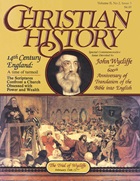
John Wycliffe was born into a century when the medieval world was coming to an end while a new world was not yet born. The Church, which had brought civilization and order to Europe, had grown in wealth, property, power … and corruption. The Crusades had ended, but France and England now turned on each other in extened combat. Kinghts in armor would fall to archer. Genghis Kahn was dead but his decendant, Tamerlane, would devastate the Asian continent. Even greater devasteion would plague Europe when the Black Death would kill 75 million by the end of the century. Exotic gifts from the Orient and mysterious tales from African empires south of the Sahara were shared by traders and explorers. Still unknown to Wycliffe’s Europe were the cultures already thriving on continents yet to be discovered in the century ahead.
Wycliffe
1330 John Wycliffe born in Wycliffe-on-Tees
1345 Wycliffe goes to Oxford
1353 With death of his father, Wycliffe becomes lord of manor
1360 Master of Balliol College
1361 Receives Master of Arts
1361 Ordained for the See of Lincoln
1361 Rector of Fillingham in Lincolnshire
1363 Prebend of Aust
1365 Warden of New Canterbury Hall
1367 Deposed at Canterbury Hall by new Archbishop of Canterbury (Langham); appeal to Pope Urban V fails.
1368 Rector of Ludgershall
1369 Receives Bachelor of Divinity
1370 First Presentation of his doctrine on the Eucharist
1372 Receives Doctorate of Theology
1372 Enters service of the crown
1374 Appointed Rector of Lutterworth
1374 Appointed to commission to Bruges to negotiate with papal delegation
1374–1376 Devolops “dominion” theory
1377(February) Rioting ends trial at St. Paul’s
(May) Pope Gregory XI issues five bulls against Wycliffe
(December) Wycliffe agrees to “house arrest” at Oxford
1378 Queen Mother ends Lambeth trial
1379–1380 Publishes views on the Eucharist
1381 Withdraws from public to Lutterworth
1381–1384 Intense work with aides on English translation of Bible
1382 Blackfriars Synod condemns Wycliffe’s writings, followed by purge of Wycliffites at Oxford
1382–1384 Prolific writing period in both Latin and English
1382 Suffers first stroke
1384 Suffers second stroke; dies on New Year’s Eve
1415 The Council of Constance condemns Wycliffe on 267 different heresies
1428 At papal command, remains of Wycliffe dug up, burned, and scattered on river Swift
England
1295 England’s Model Parliament—Edward I summons bishops, knights, and burgesses from all parishes for first representative parliament
1306 England expels 100,000 Jews who remained after Edward expulsion order of 1290
(1307-1327) Edward II
1310 England’s barons force Edward II to appoint lords ordainers to help him rule
1310 Parliament rules taxation shall be imposed only by Parliament
1314 Battle of Bannockburn assures independence of Scotland—30,000 Scotsmen under Robert Bruce VIII rout 100,000 led by Edward II
1318 At Battle of Dundalk, Ireland’s Edward Bruce killed three years after being proclaimed king
1326 Queen Isabella and her paramour, Roger Mortimer, invade England and capture her husband, Edward II
1327 Edward II is killed in prison; Isabella’s 14-year-old son becomes Edward III
(1327-1377) Edward III
1330 Edward III seizes power, ends regencey of Isabella and Mortimer
1333 Battle of Halidon Hill gives Edward III revenge for his father’s defeat at Bannockburn
1337 Beginning of “Hundred Years War” between England and France—Edward III assumes title of King of France; French king Philip VI contests England’s claims to Normandy
1341 English Parliament divided into Upper House (Lords) and Lower House (Commons)
1346 Battle of Crecy establishes England as military power; English longbowmen change face of warfare
1349 Death of William of Ockham, English philosopher, who sowed seeds of independance of church and state
1351 England removes Pope’s power to give English benefits to foreigners
1353 Parliament’s Statue of Praemunrie forbids appeals to the Pope
1356 Edward, the Black Prince of Wales, destroys French army at Battle of Poitiers
1362Piers Plowman written by English poet over next 30 years
1362 English becomes the authorized language of the law courts; French still used for legal documents
1366 Parliament refuses to pay feudal tribute to Pope
1366 Statute of Kilkenny forbids marriage between Irish and English
1370 John Ball in England preaches man’s natural equality
1374 John of Gaunt returns from French wars to become leader of the state
1376 The Good Parliament
1376 The Black Prince (son of Edward III) dies
1377 Edward III dies; 10-year-old son of Black Prince crowned Richard II; Dukes of Lancaster and Gloucester rule
(1377–1399) Richard II
1377 New Parliament reverses acts of "The Good Parliament"
1377 Parliament levies loll tax that leads to rioting in 1381
1381 The Peasant Revolt; 30,000 rioters converge on London; ends when Wat Tyler, their leader, is betrayed and killed
1385 Parliament blocks Richard II from setting up a personal government
1389 Richard II begins personal rule at age 22
1389 Statute of Provisors makes papal appointments in England invalid
1393 Second Statue of Praemunrie prohibits introduction of papal bulls
1398 Richard II moves toward totalitarianism
1399 John of Gaunt dies; Richard II confiscates his estates; Gaunt’s son, Henry of Bolingbroke, returns from exile and is acclaimed by Parliament as King Henry IV; Richard II dies a year later in prison
(1399–1413) Henry IV
(1413–1422) Henry V
1414 Sir Jon Oldcastle (Lord Cobham), disciple of Wycliffe, burned at stake
1415 At Battle of Agincourt, Henry V leads English archers in victory over larger French cavalry
1429 Joan of Arc leads small French army to liberate Orleans from English
The Church
1291 Sacreans (Muslims) capture Accre, last Christian stronghold in Palestine; end of Crusades after 200 years
1302 “Unam Sanctam,” papal bull of Pope Boniface VIII, asserts papal supremacy over every human being
(1303–1304) Pope Benedict XI
(1305–1314) Pope Clement V
1309 Pope Clement, a Frenchman, move papal court to Avignon, France, beginning “The Babylonian Captivity,” lasting until 1377
1311 Ecumenical council at Vienna
1316 Eight Dominicans sentto Ethiopia by Pope to find Prester John, legendary Christian king
(1316–1334) Pope John XXII
1322 Pope forbids counterpoint in church music
1324 Defenso Pacis, by Marsiglio of Padua suggest council, rather than Pope, as prime authority of church
1328 Louis IV invades Italy and declares Pope John XXII deposed for heresy
(1328–1330) Pope Nicholas V
(1334–1330) Pope Benedict XII
(1342–1352) Pope Clement VI
(1352–1362) Pope Innocent VI
1361 Palace of Popes at Avignon completed after 28 years of construction
(1362–1370) Pope Urban V
(1370–1378) Pope Gregory XI
1376 Catherine of Siena, popular laywoman (later a saint), tries to persuade Pope Gregory XI to return to Rome
1377 Leaving Avignon, Pope Gregory XI moves papal court to Rome; ending the “Babylonian Captivity”
1378 The Great Schism divides the Catholic Church for 39 years when two opposing popes are elected—Pope Urban V in Rome and Pope Clement VII in Avignon
1378–1389 Pope Urban VI(in Rome)
1378–1394 Pope Clement VII(in Avignon)
(1389–1404) Pope Boniface IX (in Rome)
(1394–1417) Pope Benedict XIII (in Avignon)
1415 Council of Constance condemns Wycliffe of 267 heresies and demands John Hus recant; he refuses and is burned at the stake
World Events
1294 Kublai Khan dies after 35-year reign establishing Ming dynasty
1296 A Genoese prisoner, Marco Polo, writes about his travels to Orient
1302 King Philip IV of France convenes first Estates-General (Parliament) with all estates represented
1307 Dante Alighieri, Italian poet, begins writing The Divine Comedy
1308 Duns Scotus, Scottish theologian, dies
c. 1310 Perfection of the mechanical clock
1313 Jaques de Molay, grandmaster of the French Knights Templar, burned at stake for alleged heresy
1317 Salic law, excluding women from succession to throne, adopted in France
1325 Mexico City has its beginning in the city of Tenochtitlan founded by Aztecs in Lake Texcoco
1326 First mention of gunpowder (in Venice) for warfare
1327 Meister Eckhart, German mystic, dies
1338 Declaration of Rhense—Electors of Holy Roman Empire can select emperor without papal intervention
1341Francesco Petrarch, first great humanist, crowned poet laureate in Rome
1345 Cathedral of Notre Dame completed in Paris after 182 years of construction
1347–1351 The Black Death devastates Europe, killing as many as two-thirds of the population in some parts
1350 Till Eulenspiegel, popular German prankster, dies
1350 Li Hsing Tao, The Chalk Circle, famous Chinese play
1353 Arab traveler, Ibn Battuta, visits Africa’s Mandingo Empire
1353 Giovanni Boccaccio, founder of Italian prose, completes Decamaron
1354 Cola da Rienzi is killed after seven years of trying to bring popular rule to Rome against nobles and the Pope
1356 “The Golden Bull” of Holy Roman Emperor Charles IV transforms empire from monarchy into aristocratic federation to last 450 years
1358 Revolt of French peasants at Jacquerie against oppressive taxes results in wholesale slaughter of serfs
1359 First Swedish Riksdag (parliament); all classes represented
1360 First francs coined in France
1364 Guillame de Marchant “greatest musician of his day,” composes Mass for Four Voices
1369 Tamerlane (Timur the Lame), 33, makes himself master of Samarkand, in Turkestan and builds army that will conquer much of Asia.
c. 1379 Brethren of the Common Life organized
1381 Venice defeats Genoa, beginning greatness of Venetian republic
1383 Japanese “No” drama pioneered by Motokiyo Zeami, 20, still performed 600 years later
1384 Jadviga, daughter of King Louis I, crowned “king” of Poland
1387 Chaucer begins work on The Canterbury Tales
1392 Yi dynasty, that will rule Korea until 1910, founded by warlord, I Songgye
1398 John Hus lectures on theology at Prague University
1405 Tamerlane dies, his empire quickly dissolves
Copyright © 1983 by the author or Christianity Today/Christian History magazine.
Click here for reprint information on Christian History.

Support Our Work
Subscribe to CT for less than $4.25/month