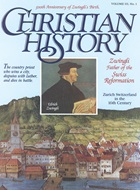
Zwingli - Father of the Swiss Reformation: The Gallery of Family, Friends, Foes & Followers


Anna Reinhart and Regula Gwalther
(1482–1538) When she married Ulrich Zwingli secretly in 1522, Anna Reinhart was the well-to-do widow of Hans Meyer von Knonau, a soldier of wild habits who had died in 1517. With ten other priests, Zwingli had appealed to the Bishop early in 1522 for permission to marry, but was refused. Thus, he married secretly, and not until April 5, 1524, did he and Anna make their arrangement public. She brought three children to the marriage, and had four others by Ulrich: Regula (July 31, 1524), Wilhelm (January 24, 1526), Ulrich (January 6, 1528), and Anna (May 4, 1530). Only one letter from Ulrich to his wife survives, dated January 11, 1528: “Grace and Peace from God. Beloved wife, I say God be thanked that He has permitted you a happy birth …” When Ulrich was killed at Kappel, Anna grieved deeply. Heinrich Bullinger took her and the children into his home and treated her like family until she died peacefully seven years later. (1524–1565) Regula, Zwingli’s oldest child, is described as the image of her mother, Anna. According to Zwingli’s own entry in his pocket Bible, Regula was born on July 31, 1524, on a Sunday at 2:30 a.m. in the house called “Zur Sul” in the Kirchgasse (Church Lane). Brought up with the children of Bullinger after her father’s death, Regula married Rudolf Gwalther in 1541 and soon was installed at St. Peter’s in Zurich as the parson’s wife. Of her six children, Anna, the oldest, is well known through the portrait by Hans Asper and as the wife of Heinrich Bullinger the Younger. Regula died of the Plague on November 14, 1565.
Leo Jud
(1482–1542) Zwingli referred to Leo Jud as “my dear brother and faithful co-worker in the gospel of Jesus Christ.” As college students—Zwingli, in his late teens and Jud, just 20—at the University of Basel, they met and studied under Thomas Wyttenbach, whose expositions on parts of the New Testament, especially Romans, inspired both of them to study the Scriptures. Thereafter they were lifelong friends. Jud succeeded Zwingli in 1518 at Einsiedeln in the important post of scholar and preacher to pilgrims and then followed him to Zurich in 1523 to become pastor at St. Peter’s. At Zwingli’s first disputation in 1523, Jud wasted no time in determining to follow Zwingli’s leadership in preaching the pure Gospel, and likewise that same year he married. His thundering September 1 sermon in St. Peter’s against images—just a few days after Zwingli’s Essay on the Canon of the Mass had left the press—fanned the fires that ended up ridding the church of images and the Latin Mass. Besides his unstinting loyalty to Zwingli, Jud used his excellent skills to translate Zwingli’s exposition of Scripture into German and Latin; he led the translation of he Zurich Bible in 1529 and provided a careful Latin translation of the Old Testament. In the same unselfish way, he assisted Heinrich Bullinger, Zwingli’s successor.
Cornelius Hoen
(d. 1524) Some men leave behind little trace of themselves, but great influence nonetheless. Little is known about Cornelius Hoen, a lawyer at The Hague and resident of Holland, yet his careful study of Christ’s words, “This is my body,” led Zwingli to a position on the Eucharist that made certain the gulf between himself and Luther. In 1509 Hoen came into charge of the library of a former dean at the University of Paris, who had engaged in a controversy with Wesel Gansfort over the authority of the Church and tradition. Among these archives was a treatise on the Eucharist by Gansfort. This set Hoen to thinking. Typical of the practice of humanists, Hoen worked out his conclusions in a letter, stating that the communion should not be a sacrament in the Catholic sense, but merely a commemoration. Hoen’s interpretation took the “is” to mean “represents” or “means.” In 1521 this letter was brought by Hinne Rode to Luther, who rejected Hoen’s interpretation. Two years later Rode visited Oecolampadius in Basel, who read the letter with much interest and urged Rode to present it to Zwingli. At that time, Zwingli’s interpretation of communion was somewhat uncertain, but the seed fell on good soil, causing him to write: “In this letter I found a pearl of great value: is has the sense of means.” In the meantime Hoen was arrested on suspicion of “Lutheran” heresies and died shortly thereafter. In 1525 Zwingli published Hoen’s Epistola Christiana. Hoen’s letter symbolizes that humanist phenomenon of autonomous intellectual positions among laymen on questions of Church doctrine.
Erasmus
(c. 1466–1536) “It was an extraordinary proof of your kindness that you were not ashamed of a man so small and so unskilled in letters,” writes Zwingli after meeting Erasmus. During his lifetime, this “father of Renaissance humanism”—Desiderius Erasmus of Rotterdam, Holland— corresponded with more than 500 leaders in politics and philosophy. His influence was felt by Luther, Zwingli, Thomas More, the Anabaptists, and others. “Is war anything but the mass murder of the many?” asks Erasmus in Institutio Principis Christiani, which Zwingli read in 1515 with the sight of 6000 Swiss dead at Marignano fresh in his memory. During the years of 1514–1519 when Zwingli was formulating his own beliefs, Erasmus exerted great influence upon him—first with Erasmus’s translation of the New Testament in 1516. Zwingli discovered foundations for his own ideas in Erasmus’s advocacy of the sufficiency of Christ for salvation, his concept of faith as trust, his criticism of papal authoritarianism and superstitions of the Church, his belief that infants dying before baptism are saved, and his argument on fasting. But with Zwingli’s move closer to the ex-monk Oecolampadius and Erasmus’s insistence on being free of religious, academic, and political ties, relations in 1521 begin to chill. To Zwingli’s “Commentary on True and False Religion” in 1524 Erasmus reportedly sighed, “O good Ulrich, what have you ever written that I have not already previously written?” And Zwingli responds in a letter to Vadian: “If only Erasmus had treated my theme with his own style! The whole world would already be of our opinion.” But for Erasmus it was “easier to put up with the faults to which one is accustomed. Hence I support the Church until I find one that is better.” Among all the Reformers, Zwingli was closest in thinking to Erasmus. Zwingli’s letter to Luther in 1527 refuting Luther’s claim to be the first discoverer of the Gospel hints that Zwingli mourned parting ways with Erasmus: “Already there were a good number of people who had reached the essential faith, if not better—which you would never admit—at least as well as you. Yes, truly, there were men who, twelve years ago now—and at that time I was on a footing of friendship with them—proved very useful to me and led me to a joyful zeal.” What would be the face of Protestantism today if that joyful zeal would have been reciprocal and Zwingli would have had Erasmus as ally?
Philip of Hesse
(1504–1567) Young and astute, Philip understood the importance of a united Protestant alliance to stand against the power of the Holy Roman emperor. Thus, bringing Luther and Zwingli together on the matter of the Lord’s Supper was to Philip an essential churchly strategy with broad political implications. Philip declared himself to stand with the Lutherans, but urged toleration of the Swiss and was suspected therefore of being a secret Zwinglian. Despite his failure to achieve union at the Marburg Colloquy (1529), Philip succeeded in building a Protestant alliance, called the Schmalkald League, through which he vigorously promoted Protestantism. The League was troubled, however, as Philip found it increasingly necessary to make concessions to his powerful Catholic neighbors. His standing as a Protestant leader was seriously tarnished by a series of sexual affairs which eventually led to his bigamous second marriage, an adjustment given secret approval by Melanchthon and Luther. Philip was only 15 years old when he assumed power over the estates of Hesse, and a mere 17 at the time of his first meeting with Luther, which left him impressed with the monk’s personage but indifferent to his cause. Then in 1524 Philip, whose formal education was not extensive, began the reading of Luther’s translation of the Bible. His commitment to reform was deepened upon meeting Melanchthon in 1527. In the same year he helped found the University of Marburg for the training of Protestant theologians. For five years (1547–1552) Philip was held captive by the Holy Roman emperor while new leaders emerged to direct Protestant political interests. For the rest of his life, Philip worked in vain for a reunion of the historic and the reformed branches of Christendom.
Grebel/Manz
Conrad Grebel (c. 1498–1526) and Felix Manz (c.1498–1527) were early comrades of Zwingli. Grebel was a layman, from a leading Zurich family, and educated at the universities in Vienna and Paris. Manz was a Hebrew scholar and illegitimate son of a canon of the Grossmünster Church in Zurich. By 1523 these and other radical reformers came to believe that Zwingli was too conservative and that the reforms he advocated were too few. They had all broken the fasts and stood squarely among the image-breakers. But now the radicals opposed the tithe, usury, military service, and the oath. They claimed that the City Council had no business legislating on matters of religion. They met covertly in homes for Bible reading and prayer. Zwingli apparently felt the choice was between orderly change and ecclesiastic anarchy. He urged moderation and patience and engaged the radicals in a series of public debates, but when the radicals began re-baptizing in February, 1525, he sided with the Council in its decision to outlaw private meetings and require that all children be baptized. Grebel, Manz, and others refused, protested the Council’s decision throughout Zurich, and were arrested. Grebel was exiled and died of the plague. By order of the Council, Manz was executed by drowning in the River Limmat, the first Anabaptist martyr. Whether Zwingli consented to the death sentence is not known; he did not openly oppose it.
Heinrich Bullinger
(1504–1575) After the defeat of the Protestants at Kappel in 1531, Bullinger was chosen to replace the fallen Zwingli as pastor of the Grossmünster in Zurich. As the Zurich artistes, Bullinger performed the functions of a “Reformed” bishop, helping to reorganize the cantonal synod and mediating between the Zurich Council and the clergy. Bullinger was a prolific writer. His widely-published works included Decades of Sermons (fifty sermons on Christian doctrine), The History of the Reformation, and The Diary. He joined John Calvin in producing the Consensus Tigurinus on the Lord’s Supper. He was the chief author of the First Helvetic Confession, a response to the Wittenberg Concord adopted throughout Upper Germany, and thirty years later with Peter Martyr authored the Second Helvetic Confession, which summarized the beliefs of the Evangelical-Reformed churches in France, Scotland, Holland and central Europe. His still extant 12,000 letters written to theological and political leaders throughout Europe made him both a highly informed theologian and a great influence on Reformed groups all over the world in his day. His correspondents included Henry VIII and Edward VI of England. When, in 1570, Pope Pius made the final breach between the Papacy and the English Church, Queen Elizabeth turned to Bullinger to prepare her reply to the Papal charges. Born the son of a parish priest at Bremgarten, Bullinger studied at the University of Cologne where he became familiar with the works of Erasmus, Melanchthon, and Luther whose writings decisively influenced him. When he returned to Switzerland in 1523, he joined the supporters of Zwingli’s reformation in Zurich and took part in the Berne Disputation of 1528. The Second Kappel War destroyed his fortune and compelled him to flee from Bremgarten, where he had succeeded his father. He took refuge at Zurich. From there Bullinger consolidated and continued the Reformation begun by Zwingli.
Diethelm Röist
(1482–1544) Himself the mayor of Zurich in Zwingli’s day, Diethelm Röist was born in 1482 as the son of the mayor of Zurich. Originally a follower of the Pope, Röist took his stand as the chief supporter of the Reformation at Zwingli’s side. He was mayor of Zurich during the decisive years of 1524–44. Without Röist’s political support of Zwingli, it is possible that the Reformation in Zurich would not have succeeded. He accompanied Zwingli in 1528 to the debate in Berne.
Oecolampadius
(1482–1531) A genius at scholarship and debate, Oecolampadius was to Zwingli what Melanchthon was to Luther: Less forceful, less popular, less original, but a more careful student and logician, and more temperamentally capable at achieving consensus among disputants. Oecolampadius was born Johann Hausschein or Husschyn, but adopted as his name the Greek equivalent (meaning houselamp). He studied law, philosophy, scholastic philosophy, and theology at Heidelberg and Tübingen completing a baccalaureate at age 19. Seven years earlier, however, he was already composing Latin poetry. In 1515 he was called to the pulpit at the cathedral at Basel, where he soon became a close friend of Erasmus. His spiritual search included two years in a convent, but following a study of Luther’s tracts and a growing friendship with Melanchthon, Oecolampadius was won over to the Reform movement. He introduced many of the reforms to his city: Mass in the vernacular, rejection of Mariolatry, and intolerance for Anabaptists. At the famous Colloquy of Marburg, Oecolampadius was second to Zwingli in defense of the Reformed view of the Lord’s Supper. When Luther determined on October 3, 1529, that adversaries of consubstantiation were to be abandoned to God’s judgment, Oecolampadius replied, “We will do the same, You need it as much as we.” Earlier Luther had compared the strength of Oecolampadius’ logic and persuasive skill to that of Luther’s Catholic adversary, Johann Eck. Oecolampadius waited until the age of 45 to marry. His wife, Wilibrandis Rosenblatt, was already once a widow, and Oecolampadius was to be the second of her four Reformer husbands. To him she bore three children, named for the qualities he prized in his home: Godliness (Eusebius), truth (Alitheia), and peace (Irene).
Copyright © 1984 by the author or Christianity Today/Christian History magazine.
Click here for reprint information on Christian History.

Support Our Work
Subscribe to CT for less than $4.25/month