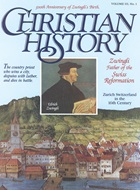
Zwingli - Father of the Swiss Reformation: Christian History Timeline


It was an age reaping the benefits of events of the 1450’s—when Constantiople’s fall to the Turks threatened all of Europe and Gutenberg’s innovation of movable type gave more than a select few the privelege of coming to their own conclusions. In Zwingli’s lifetime—a mere fifty years—scholars of the church questioned the faith as Rome had tought it, and courageous explorers thrust through ancient myths and fears to discover new horizons. It was a world encountering a new kind of trade, including tasty foods from exotic lands. It was a world becoming stronger—in England, France, and Spain. It was a world equipping itself with giants—moneyed families such as the Medici and the Fuggers, geniuses of form such as Michaelangelo, Da Vinci, and Raphael, singleminded leaders such as Columbus, Henry VIII, Ferdinand and Isabella, and Luther. It was an age to give people hope in princely powers as well as in personal ideals. It was an age beginning to change at a faster pace, yet it was an age when one could still burn as a heretic.
1477 Swiss pikemen distinguish themselves at Battle of Nancy, making them much sought after as mercenaries
1480 Ferdinand and Isabella appoint Inquisition against heresy among converted Jews
1480 Ivan III styles himself Czar of the Russians
1482 Portuguese explorers discover bananas on west coast of Africa
1483 Martin Luther born
1484 “At Hammel in Saxony, on the 20th of June, 1484, the Devil, in the likeness of a pied piper, carried away 130 children, that were never after seen.”
1484 Japan’s shogun Yoshimasa introduces the tea ceremony
1484 Huldrych Zwingli born at Wildhaus (Toggenburg) in Canton of St. Gall
1485 Battle of Bosworth on August 22 ends England’s 15-year Wars of the Roses; Henry VII crowned first king of 117-year Tudor dynasty
1489 Symbols + and – come into use
1490 Beginnings of ballet at Italian courts
1492 Christopher Columbus, with three ships and 78 men set sail on September 6 after first attempt aborted; arrives in the Bahamas, thinking he has reached the East Indies
1492 Isabella and Ferdinand take Granada from the Moors and expel 200,000 Jews
1492 Lorenzo de’ Medici dies
1492 Christopher Columbus introduces Europeans to the pineapple, parrots, Indians, peppers, allspice, maize, and sweet potatoes
1492 Nuremberg geographer Behaim constructs first terrestrial globe
1492 Leonardo da Vinci draws a flying machine
1492 Profession of publisher emerges, consisting of typefounder, printer, and bookseller
1493 Maximilian I becomes Holy Roman Emperor
1494 First moblie artillery firing iron cannon balls, used by Charles VIII in Italy
1495 First recorded outbreak of syphilis; infects army of Charles VIII at Naples
1495 Merchant-investor Jakob Fugger ensures powerful political power through leasing of copper and siver mines
1495 The Imperial Diet of Worms attempts to modernize the Holy Roman Empire; proclaims Perpetual Peace, and imposes common penny as general tax
1498 Vasco de Cama establishes sea route between Portugal and India
1498 Savonarola burned at the stake for heresy in Florence
1499 War between Swabian League and Swiss Cantons. Swiss victory forces Treaty of Basel granting Swiss independance
1499 Granada’s Moors revolt as Inquisitor de Cisneros introduces forced wholesale Christian conversion
1500 Pope Alexander VI proclaims a Year of Jubilee; imposes a tithe for crusade against Turks
1500 First human Caesarian operation performed by Swiss pig gelder Jakob Nufer
1500 Postal service between Vienna and Brussels established
1501 Music printed for the first time by use of movable type
1501 Peace of Trent between France and Emperor Maximilian I recognizes French conquests in Upper Italy
1501 Erasmus’ Enchiridion promotes a Christianity based on the Sermon of the Mount
1501 Michaelangelo completes Pieta
1502 University of Wittenberg established by Frederick, Elector of Saxony
1503 Canterbury Cathedral completed after 436 years of construction
1503 Da Vinci paints “Mona Lisa”
1503 Pocket handkerchief comes into use
1504 Venice sends ambassadors to Sultan of Turkey, proposing construction of a Suez Canal
1506 Completes Master of Arts at University of Basel
1506 Becomes parish priest at Glarus
1507 New geography by Waldseemüller proposes the New World be called “America” after Amerigo Vespucci
1507 League of Cambrai formed by Margaret of Austria, the Cardinal of Rouen, and Ferdinand of Aragon to despoil Venice
1507 Diet of Constance recognizes unity of Holy Roman Empire
1507 Martin Luther ordained
1509 Erasmus writes Praise of Folly at Thomas More’s home
1510 African slaves cross the Atlantic to work in Portuguese sugar plantations in Brazil
1510 Jakob Fugger lends Maximilian 170,000 ducats to finance war against Venice
1511 Pope Julius forms Holy League with Venice and Aragon to drive French out of city; Henry VIII joins Holy League
1511 Servetus, Spanish theologian and physician executed in Geneva as a heretic
1512 Forces of the holy League meet defeat at Ravenna; coalition of Swiss, papal, and imperial forces drive French and their German mercenaries out of Milan
1513 Giovanni de Medici becomes Pope Leo X —“one of most severe trials to which God ever subjected his church”
1513 Peasant and labor rebellions spread eastward from Switzerland
1515 French decisive victory over Swiss and Venetians at Battle of Marignano; Swiss retain Alpine passes and French gain right to enlist Swiss mercenaries
1515 Lateran Council forbids printing of books without permission of Roman Catholic authorities
1515 Witnesses Swiss routed in “Battle of Giants” at Marignano
1515 Writes satire of mercenary war, The Labyrinth, calling for Christian love and brotherhood and end to violence
1515 Meets Erasmus, Dutch humanist
1516 Out of step with Glarus’s French leanings, moves to Einsiedeln; affar with local barber’s daughter
1516–17 Reads Erasmus’s translation of the New Testament, Novum Instrumentum
1512-1517 Pope Julius II convenes the Lateran Council to undertake reforms in abuses of Church in Rome
1517 Martin Luther posts 95 Theses in protest of sale of indulgences
1518 Appointed Leutpriester at Zurich Grossmünster
1519 Begins New Testament sermon series, signalling new era of Biblical preaching
1519 Ministers to Zurich’s plague victims, ill himself 3 months with plague
1519 Leads Zurch to withdraw from alliance with Catholic France; Zurch mercenaries forbidden to hire out to France
1521 Diet of Worms; Luther refuses to recant; gets backing of German princes; begins German translation of Bible
1522 Attends printer Christopher Froschauer’s party where Lenten rules are broken; writes “Freedom of Choice in Eating” to oppose fasting
1522 Secretly marries widow Anna Reinhart; signs memorial with 10 other ministers asking the Bishop of Constance for sanction to marry
1522 Develops circle of young clergy and humanists—Grebel, Manz, Reublin, Brotli, Stumpf
1522 Writes Apologeticus Archeteles, his testemony of faith
1522 Resigns priesthood; re-employed by City Council as evangelical pastor in same post
1523 Under auspices of Zurich Council, invites Christian Europe to public disputation of 67 theses; authorized by Council to continue preaching the Gospel
1523 Writes “Of divine and human justice” to defend Council’s refusal to modify tithes legislation
1523 Holds second public debate on images and mass; recommends that Council authorize removal of images
1524 Publicly marries his wife
1525 Public disputation on infant baptism; draws the battle line for former followers, Grebel and others
1525 Writes two anti-Anabaptist pamphlets, “On baptism” and “On the preaching office”
1526 Convinces council in March to issue edict authorizing execution of Anabaptists
1526 Decides that Swiss unity must be maintained even with force after Swiss-Catholic assembly at Baden
1528 Accepts Berne’s invitation to a public debate, resulting in elimination of the mass, images, and alters there
1529 Accompanies Zurich forces to First Kappel War
1529 Meets Luther in Marburg in October for four days of discussion called by Philip, Landgrave of Hesse
1531 Angles for French support for the Reformation by allowing Swiss mercenaries to be hired
1531 Dressed in battle armor, joins the forces on October 11 and is killed
1532 Calvin starts Protestant movement in France
1534 Act of Supremacy; Henry VIII declared supreme head of Church of England
1534 Ignatius Loyola founds Society of Jesus to spread Counter Reformation
Copyright © 1984 by the author or Christianity Today/Christian History magazine.
Click here for reprint information on Christian History.

Support Our Work
Subscribe to CT for less than $4.25/month