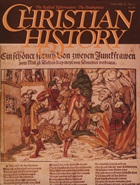
Showing Them How to Die; Showing Them How to Live


Michael and Margaretha Sattler
The marriage of Michael and Margaretha Sattler was the most natural thing that could have happened, a logical outcome of a common vision of love, faith and hope. Except Michael and Margaretha were out of step with their times. For a simple priest to marry broke Catholic canonical law, and Michael was already a prior, second only to the abbot of the Benedictine monastery of St. Peter’s in the Black Forest in southern Germany. Margaretha, a refined and comely woman, had been a Beguine; even though it was a lay order, she, too, was breaking a vow. To compound matters, Michael and Margaretha had joined the fledgling Anabaptist movement. It was less than two years old, full of vitality yet without singleness of purpose, seen by the ecclesiastical and magisterial powers as dangerously virulent.
Michael and Margaretha Sattler must have felt the weight of their decision. Yet they took courage from their choices. They were part of a group composed solely of mature believers gathered in the name of Christ, giving their ultimate obedience to their Lord God and only a qualified obedience to the magistracy. They were committed to the principle of mutual address: Whatever they would do, would be done only in the light of careful counsel of the community of the faithful.
Sattler felt at home in this movement that he had joined in 1526. The choice of adult baptism as a nonconformist act paralleled in a way the adult, monastic vows of nonconformity he had taken earlier. Likewise, the posture of peace taken by the Zurich Brethren—Conrad Grebel, Felix Manz, George Blaurock, Wilhelm Reublin and others—struck him as essential to Christian faith. In Strassburg that year he had realized that this movement needed a form. Perhaps his conversations with Reformers and other Anabaptists prompted this realization. A form must set boundaries and yet preserve freedom. It must equip its followers to resist the onslaught of fanatics, the coercion of “Christian” governments, and the cleverness of persuasive preachers. What he had put together in Strassburg, a group of Anabaptists meeting on 24 February 1527 in a small South German town of Schleitheim adopted as the seven articles of their faith. This “Brotherly Union” (see The Schleitheim Confession) was the essence of what they could agree upon; it organized them into a church.
It is one thing to witness through powerful words; quite another, to witness with one’s blood. Yet with their adult commitment, Anabaptists invited a baptism of water, of the Spirit, and of blood.
On their return from Schleitheim Michael, Margaretha, and others were captured. While searching Michael, officials found the “Brotherly Union” and some important notations on the plans and activities of the Swiss Brethren.
What a catch! Nine charges were assembled. When the two-day trial opened on Friday, 17 May, in Rottenburg, on the defendants’ beech sat Michael, Margaretha, and nine other men and eight women. The charges dealt with violations of Catholic doctrine and practice—the Eucharist, baptism, unction, and the veneration of the saints. Additionally, Sattler was charged with having left the monastery, marrying, and urging nonresistance toward the Turks. This last charge implied both sedition and heresy; however, this was a case largely of violations of church law.
Speaking for the group and for himself, Sattler refuted the charges. Concerning the last point, Sattler admitted that he had taught that if the Turk should come, no armed resistance should be made in accordance with the commandment: Thou shalt not kill. Sattler also admitted having said that if war were right, he would rather march against supposed Christians who persecute, capture, and kill the God-fearing. “The Turk knows nothing about the Christian faith; he is a Turk according to the flesh. But you want to be considered Christians, boast of being Christ’s, and still persecute his pious witnesses. You are Turks according to the spirit.”
In his defense, Michael Sattler said that the Anabaptists had done nothing contrary to God and the Gospel. He asked that a debate be arranged. The Anabaptists were ready to be taught from the Bible. If they were proved to be in error, they would gladly bear the punishment. “But if we are not shown to be in error, I hope to God that you will accept teaching and be converted,” he said sincerely. That a defendant should propose to teach his judges caused a titter of laughter. Then the court secretary snapped, “You rascal of a monk, should we dispute with you? The hangman shall and will dispute with you!”
One and one-half hours later, the judges returned with the sentence: “Michael Sattler shall be committed to the hangman, who shall take him to the square and there first cut out his tongue, then chain him to a wagon, tear his body twice with hot tongs there and five times more before the gate, then burn his body to powder as an arch-heretic.” At the marketplace and at the site of execution one-quarter mile outside the town Michael prayed for his persecutors. Among the chagrined onlookers was 25 year-old Klaus von Grafeneck. He had been summoned there to protect the court while it was in session. To his amazement, through the condemned man’s slurred speech, Grefeneck heard Sattler pray specifically for him. He watched as the executioner bound Sattler to a ladder. Sattler admonished the crowd to be converted, and he prayed: “Almighty, eternal God, Thou art the way and the truth; because I have not been shown to be in error, I will with Thy help on this day testify to the truth and seal it with my blood.” With a sack of powder tied around his neck to hasten the death, Sattler was thrown into the fire. When the ropes on his hands burned through, the dying man raised his hands in a sign of triumph and prayed, “Father, I commend my spirit into Thy hands.” Then three more men were burned.
Over the next few days the countess attempted to persuade Margaretha Sattler to recant and join her court, but Margaretha declared that she would be true to her Lord and to her Christian husband. Eight days after Michael’s death she was drowned in the Neckar River that flowed past Rottenburg.
Klaus and Margareth Von Grafeneck
The martyrdom at Rottenburg was an event that sent shock waves throughout Europe. Strassburg Reformers had known Michael Sattler personally. Even though they considered him theologically misguided, he was, nevertheless a “dear friend of God.” Not long after, Anabaptists began carrying the “Brotherly Union” and account of Sattler’s death in miniature versions on their persons to give them courage to live their lives in the same way.
Young Grafeneck left Rottenburg shaken. A condemned man had prayed for him! His own prison experience two years earlier was still fresh on his mind (he had been imprisoned for leading a band of peasants during the Peasants’ War in 1525). Someone must write down what had just happened. So Grafeneck set about doing that. “All this I saw with my own eyes. May God grant us also to testify of Him so bravely and patiently,” he wrote at the end of his account.
Why would a newly married young man in 1533 ask his brother-in-law, a printer in Zurich, to risk publishing a sympathetic account of this renegade group called Anabaptists? “Because the kingdom of Christ is gaining ground in spite of the counterforces at hand, which are trying to seduce genuine believers,” wrote Grafeneck in his preface. Second, he wanted to show “how God so marvelously deals with His saints here and tests them as gold through fire, so that everyone might use and strengthen his faith.” In his horror at the cruel baiting of Sattler and others by judges and soldiers, Grafeneck must have resolved to be more tolerant should he ever have occasion again to cross paths with Christians imprisoned for their beliefs.
Paul Glock
Twenty-five years later, before breakfast one morning in September 1562, Klaus van Grafeneck, as head warden at the prison of Urach, joined some members of the nobility, some doctors of theology, and three Lutheran ministers in examining two prisoners. They were Hutterites named Adam Horneck and Paul Glock. After three hours, Grafeneck was getting hungry and good-naturedly suggested breakfast. During the meal he questioned Glock about his view of the magistracy, for Glock had insisted that a magistrate was not redeemed. The prisoner responded by comparing the two types of servants God placed on earth—the “Pharaohs” and the “Pauls”—who were mutually incompatible. Grafeneck must have been stunned by his prisoner’s confident analysis. He was a devout man, used to rising at midnight for prayer and Bible reading. Indeed, his wife and daughters were Schwenkfelders, a loosely organized group with a certain kinship to Anabaptism except that it chose to remain within the larger Lutheran context.
For his part, Paul Glock welcomed this chance to witness to his faith. In his letter home the following spring to his wife Else, a teacher at a Hutterite school, he admonished her and his fellow brethren to become a “sweet fragrance to those who would be redeemed and a witness to those who would be lost. May the Lord align your hearts and ours with the image of Christ, our savior, that at all times we may conform to him in the whole of our lives, mirroring the life of Christ to the world, through which we and all godly people derive an abiding consolation and hope.”
This was Glock’s second time in prison. In 1550 he and his parents had been imprisoned for their faith. Sometime thereafter he had been released, joined the Hutterites located in Moravia (present-day Czechoslovakia), married, and gone on a mission to South Germany, where he was apprehended near Stuttgart in June 1558.
Little did Paul Glock realize then that he would be “mirroring the life of Christ to the world,” not through a martyr’s death like Michael Sattler but rather through 19 years of imprisonment. In 1564 he lost the company of his fellow believer, Adam Horneck, and the distant comfort of his wife and child, who had just died in Moravia. Then in the fall and winter of 1565, something highly unusual happened. For six months Paul Glock was given as pure a freedom as any prisoner would dare dream of—freedom to travel and visit friends merely by promising to return in the evening and the freedom of unlocked doors at night. He ran errands for one warden, dined regularly with Klaus and Margarete von Grafeneck, planted a vine in their garden, and traveled on an errand forty kilometers to Grafeneck’s daughter. It was a freedom that made him hope for a speedy release from prison.
But the Lutheran ministers were looking for concessions on certain doctrines in exchange for such freedom, so that they could report to their congregations that the Anabaptist Glock had finally yielded. The doctrine they sought Glock’s capitulation on concerned whether the princes and lords were good Christians and would be saved at death. Glock responded in the negative. Until he admitted that Lutherans were good Christians, it seemed better to hold Glock in prison for the rest of his days. Not even Warden Klaus and his wife were allowed to visit him.
In June 1567 believing that he was about to die from the scurvy that had wracked his body for the past five weeks, Paul Glock wrote his “last letter” home to Moravia. Although the arrow of Job had pierced him, he was certain that God would never forsake him, and he asked for the prayers of the Brotherhood. He had dictated a letter to the authorities and let his condition be known. A simple recanting would have brought immediate relief but Glock was determined to witness as a living human being. Through his friends, Glock received a special medicine from the Hutterite pharmacy, a berry juice purgative that restored his body despite the starvation diet and solitary confinement. While the clergy saw this heretic Glock improve, among the magistrates at least one family—the Grafenecks—must have rejoiced to have their friend who could sing, talk about the weather, crops, and politics recover. They saw to it that Glock was moved to a pleasant, well-heated room and his bread-and-broth diet exchanged for a feast of two daily meals including wine. In return for the pleasant company provided by the Grafeneck family, Glock wrote home asking that some of the famous Hutterite carved antler handle knives and spoons be sent to his kind hosts and friends.
By 1571 Glock was again enjoying freedom on the basis of his promise not to escape. He was fetching wood, repairing shoes, doing odd jobs, but staying in his room when strangers approached so that the Lutheran ministers would not know about his freedom. Then for one year until the autumn of 1572 he became a guest in the home of Klaus von Grafeneck. During this time the Hutterite Brotherhood decided that Glock should attempt an escape and return to Moravia. Glock had often been tempted with this idea, but had always seen it as a temptation in light of his promise. Therefore, it was hard for him to accept the Brotherhood sentiment. What a dilemma! Klaus himself had often told Glock that were he in Glock’s predicament, he would flee. Yet Klaus refused to give Glock an official pardon to leave legally. Therefore, if Glock had taken the Brotherhood’s and Klaus’ suggestions, Klaus and the other lords who had entrusted him with so much freedom, would have been in deep legal trouble. Furthermore, if he were to escape, future Anabaptists imprisoned in that area would at once be considered suspect. Because of Glock’s actions, any Anabaptist would be categorized a “lying rascal.” He did not want to be a hero in chains, nor was he unwilling to return to the Brotherhood—Glock wrote to them. But as a follower of Christ, he must be a person of his word. Attempting to escape might completely ruin the work of God, who had his own schedule.
In 1575 Klaus von Grafeneck died. Late in 1576 a fire broke out in the castle where Glock was. Glock and a fellow Hutterite prisoner, Matthias Binder, helped to put out the fire. Working rapidly, they saved more equipment and supplies than anyone else. After the fire was extinguished, Glock and Binder officially requested to be set free since they had never harmed anyone. They further promised that they would never attempt to avenge their time in prison. Before the “jealous Lutheran ministers” could stop the action, the prince commanded their release and ordered a traveling allowance for them. On New Year’s Day 1577 Paul Glock returned to the Brotherhood, where he died a natural death in 1585. In far-off Ukraine, two centuries after his death, the Hutterites were still telling their grandchildren about “those wonderous events that came to pass in the life of Paul Glock.”
In an era characterized by inflexibility and intolerance—where Catholic, Lutheran, and Anabaptist alike had a hard time affirming God’s hand in history among any group but their own—at least one witness— the von Grafenecks—could affirm and uphold another’s faith across the barriers of religion, class, and role that otherwise separated them. Did they, too, like Anabaptists choose to take from the lives of Sattler and Glock lessons in how to die and how to live?
Copyright © 1985 by the author or Christianity Today/Christian History magazine.
Click here for reprint information on Christian History.

Support Our Work
Subscribe to CT for less than $4.25/month