




Telling Tales to Tell the Truth


If you were to visit the Netherlands today and walk on one of their protective dikes, you would be enchanted with a tranquil setting. On your right would be water as far as the eye could see. To the left and lower than the water would be lush green pasture land which hosts small farms and grazing sheep. The serenity of the scene gives no hint of the once brutal religious persecution that swept over this land in the 16th century during the Reformation.
In 1531 the first Anabaptist or Doopsgezind was put to death in the Netherlands for his belief in the free church movement. By the end of the century, many hundreds of Anabaptists had been executed under various bloody decrees issued by government officials. The slaughter of innocent men and women, who asked nothing more than the right to worship God as their consciences directed, only subsided in 1578 when the Dutch provinces established a limited degree of religious toleration.
Thieleman van Braght (1625–1664) was a Dutch Mennonite minister who believed that even though the stories of the murders of Anabaptists from the previous century were horrible they needed to be remembered. What was the message in these descriptions of burnings and beatings, bold testimonies in prison to inquisitors, and letters of encouragement slipped out to brothers and sisters of the faith but still at large? As a successful pastor and author, van Braght worked diligently to keep Dutch Mennonites true to their historic faith. In his own day, the Dutch Mennonite church was divided into two main factions—one traditional in their Anabaptist theology and the other more progressive. These two groups were known as Coarse and Fine—the Coarse held more tenaciously to the old patterns of a vigorous use of church discipline, feetwashing, nonconformity and avoidance of the world in general, whereas the Fine were more liberal in church discipline and approach to the world.
The 17th century was a golden age in Dutch history. The Netherlands reigned as the Venice of the North. Because of a lack of natural resources the Dutch, early in their history, were compelled to prowl the seas as traders and carriers of Europe. The prosperity and opulence that emerged during the 1600’s from shipping and trading resulted in a wealthy merchant class intent on spending vast sums of money. Craftsmen in numerous mediums were commissioned by this wealthy mercantile class to build elaborate homes, compose music, and author books. Yet the true genius of the Dutch has always been mainly expressed in their painting and drawing. The history of European painting in the 17th century is virtually a catalogue of Dutch names—Rembrandt, Hats, Vermeer, de Hooch, and Cuyp.
Among Dutch Mennonites there was also a golden age during the 17th century. While there were still some restrictions, Mennonites were able to earn and invest money. With newfound toleration, Mennonites entered the marketplace with abandon. They became the owners of companies and ships that brought in vast amounts of money. Like their non-Mennonite counterparts they could commission portraits and engage in cultural pursuits. Mennonites were confronted with a new set of questions that the previous generation did not have. Questions as to whether a Mennonite ship owner could in good conscience mount cannons on his ships to protect their cargo. Or may a Mennonite marry a non-Mennonite and still remain a member of the church? Where in the past Mennonites were a people literally without a home, now in the 17th century some Mennonites in Amsterdam built such large and imposing homes high above roads and canals that their neighbors pointed up at the Mennonites’ homes and wagged their tongues about the “Mennonite heaven.”
The greatest achievement of Thieleman van Braght was his attempt to keep Mennonites in touch with their own tradition of being a pilgrim people. To that end van Braght gathered together and published a massive book entitled The Martyrs’ Mirror. This tome contained not only the shocking record of the Reformation martyrs, but audaciously placed the 16th century martyrs in the same congregation of saints as Stephen and Jesus Christ. It was a book intended to bring about renewal and its theme was “the cost of discipleship.”
The Martyrs’ Mirror accomplished van Braght’s objective when it taught its readers that the Anabaptist theology of martyrdom was to be found coursing through church history and true Christianity like a red thread. The martyr book assumes that to suffer for following Christ is part of recapturing the life and faith of the early church. The Christ they followed and emulated was himself a cross bearer, who called his followers to also take up the cross of suffering upon themselves. This theology of suffering proclaimed that it is not enough to only benefit from Christ’s suffering. Sincere Christians became fellow partakers in Jesus’ suffering, taught the Anabaptist martyrs.
The Martyrs’ Mirror remembered those men and women who claimed that, “Suffering is the way, the door, and the means to God, the gate into the sheepstall.” It is left to modern church historians to ponder what it does to a people to have placed in their hands a book that is a catalogue of martyrs starting with the apostolic church and concluding with martyrs from their own time and religious belief.
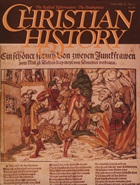
The Martyrs’ Mirror has been second only to the Bible in importance to the thought and history of the Anabaptists and Mennonites. This remarkable book had its beginnings in a pocket-size volume published in 1562 entitled Het Offer des Heered (“Sacrifice unto the Lord”). In 1631 Hans de Ries enlarged the collection of martyr stories. Finally in 1660 the martyrologist van Braght updated and enlarged the collection of stories. In 1685 the largest edition ever produced included engravings by the Dutch artist Jan Luyken. The weight of this edition is 17 1/2 pounds and measures 16 1/2 x 11 x 7 inches.
Jan Luyken may well be the very kind of young man from a Dutch Mennonite home of the 17th century that Thieleman van Braght was attempting to speak to when he published his first edition of the martyrology in 1660. Luyken was far more interested as a young man in the bohemian artist’s life of wine, women and song than in the appeals of his pious Mennonite mother. In 1672 he married a woman from a chorus called the “Amstelhymphlets” which entertained at a tavern called the “Sweet Rest” which Luyken and his friends frequented.
In time, Jan Luyken matured and became more serious about life and his Christian faith. Luyken’s art and writing also changed. No longer was he willing to write and paint in worldly motifs. By 1675 Luyken had given all of his artistic gifts to the telling of the church’s story. Art historians today know of 3,275 different works of art that Luyken produced. Thus it was in 1685, twenty-one years after the death of van Braght, that van Braght’s 803 stories of Anabaptist martyrs and Jan Luyken’s gift as an engraver-illustrator were brought together in one volume. Luyken created 103 copper etchings to illustrate the 1,290 page book that would prove to be a reminder to all future generations of Mennonites that to follow Christ means to take on his suffering.
The Martyrs’ Mirror has not simply been a book that is an antiquarian’s fancy. For over three hundred years various generations of Mennonites have rediscovered the power of its message. In colonial America Mennonite leaders became alarmed that their young people did not completely understand or embrace the nonresistant way of historic Mennonitism. Leaders of the church in the Franconia, Pennsylvania Mennonite Conference resolved to have the old Dutch martyr book translated into German in 1748 so that the young people would know and understand their own theological lodestar. Then in 1812 as a result of his reading of Martyrs’ Mirror, Klaas Reimer began a renewal movement among Russian Mennonites and this volume served to fuel the 1860’s renewal movement among Mennonite Brethren in Russia. Mennonites once again found guidance from the pages of the Martyrs’ Mirror when Adolf Hitler came into power in Germany. In 1933, drawing on the theology found in the pages of the Martyrs’ Mirror, a Mennonite, Ethelbert Stauffer, wrote a long article entitled, “The Anabaptist Theology of Martyrdom,” in a leading German magazine.
Has there been a continuing vision? There are 28 complete editions of the Martyrs’ Mirror—three in Dutch (the most recent printed in 1984),12 in German, and 13 in English—and numerous excerpted versions. For some Anabaptist descendants the drama of the martyrs is not very glamorous in an era of accommodation to the world. The Amish and conservative Mennonite groups continue to find the stories a source of encouragement in their countercultural stance.
In its story of men, women, and teenage martyrs, the Martyr’s Mirror continues to speak forcefully to the question: Must followers of Christ suffer for their faith? Its tales are meant to keep the truth—of course the oppressed are then emboldened by them, and those weak of conscience, convicted.
Joseph S. Miler is archivist and administrator of the Mennonite Historians of Eastern Pennsylvania.
Copyright © 1985 by the author or Christianity Today/Christian History magazine.
Click here for reprint information on Christian History.

Support Our Work
Subscribe to CT for less than $4.25/month