Principalities and Powers: Authorities in Conflict


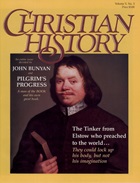
The events of Bunyans life were played out in 17th century England. It was a time when politics and religion were inextricably intertwined, and both state and church were facing major conflicts.
King and Parliament in Conflict
King James I (who ruled 1603–1625) alienated Parliament with his high-handed methods and declarations of the divine right of kings, seeing no reason why his royal power should be questioned. Under his rule the opposition groups in Parliament united against him, merging lawyers concerned for the traditional common law, and the Puritans desiring to reform the Church of England.
When James’s son Charles I took the throne (1625–1649), the opposition between Parliament and crown was well developed. The issues were debated throughout England in a heated war of pamphlets, with its share of treasonous statements and resulting imprisonments. Parliament enacted the Petition of Right, bringing a number of specific limitations to the king’s power. In opposition, Charles attempted to rule without Parliament —none was called into session from 1629–1640.
Charles I repeatedly offended the religious sensibilities of the Puritans. Though Charles was Anglican, he allowed strong Catholic influences in his court—particularly evident in the priests at his Catholic wife’s chapels, and in artists and artwork from Italy and France. Protestants also resented Charles’s indifference to the Catholic Hapsburg rulers, who were battling Protestantism throughout Europe during the Thirty Years War (1618–1648). Charles’s archbishop of Canterbury, Archbishop Laud, angered Puritans with his insistence on the Anglo-Catholic liturgy of his Prayer Book and his continual attempts to reform church ritual.
The dispute between King and Parliament, between divine right and common law, between high-churchmen and Puritans escalated. Faced with rebellion in Scotland, and in desperate need of money, Charles was forced to summon Parliament. Parliament asserted its authority, then raised an army against the king.
The English Civil War
The English Civil War lasted from 1642 to 1646, pitting the king’s army (known as Cavaliers) against the Parliamentary forces (known as Roundheads). The Parliamentary army included Puritans and other religious dissenters as well as political opponents of the monarchy. (Bunyan served in the Parliamentary army from 1644–1647, though he may have seen no action. This experience exposed him to Puritans and Separatists who took their religious profession seriously.)
Parliament continued to sit during the war, but as its numbers and strength dwindled, control shifted to the Parliamentary army. The Puritan Oliver Cromwell arose as the most capable military and political leader of the Parliamentarian cause.
The Parliamentary forces defeated Charles I, who was tried and executed in 1649. Faced with a divided and ineffective Parliament, Cromwell assumed greater power, establishing an efficient military dictatorship as Lord Protector of the Commonwealth.
The Protectorate
Cromwell reformed the courts and the system of taxation, and established a new system of church government. A minister could choose any Puritan system, as long as his congregation would follow, organizing his church along Presbyterian, Independent, or Baptist lines. Any who objected to the system in their parish were free to form separate congregations. Even Jews, who had been banished from England for more than three centuries, were allowed to return. This freedom of worship did not extend, however, to Catholics or high-church Anglicans, whose forms of worship were forbidden. The Puritan concern for godly living became a matter of law, modeled on Calvin’s Geneva—theaters were closed, Sabbath observance was enforced, and moderation in dress and manners was legislated.
Cromwell’s policies allowed Puritanism and other non-Anglican forms of Protestantism to gain a strong foothold in England. It was during this period that Bunyan came under Gifford’s ministry, was baptised, and began to preach and write.
Cromwell was not able to solve the constitutional problems of the Commonwealth, or to provide all the liberties the Parliamentarians had fought for: a free Parliament and freedom of speech and press. The middle and lower classes did not receive the political rights they had fought for—such rights were still tied to class origins and ownership of property. After Cromwell’s death, the Protectorate survived only two years.
The Restoration
In 1660 Charles II (son of King Charles I) returned from exile in France and Holland to a willing reception by a nation eager for the stability of monarchy. King Charles II was a popular and capable ruler, who used his astute political skills to restore the power of the monarchy and forge a workable relationship with Parliament.
The restoration of the monarchy brought with it the restoration of the Established Anglican Church. Charles had promised liberty of conscience, but it was not long before Puritan and Non-conformist worship was systematically repressed through a series of laws known as the Clarendon Code. In 1662, Parliament passed the Act of Uniformity, requiring episcopal ordination for all ministers and reimposing the Book of Common Prayer. In 1664 the Conventicles Act forbade religious meetings which did not follow the forms of the Established Church. Thousands of clergymen who could not comply with a clear conscience were cut off from their ministries and livelihoods, and jails filled with Non-conformists who refused to be silenced. So it was during this period that Bunyan spent twelve years in prison, from 1660–1672.
The two opponents of the Anglican church, Non-conformists and Roman Catholics, both faced suspicion and persecution. Anglicans associated Non-conformity with the Puritan revolution against the monarchy, and thus considered it subversive and dangerous. English Catholics were viewed as potential traitors by most of the population. In contrast to his kingdom, Charles II himself had Catholic sympathies, though he concealed this until the end of his life.
A desire to favor Catholics was a likely motivation behind the Declaration of Indulgence Charles issued in 1672, suspending all laws against both Catholics and Non-conformists. It was under this provision that Bunyan was finally released from his long imprisonment. Opposition in Parliament led to its revocation the next year. (Bunyan was able to remain free, except for a six-month imprisonment in 1677.)
Out of the religious and political , turmoil of this period emerged the beginnings of the two political parties that would later dominate English politics. The conservative party (Tories), supported primarily by the landed gentry and country clergy, supported the king and Anglican church, and opposed religious Non-conformity and the newer wealth of the middle class. The opposition party (Whigs) found its leadership among powerful nobles, but also included merchants and financiers, low-church clergymen, and Non-conformists.
The greatest crisis of Charles’s reign was the Popish Plot in 1678, when it was announced that secret information had been obtained concerning a Catholic plot to murder Charles and establish Roman Catholicism in England. This was a fabrication, an attempt to stir up panic and exclude Charles’s Catholic brother and heir, James, from succeeding him. It failed to exclude James, but brought the Whigs and Tories into sharp conflict.
Upon the death of Charles II in 1685, the Catholic James II came to the throne. His policies brought increasing opposition as he declared his right to overrule Parliament, issued the Declaration of Indulgence (which gave freedom of worship to Catholics and Non-conformists), and began appointing Catholics to positions in the government, army, and universities.
The Glorious Revolution
With both Anglicanism and the rights of Parliament in jeopardy, secret negotiations were made to bring the Protestant leader William of Orange of the Netherlands to England. James fled, and William III and his wife Mary, a Protestant daughter of James II, were established as co-rulers.
William’s reign (1689–1702) showed the influence of the Whigs, who were largely responsible for the Bloodless Revolution which put him in power, and was the beginning of a more tolerant period. The Bill or Rights (1689) limited the king’s power, established the authority of Parliament, and guaranteed important individual rights. The Toleration Act (1689) assured freedom of worship for religious dissenters. Bunyan had died the year before, in 1688.
Copyright © 1986 by the author or Christianity Today/Christian History magazine.
Click here for reprint information on Christian History.

Support Our Work
Subscribe to CT for less than $4.25/month