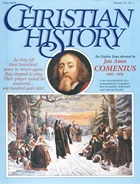
Between Hus and Herrnhut


Comenius and the Unity of the Brethren
The Reformation started by John Hus (1369–1415) in Bohemia did not die when he was burned at the stake. A number of small communities spun off from the Hussites, each rebelling against Rome in its own ways. The first “Brethren” moved to a remote village called Kunvald in 1457 to live together as the early church did, and follow the law of Christ.
From the start, the Unity of the Brethren, as they became known, had contacts with the Waldensians, a communal group that preserved the teachings of Peter Waldo from the twelfth century, promoting equality of believers and opposing ecclesiastical hierarchy. Significant also for the Unity’s founding was the thought of Peter Chelcicky, who condemned the use of force in matters of faith and the participation of Christians in political power struggles, especially in war. Chelcicky dared to call the Pope and the emperor “whales who have torn the net of true faith,” since they had established the Church as the head of a secular empire.
These ideas, denial of material aspirations and refusal of secular power, as adopted by the Unity, did not sit well with the authorities. The Unity was outlawed and persecuted by secular and religious powers alike, but its numbers grew, new communities were formed, and its influence went far beyond its ranks.
Despite their commitment to Christlike poverty, the Brethren presented the Czech nation with a wealth of spiritual resources. They translated the Scriptures into Czech; they composed hymns that are still sung in Czech churches today; they published a confession of faith praised by Luther, and left an unmistakable mark on the Confessio Bohemica (Czech Confession)—the first ecumenical confession the world had seen.
The Exile
Jan Amos Comenius stands as the most notable figure in the Unity, though the church was dying out during his lifetime. The death blow was their banishment from their homeland, Bohemia, after the Battle of White Mountain in 1620.
Leading a group of exiles over the mountains into Poland, Comenius prayed that a “hidden seed” of this faith would grow and bear fruit. But that prospect looked dim in the ensuing years, as the Brethren dispersed throughout Europe. Some fled with Comenius to Poland; some to Transylvania (now part of Hungary); some to Germany. Wherever they went, they found persecution, caught between Lutherans, Calvinists, and Catholics.
The Hidden Seed Did Grow
By 1650, Comenius had written a treatise entitled “The Bequest of a Dying Mother, the Unity of Brethren, by which, ceasing to exist in her own nation and her separate individuality, she distributes among her sons, daughters, and heirs the treasures which God entrusted to her.”
In this bequest for his “dying church,” Comenius called for reformation in the Bohemian and Polish Unity, in the “beloved sisters, Protestant communions,” and in “our mother who has borne us, thou Church of Rome.”
In what sounds like the ecumenical language of today, Comenius wrote: “To all Christians together I bequeath lively desire for unanimity of opinion and for reconciliation among themselves, and for union in faith, and love of the unity of spirit.”
In 1660 Comenius published the Ratio Disciplinae, a Latin book containing a history of the Brethren’s church and the essentials of their faith. He dedicated the book to the Church of England and urged that communion to care for his beloved Unity. “If there is no help from man, there will be help from God,” he wrote in hoping against hope for the church’s faith to be preserved.
Herrnhut
In 1722, a few Moravian pilgrims went across the border from Bohemia and Moravia to the estate of Count Zinzendorf in Silesia, Germany. There they found refuge and encouragement from the Lutheran nobleman. They called their settlement Herrnhut. These new Brethren adopted much of Zinzendorf’s pietism, but the legacy of the old Unity remained alive among them.
On August 13, 1727, there was a revival in Herrnhut, a spiritual explosion of sorts which prompted widespread missionary fervor. The Herrnhut community sent missionaries to the Americas, and eventually throughout the world.
The preparation for that August 13th renewal came from the count’s reading of a copy of Comenius’ Ratio Disciplinae at a library in Zittau earlier that year. It helped Zinzendorf understand the depth of the Moravian faith and the reason why the refugees were saying, “God has brought us here so that He might restore our Church.” Zinzendorf used the Ratio Disciplinae as the basis for a new “Brotherly Agreement” which he developed as the standard for the faith and life of the Herrnhut community. This document (revised many times) continues to be the “Brotherly Agreement” or the “Covenant for Christian Living” for the Moravian Church today.
There was also a personal tie between Comenius and the renewed church. On November 5, 1662, Peter Jablonsky (Comenius’s son-in-law) was consecrated a bishop of the Unity. His son, Daniel Ernest Jablonsky, was also consecrated a bishop, and when the renewed Moravian Church sought the consecration of its first bishop, David Nitschmann, in 1735, it was Daniel Ernest Jablonsky who officiated at the service.
The Discipline
A part of the discipline of Bishop Comenius which was bequeathed to the Moravian Church was his hope and prayer that all the world should come to know the saving Word of God. Comenius struggled all his life to educate all people. With his Janua Linguarum, he unlocked languages so that the rich and poor could learn to read. He prayed earnestly for the day when “peace would come” to all lands, but he knew that the only true peace came from knowing Jesus Christ, the Savior.
In his Labyrinth of the World, Comenius’s pilgrim finally is taught to know Christ, and the Christ tells the pilgrim: “Thou hast seen, when among the scholars, how they strive to fathom all things. Let it be summit of thy learning to seek me in all my works, and to see how wondrously I rule thee and everything… But thou must seek all this learning, not that thou mayest please others, but that thou mayest come nearer to me.”
In the band of Brethren who came to Herrnhut, Zinzendorf sensed a community dedicated to one concept: “serving the Savior to save the world.” The seed grew in Herrnhut, but it did not stay there. The strength of the church which was renewed came when it reached out from the small Silesian community into the world with the simple gospel message. David Nitschmann and Leonard Dober became the first missionaries to the West Indies. Others followed to Greenland, to Africa, to Asia, to North America. The “hidden seed” came to life and bore fruit for the Savior throughout the world.
Copyright © 1987 by the author or Christianity Today/Christian History magazine.
Click here for reprint information on Christian History.

Support Our Work
Subscribe to CT for less than $4.25/month