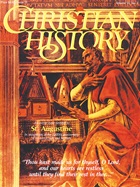
The City of God: Augustine's Timeless Classic About the Timeless City


Rome’s empire was collapsing. It had been a Christian empire for the better part of a century, but now the barbaric Goths were kicking in its doors. So Augustine tried to shore up the faith of his flock with a book he called The City of God.
Written more than 15 centuries ago, it is now an undisputed classic. Begun in 413 A.D. and appearing in installments over the next 13 years, Augustine’s masterpiece has spawned innumerable other books and articles since. Later philosophers and theologians have been deeply influenced by it, with its impact being felt from literature and historiography. Its greatest influence has been within the Christian church itself, as one might expect of a book written by a bishop who was a great theologian as well as philosopher and administrator.
It was written in response to a particular historical context. In 410 A.D., Alaric and his Goths, Germanic barbarians from the north, sacked Rome. Since Rome had been undisputed queen of civilization for a millennium, her fall shocked the ancient world. As Jerome put it, “The whole world perished in one city.” Josef Pieper notes, “To Augustine himself and to all with whom he dealt, Rome was nothing less than the symbol of order in the world.” Many blamed Christianity for Rome’s fall, suggesting that the pagan gods were angry because Christianity had been promoted by the empire. Augustine’s answer was The City of God.
The book covers an astonishing range of topics. As one might expect from its title, it contrasts “the City of God” with “the city of men.” But it also deals with creation, time, the origin of evil, human freedom, divine knowledge of the future, the resurrection of the body, final judgement, happiness, the Incarnation, sin, grace, and forgiveness (among others). The sheer scope of the work is impressive.
Equally impressive is the quality of Augustine’s discussions. He offers broad, deep, rich, and generally clear analyses of very difficult topics—topics on which it is easy to write obscurely and foolishly. Even where one is inclined to disagree, one can still learn much from him.
Further, he is often simply eloquent. Consider, for example, his brief description of the core of Christianity: “God’s son, assuming humanity without destroying his divinity, established and founded this faith, that there might be a way for man to man’s God through God’s man.” To the suggestion that human beings can be saved from their sins by their own efforts, without God’s grace, his terse reply is: “Without him, what have we accomplished, save to perish in his anger?” Concerning human suffering as evidence of God’s non-existence or unconcern, he writes: “Our God is everywhere present, wholly everywhere; not confined to any place. He can be present unperceived, and be absent without moving; when he exposes us to adversities, it is either to prove our perfections or correct our imperfections; and in return for our patient endurance of the sufferings of time, he reserves for us an everlasting reward.” These are pithy, thought-provoking answers to difficult questions. Not that these are the only answers, but it is clear that Augustine has something to say, and generally says it very well.
The basic reason for his perpetual influence is very simple: much of what Augustine offers his readers is a very blunt statement of Christianity. He sees, and forcefully states, some of the most basic implications of the Christian gospel. That gospel, to use a contemporary term, is a message of “tough love”— and he sees no other sort of love that is really worth having.
Christianity has often been presented as a solution to the problem of success: everyone needs to succeed and God offers success to those who will believe. Success, in turn, tends to be defined in terms of power, financial security, and possessions. Presentations of this sort, parading as Christianity, abound in American culture. Augustine, like the New Testament itself, has no such “gospel.” It is true that preaching that sort of message would make one sound a little shallow against the backdrop of the collapse of a civilization. But it was never Augustine’s message, and what he said before the fall of Rome was not something he later had to modify in the face of the war, cruelty, poverty, and death that came with that fall. After all, regardless of what cities rise or fall, death and suffering face every human—both us now and those alive in 410 A.D. Any “gospel” worth hearing has to face this fact squarely.
Many lost all that they had to the conquering armies. To these people, Augustine wrote: “Our Lord’s injunction runs, ‘Lay not up for yourselves treasures upon earth, where moth and rust corrupt, and where thieves break through and steal: for where your treasure is, there will your heart be also.’ And they who have listened to this injunction have proved in the time of tribulation how well they were advised in not despising this most trustworthy teacher and most faithful guardian of their treasure. For if many were glad that their treasure was stored in places which the enemy chanced not to light upon, how much better founded was the joy of those who, by the counsel of their God, had fled with their treasure to a citadel which no enemy can possibly reach…those who are now repenting that they did not obey him have learned the right use of earthly goods, if not by the wisdom which could have prevented the loss, at least by the experience which follows it.”
Augustine’s concern here is with the question of value, and the human nature that lies behind it. If a person is no more than a biologically sophisticated animal that lives for a few years on earth and then no longer exists, it is not unthinkable that a man’s or a woman’s life, insofar as it is worthwhile, does consist in the abundance of what he or she possesses—that the whole point of life is one of acquiring and enjoying as many things as one can, of seeking wealth and pleasure and power to the fullest extent available. But if a person’s life on this earth is but a small part of his overall existence, and if the purpose of life is fulfilled only if one loves God with all one’s heart, soul, mind and strength, and loves others as him or herself, then what Jesus said is appropriate.
People weigh the loss of possessions on different scales, depending on their view of human beings and human life. From Augustine’ s point of view, the real tragedy is not that one loses all of one’s possessions, but that one has loved those possessions in the first place. And he suggests that if losing them cancels out one’s love of them, then one has actually received a significant net gain.
Augustine’s perspective here, surely, is simply that of Christianity. He has taken the New Testament seriously on this point, believed it, and followed out its implications. Thus he says: “They lost all they had? Their faith? Their godliness? The possessions of the hidden man of the heart, which in the sight of God are of great price? Did they lose these? For these are the wealth of the Christian to whom the wealthy apostle said, ‘Godliness with contentment is great gain. For we brought nothing into this world, and it is certain we can carry nothing out. And having food and raiment, let us therewith be content.’” If Augustine is Christianly blunt about possessions, he is moreso about life itself: “But, it is added, many Christians were slaughtered, and were put to death in a hideous variety of cruel ways. Well, if this be hard to bear, it is assuredly the common lot of all who are born into this life. Of this at least I am certain, that no one has ever died who was not destined to die sometime. Now the end of life puts the longest life on a par with the shortest…That death is not to be judged an evil which is the end of a good life; for death becomes evil only by the retribution which follows it. They, then, who are destined to die, need not inquire about what death they are to die, but into what place death will usher them.” It is not that Augustine does not value life; it is that he values it, and death, from within a Christian framework.
In these areas, Augustine has looked squarely at what Christianity has to say about basic and difficult issues, seen it clearly, and communicated it forcefully. If there is a single reason for the continuing influence of his writings in a wide diversity of cultures and times, that is it.
As one might expect, Augustine was clearly aware of the existence and depth of evil. As can anyone who has eyes to see, he saw it both in his own heart and in the events of his day. He held that evil presupposed good in a way in which good does not presuppose evil; evil, he suggested, is good gone bad, but good is not evil reformed. He claimed that “… without doubt, wickedness can be a flaw or vice only where the nature previously was not vitiated. Vice, too, is so contrary to nature that it cannot but damage it. And therefore departure from God would be no vice, unless in a nature whose property it was to abide with God. So that even the wicked will is a strong proof of the goodness of the nature.”
Why should anyone accept the values that Augustine embraced, or his theology? Augustine offers an answer in the passage just quoted. He implies, for example, that unless there is value in being human, there is nothing wrong in destroying human life: unless there is value in being a good person, there is nothing wrong with being an evil person. And there is value, even in an evil person; that a person is evil does not mean that he or she may be destroyed. Human nature has worth. Only so can taking human life be wrong, and only so can it be wrong to remain always childish. Tragedy is the compliment that evil pays to goodness, and the greater the tragedy, the greater the good that is presupposed. As there is no higher good for us than to have been created in God’s image and redeemed by his love, there is no greater tragedy than the defacing of that image or the rejection of that love. Sin, even as it breaks God’s law, in its own way also testifies to the existence and nature of God. Thus even evil itself, which by many is seen as evidence against either God’s goodness or his existence, is for Augustine evidence that God exists and is good.
Earlier it was suggested that Augustine rightly saw the content of Christianity as a message of “tough love,” containing no promise to Christians of all-comfortable lives nor freedom from suffering. This comes through particularly clearly when he writes, “And who is so absurd and blinded as to be audacious enough to affirm that in the midst of the calamities of this mortal state, God’s people, or even one single saint, does live, or has ever lived, or shall ever live, without tears or pain …?” Augustine did not forget, as so many have, that a servant is not better than his Lord.
Another demonstration of his humble spirit in this work, though it is easily lost in the mass of profundities, is his scholarly modesty. It is both charming and revealing. For example, concerning Paul’s comments in 1 Thessalonians about the “mystery of iniquity,” he says, “I frankly confess I do not know what he means,” and goes on simply to tell us about interpretations that have been offered. Concerning the length of the “days” in Genesis, he writes, “What kind of days they were it is extremely difficult, or perhaps impossible for us to conceive, and how much more to say!” Willing to tackle the most difficult of topics, and able to do so with great skill, he is also able to admit ignorance and say that, for now anyway, he has gone as far as he can.
It would probably be wrong to not mention one other topic on which Augustine’s views are justly famous. If one holds that God created the world at a particular time, then it seems that there must have been a long time before he created anything. One might easily wonder why the world was created when it was, not, earlier or later. Augustine did not hold that God created the world at some particular time (or at several sequential moments of time either). He held that time itself and the world were created together and wrote that “assuredly the world was made, not in time, but simultaneously with time.”
The discussion of these themes, among many others, occurs in the overall context of a discussion of two cities. “The City of God we speak of is the same to which testimony is borne by that Scripture, which excels all the writings of all nations by its divine authority, and has brought under its influence all kinds of minds, and this not by a casual intellectual movement, but obviously by an express divine providential arrangement. For there is written, ‘Glorious things are spoken of thee, O City of God.’” Elsewhere he adds, “These two cities were made by two loves: the earthly city by the love of self unto the contempt of God, and the heavenly city by the love of God unto the contempt of self.” It is important to keep in mind that the “contempt of self” Augustine mentions is not contempt of human nature that has been created in God’s image and been restored in repentance and faith. Rather, it is contempt of the human nature that is asserting its independence of God. He says God “speaks to that part of man which is better than all else that is in him, and than which God alone is better. For since man is most properly understood (or, if that cannot be, then at least believed) to be made in God’s image, no doubt it is that part of him by which he arises above the beasts, which brings him nearer to the Supreme. But since the mind itself, though naturally capable of reason and intelligence, is disabled by besetting and inveterate vices, not merely from delighting and abiding in, but even from tolerating his unchangeable light, until it has been gradually healed, and renewed, and made capable of such felicity, it had, in the first place, to be impregnated with faith, and so purified.” It is a person who is “disabled by besotting and inveterate vices”—a self-love that loves others less and God less still—that Augustine describes as worthy of contempt, not merely by God but by himself.
All of this barely scratches the surface. Its point is not to try to discuss, even briefly, all the topics Augustine discusses in The City of God. Nor is there any intention to deny that Augustine was, as they say, “a man of his time” with the limitations, and advantages, that were his by virtue of being part of ancient Western culture and not some other. The point is that Augustine’s theology and philosophy deal with various, even transcultural topics, problems and concerns. What he said then is relevant now. It is, frankly, far better reading than the books of many contemporary theologians and philosophers. Similar to the eternal City of God, it has stood when more superficial entities have fallen.
Keith E. Yandell is chairman of the philosophy department at the University of Wisconsin in Madison
Copyright © 1987 by the author or Christianity Today/Christian History magazine.
Click here for reprint information on Christian History.

Support Our Work
Subscribe to CT for less than $4.25/month