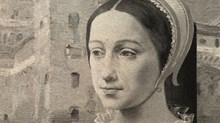
Paula: A Portrait of 4th Century Piety


One of several Roman noblewomen who supported the work of the scholar Jerome, Paula became his fast friend and colleague. As part of her Christian commitment, she changed her lifestyle from Roman richness to strict asceticism. Noted historian Nancy Hardesty details Paula’s devotion.
“She was squalid with dirt; she mourned and she fasted … her eyes were dim with weeping … the Psalms were her only songs; the gospel her whole speech; continence her one indulgence; fasting the staple of her life.” Thus Jerome (347–420, in Letter 45) describes the piety of his close friend and most generous benefactor: Paula (347–404).
Jerome first met Paula in Rome in about 382. She was one of a group of high-born women who devoted themselves to strict asceticism and benevolent service. The leader of the group was Marcella (325–410), an ardent student of the Bible to whom Jerome referred questions from bishops and presbyters after he left the city. With her friend Principia, she opened the first convent for women. The group included Ascella, Albina, Marcellina, Felicitas and Fabiola.
From Wine to Water
Formerly these women had devoted their lives to family and fashion. Since it was the custom for older men to marry much younger women, most of them had been widowed at an early age. Before becoming Christians, they had dressed in silks, Chinese fleeces and gold brocades. They rouged their faces, darkened their eyes with kohl, plaited blonde hair pieces into their own dark hair, wore gold shoes, and were carried everywhere on litters borne by eunuchs.
But when they became Christians they forsook all that, and adopted simple brown cassocks. They no longer ate meat or sweets, but took only bread and a little oil. Many drank no wine, only water.
Their lives came to revolve around charity—blankets for the poor, money and food for the bed-ridden, burial for the paupers. With the help of Paula’s widowed son-in-law, Pammachius, Fabiola founded Rome’s first hospital.
Paula was the daughter of Blesilla, a descendant of the Scipios and Gracchi families, and of Rogatus, whose Greek family was said to descend from the Greek king Agamemnon. At 17 she married a senator, Toxotius, whose most—famous relatives were Aeneas and Julius Caesar. Together they had four daughters—Blesilla, Paulina, Eustochium and Rufina—and one son, Toxotius, who was just an infant when his father died in 380. Shortly thereafter, through the witness of Marcella, Paula became a Christian.
When the bishops of the Western church gathered in Rome in 382 to determine their response to the Eastern church’s 381 Council of Constantinople, Paula hosted Epiphanius, the bishop of Salamis in Cyprus. Later during the council she met Jerome, who had also attended the Constantinople conference.
She and the other noblewomen studied the Scriptures with Jerome, and adopted the austerities being popularized by Paul the Hermit (whose biography Jerome had written), by Anthony, by the two Melanias, Elder and Younger, and by the others who were fleeing into the deserts of North Africa to devote themselves to God. Paula’s daughter Blesilla, having been recently widowed after just seven months of marriage, began rigorous fasting and other austerities. Within three months she was dead. Some said that the public reaction to her death, directed against Jerome, hastened his departure from the city in 385.
Following Jerome
He urged Paula to follow him, and soon thereafter she and her daughter Eustochium sailed for the East, leaving on the shore her daughter Rufina sobbing and little Toxotius stretching out his hands in entreaty. Jerome notes that while “no mother… ever loved her children so dearly,” Paula “overcame her love for her children by her love for God.”
After visiting Bishop Epiphanius on Cyprus, Paula and Eustochium sailed to Antioch to see Bishop Paulinus. From there they toured the Holy Land, some of the first Christian women to do so. And though it was midwinter, Paula rode simply on an ass.
Among other places, the two women saw “the humble abode of Philip and the chamber of his daughters, the four virgins ‘which did prophesy’ ”; the mausoleum of Helen, queen of Adiabene, “who in time of famine had sent corn to the Jewish people”; “the blood-stained column to which our Lord is said to have been bound when he suffered his scourging”; Rachel’s tomb; and the home of Sarah where they “beheld the cradle of Isaac.” Paula even kissed the stone the angel had rolled away from Christ’s tomb, and “licked with her mouth the very spot on which the Lord’s body had lain.”
Mother and daughter continued into Egypt, visiting all the hermits of the desert, then returned to Bethlehem. There, for three years, they lived in a mud hut while they built a monastery for Jerome to oversee, as well as three convents for women, which Paula eventually supervised. They also built a chapel, and a guest house for pilgrims, the sick, orphans, the elderly, the destitute and any others who were needy.
Paula was one of many Greek and Roman women of this period who gave of their wealth to build the institutional church. Paula was said to own most of the city of Nicopolis near Actium. But once converted, she vowed she would become poor for Christ’s sake. When she had given away her own wealth, she took loans in order to continue her good works. Finally, reported Jerome, “she obtained her wish at last, and died leaving her daughter overwhelmed with a mass of debt.”
Ascetic, Philanthropist, Scholar
From the time of her husband’s death until that of her own, Jerome tells us, she never ate a meal with a man, no matter how holy or venerated he was. She never entered a bath, except when dangerously ill. Even when she suffered from fevers she slept only on the hard ground, covered with a mat of goat’s hair; and most nights she prayed rather than slept anyway.
Jerome’s great work was translating into Latin the Septuagint (the Greek Old Testament) and the Greek writings of the Christian canon. His translation is known as the Vulgate. Paula not only paid his living expenses, she also gathered and purchased the expensive manuscripts and supplies needed for his work. Within her convents, she and the other women copied manuscripts by hand in order to facilitate their use and to preserve them. For the next 1,000 years, nuns and monks were to continue that work, preserving for us not only Scripture and commentaries on it, but also other theological works, and cultural works of the ancient world.
But Paula was more than the scholar’s financial support; she shared with him the work of translation. Having learned Greek from her father, Paula was eager to learn Hebrew from Jerome. He found her an apt pupil, saying she “succeeded so well that she could chant the Psalms in Hebrew and could speak the language without a trace of the pronunciation peculiar to Latin.” She gave him inspiration, intellectual stimulation and critical response. To her and her daughter Eustochium, Jerome dedicated his versions of Job, Isaiah, 1 and 2 Samuel, 1 and 2 Kings, Esther, Galatians, Philemon, Titus and the 12 minor prophets.
Some criticized him for dedicating his books to women, but Jerome responded, “These people do not know that while Barak trembled, Deborah saved Israel; that Esther delivered from supreme peril the children of God … Is it not to women that our Lord appeared after His resurrection? Yes, and the men could then blush for not having sought what women had found.” Ironically, however, a new Roman Catholic edition of the Today’s English Version of the Bible, which is being advertised as “St. Jerome’s Bible,” does not mention Paula once in its lengthy introduction.
An Unusual Couple
Jerome was a very difficult man, and he himself admits that Paula was the only woman who had power to subdue him—she was probably the only person with enough patience to work with him as well. Their friendship illustrates an interesting ambivalence about women in the 4th-century church. Like many of the earlier church fathers, Jerome equated “woman” with “body,” and thus with sexuality and evil. He wrote with total disgust of the life of the average woman. In a letter written about 403 concerning the upbringing of Paula’s granddaughter, Jerome said she should not be taken to the baths, because there she might see the totally revolting sight of a pregnant woman. Indeed, she should not be given baths, because any woman should find the sight of her own body disgusting. He considered marriage, sexual relations, giving birth, mothering children, and attending to one’s hair, clothes or face as repulsive. From reading Jerome’s comments, one might think he despised women.
Yet his descriptions of Paula, Eustochium, Marcella and the other women of their circle are filled with genuine affection, friendship and respect. Once a woman had adopted a celibate lifestyle, became a “virgin” and devoted herself to Christ, Jerome supported her choices and gave her every encouragement. In his several letters to and about women, he often lauds their spirituality as far superior to his own. In his tribute to Paula after her death (Letter 108), he constantly describes her spiritual practices as more rigorous than his own, and cites many occasions when her faith and spiritual wisdom exceeded his.
Paula died at Bethlehem at age 56. Six bishops carried her to a grave near the place where Jesus was born. The whole population of Palestine came out for the funeral—even the desert monks and virgins. For three days they chanted the Psalms in Greek, in Latin and in Syriac, for the sake of this woman who was, as Jerome said, “one of the marvels of the Holy Land.”
Nancy A. Hardesty, a church historian who lives in Atlanta, Ga., is the author of Great Women of Faith (Abingdon) and Women Called to Witness (Abingdon). Her most recent book is Inclusive Language in the Church (John Knox).
Copyright © 1988 by the author or Christianity Today/Christian History magazine.
Click here for reprint information on Christian History.

Support Our Work
Subscribe to CT for less than $4.25/month