The Benevolent Tradition: The Charity of Women


Jesus’ portrait of the charitable woman in Mark 12:44 is the emblem of a continuous tradition within the Church: A feminine tradition of benevolence born in spite of cultural restrictions. Consider his description of this poor widow who donated two copper coins to the treasury: “… she gave everything she had, her whole being.” In another time this woman might live in a castle or a cloister, a settlement or a city, but, although less likely to receive from her contemporaries the recognition Jesus gave her, her philanthropic spirit would continue to express itself through acts of financial sacrifice.
Like the scribes, Christ often had his material needs met by women. But, unlike the scribes, he did not “devour widow’s houses” (Luke 20:47). The group of Galilean women who accompanied Jesus in his travels, and who ministered to him and the disciples, as Luke 8:3 says it, “out of their means,” included Mary Magdalene, Joanna, Susanna, and “many others.” They were treated as companions, an anomaly in a culture that transferred a woman from the guardianship of her father to that of her husband. These arrangements included financial control as well; a woman rarely took responsibility for her own funds until her husband’s death, or until her husband decided to divorce her.
“I tell you the truth, this poor widow has put more into the treasury than all the others. They gave out of their wealth; but she out of her poverty put in everything—all that she had.” Mark 12:43–44
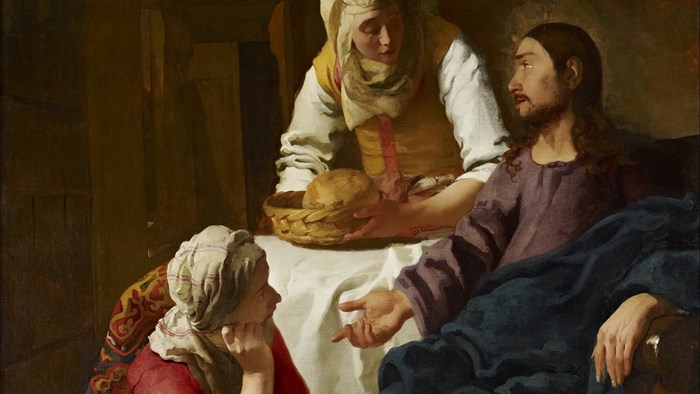
It is unclear how these women freed themselves from the familial and financial structures of first century Palestine; it is clear that Jesus gratefully accepted their support. The reciprocity of these relationships is clearly seen between Christ and Mary of Bethany. Because of her love and gifts of hospitality, he allowed her to sit at his feet and learn. In response, as recorded in John 12, she took an “alabaster flask of pure nard, very costly,” and anointed him. The oil was worth about 300 denarii—almost a whole year’s wages for a vineyard worker. Her sense of the greater purpose of Christ’s mission inspired her to make this costly temporal sacrifice.
In New Testament times women were restricted from roles of leadership. The apostle Paul, within these limitations, followed Christ’s example of acceptance and validation of female support. He cites three women who supported churches within their homes: Priscilla, who was in business with her husband Aquila, Chloe in Corinth, and Nympha of Colosse. These hostesses must have had some wealth to use as a bridge of authority between the domestic and ecclesiastical realms.
Lydia, another businesswoman of the early Church, is described as a “dealer in purple” (Acts 16:14). Though a Gentile, she attended Jewish services and supported the synagogue. She became the first convert from Paul’s preaching in Europe, and established and supported a church for the people of Thyatira, as well as a refuge for Paul.
Two of the five basic offices established in Acts and the Epistles were made up of women: “widows and deaconesses.” Both were ministries of charitable service. Leadership was maintained through service. Paul describes Phoebe, a deaconess in the church at Cenchreae, as a prostatis. In its technical usage this term referred to a legal representative of strangers who were deprived of civil rights, or to a patron. Phoebe, “a helper of many and of me [Paul] as well,” (Rom.16:22) apparently provided financial aid, and possibly legal assistance.
Early Servants
Widows and deaconesses continued their charitable work throughout the early centuries of the Church. Olympias (368–408), a deaconess in the church at Constantinople, used her inheritance to buy the freedom of hundreds of slaves, give to the poor, relieve suffering, and to build a monastery. She, along with many other Christian women in her time, chose the humility of poverty over the comforts of wealth.
In the late fourth century, the Church Father Jerome was supported by several dynamic and affluent patronesses, including Paula, an aristocratic Roman widow. After her conversion, Paula lived an ascetic lifestyle, protesting against materialism and giving to the poor. She built monasteries, churches, and hospitals, and then followed Jerome to Bethlehem, where, with her money, they founded three nunneries and a monastery that served as sanctuaries for the needy. She helped Jerome in his work of translation, and bought rare books and manuscripts essential to his task. Jerome wrote of her, “What bedridden man was not supported with money from her purse?”
Medieval Times and Reformation
As the Church approached the Medieval period and continued to define its hierarchy, the offices of deaconess and widow were phased out. At the Synod of Orleans in 533 the office of deaconess was officially nullified “… on account of the weakness of this sex.” Women found alternatives for service within monastic communities, ministering to each other and to the needy. Entrance into these communities became contingent on wealth as nunneries demanded that postulants provide dowries. Increasingly, affluent families funded the building of monasteries as a sign of prestige. Yet in spite of this elitism and these less than spiritual motivations, the growing number of convents offered women opportunities for financial administration. At best, a woman might invest in the founding of a monastery, and, securing the position of abbess through her monastery donation, hold authority over the monks.
The cloistered seclusion of Medieval women had its advantages, considering the times, but it also limited their charitable outreach to the culture as a whole. With the Reformation, the young Protestant Church established the domestic world as the realm of women, and financial service was most often a gesture of hospitality. Women opened their homes and cupboards to Protestant travelers and refugees. Public ministry—typified by convent life—was condemned by the Protestants. Again only the wealthy could volunteer funds for benevolent causes: Lady Armyne (1594–1675) gave liberally for the conversion of Indians in New England; Isabella Bresegna (1510–1567) used her wealth to oppose papal authority during the Inquisition; Anne Pembroke (1589–1674) and Marie Miramion (1629–1696) poured their money into charitable concerns, particularly care for the poor and sick.
Puritans and the Awakening
During the colonization and denominationalism of the seventeenth and eighteenth centuries, women could find outlets for organized charity within dissenting religious movements. But if they were unable, or unwilling, to rebel against the standard of Church authority, they did not exceed their roles as wives and mothers. Puritan society allowed women limited control of financial affairs, but, as congregations became crowded with women, and many men withdrew from Church community, the contributions of women became harder to ignore. In acknowledging that women were “the hidden ones,” Cotton Mather challenged the nascent American Church to notice this element in the shadows. Puritan preachers began to praise women not only for their saintly qualities, but for their pragmatic abilities. Increase Mather wrote that his mother, “a woman of singular prudence for the management of affairs, had taken off from her husband all secular cares, so that he wholly devoted himself to his study, and to sacred employments.”
The Great Awakening of the 1730s and ’40s not only changed religious life, but initiated an onslaught of social change, affairs that were, without doubt, managed by women. Pragmatic virtues were stressed with a fervor reminiscent of the New Testament church. Although women still had no legal status (common law assured a husband’s control over his wife’s assets), and no real professional outlets, the Church encouraged women more openly, supporting their financial and moral contributions toward the revivals of the Awakening. Women could work for the salvation of their husbands and sons on the grounds that there was “neither male nor female” in the religious community.
19th Century Change
This spiritual rebirth pushed congregations out of their immediate worlds and an evangelical cause took hold. As in the first century, the missionary movement gave women the opportunity to play public roles. In spite of the many obstacles before the American Civil War, women organized themselves into numerous missionary societies, financing their efforts out of their household budgets. Most of their fund raising supported work directed by men. Sally Thomas (1769–1813) gave the first gift to the American Board of Commissioners for Foreign Missions, and although she received little money for her work as a housemaid, in her will she left all she had for missions.
The Civil War monopolized the efforts of the male missions directors and administrators, teachers and theologians, and it became necessary for women to oversee the causes they had thus far only supported. For the first time, the accepted social stigmas were actively questioned, and Christian women redefined their public roles. They supported relief programs, organized fund raising efforts for medical and devotional work among soldiers, and took charge of the transportation of women and children, caring for those left vulnerable because their usual guardians were away at war. Many women supported the Abolition movement and initiated ardent campaigns against slavery. Leaders such as Harriet Beecher Stowe, Julia Ward Howe, and Sarah and Angelica Grimke provided financial support for the organized effort. Emily Tubman (1794–1885) was a precursor of the Emancipation Proclamation; after her husband’s death, she freed her slaves and gave them homes and supplies.
With the conclusion of the war, women continued to use the administrative skills they had learned and invested their efforts in corporate work. Benevolent organizations fought the poverty that escalated as immigrants flocked to the cities. Similar organizations had existed in the early years of the 1800s. Isabella Graham (1742–1814) had established the Society for the Relief of Poor Widows With Small Children. Phoebe Palmer founded the Five Point Mission and provided schooling, religious training, and material needs for the poor; Elizabeth Seton founded the American Sisters of Charity in 1808, an organization that would establish the first Catholic hospital in America.
The war’s end and the success of the Abolition movement were the catalysts for an irrevocable spirit of change. Women administered and gathered funds for urban organizations like the YWCA. The Salvation Army welcomed the leadership skills of female members. Evangeline Booth (1865–1950), daughter of founders William and Catherine Booth, was the commander of the Salvation Army in America and the first general of the International Salvation Army. She was described as, “able to hold large audiences spellbound for hours,” and “adept at drawing large fortunes for the Army out of rich men.”
Francis Willard was a supporter and leader of one of the greatest humanitarian efforts of the nineteenth century: the Temperance Movement. She helped found the Women’s Christian Temperence Union, possibly the first major women’s organization active around the world. These White Ribbon Missionaries often incorporated evangelism into their work with men from all areas of society, and Willard, with her fellow workers, also funded efforts in Asia, Africa, and South America.
Willard’s lectures supported both Prohibition and Sufferage, for she felt that only women would vote for the laws that the White Ribbon Missionaries fought for. After Willard’s death, Union members continued to raise the funds for their work, until in 1919 the Eighteenth Amendment established Prohibition as law.
The White Ribbon Missionaries were a component of the larger evangelical work that mushroomed among women near the end of the nineteenth century. Female missionary societies organized “the work of women for women,” sending out female missionaries and supporting the schools and hospitals they founded overseas. Churches became amenable to separate boards for women, once it was demonstrated that they could raise money over and above the pledges made by men. The control that women had over the funds they raised, however, varied from denomination to denomination.
When Mehitible Simpkins formed “mite societies” in New England, female contributors, in the spirit of the Poor Widow, overwhelmed the Massachusetts Missionary Society with pennies. By 1880, 57 percent of the missionaries on the field were women, and the sixteen existing missionary societies had raised almost six million dollars. In 1893, 60 percent of the missionaries were women and good publicity had continued to back massive fundraising efforts for these teachers, doctors, evangelists, and relief workers.
Charlotte (Lottie) Moon (1840–1912), a prototype of the single female missionary of this period, established a special Christmas offering with the women of the Southern Baptist Churches in 1888, raising funds to relieve the starvation that plagued China and supporting three additional woman missionaries. The offering continued to supply support in following years, but Moon, sharing the sufferings of those she served, died of starvation. In the years following her sacrifice, the Lottie Moon Christmas Offering grew to millions of dollars annually.
Forward and Back
By 1900, there were more than forty successful women’s mission societies in the United States alone. Yet in spite of their consistently strong administrative and fund-raising efforts, the early decades of the twentieth century saw the reorganization of these societies under male-run boards. With this merger, women lost control over projects and finances, as well as their active sense of unity. At the same time, as social service became professionalized, much of the control of benevolent organizations was relegated to men.
Regardless of these trends, the tremendous impact of the involvement of women in the nineteenth century cannot be denied; some historians have spoken of this time as the “feminization of American religion.” This phenomenon has extended into the twentieth century, as women continue what is, at times, the thankless work of fund raising for the greater cause of charity. Though feminine ministry has historically been defined in terms of service, rather than leadership, the statement throughout Christian history that women have made as they have anointed Christ’s mission with their gifts can be clearly heard, even in those eras when their voices are silent.
Karen Halvorsen is a visiting professor in the English department at Wheaton College In Wheaton Illinois.
Copyright © 1988 by the author or Christianity Today/Christian History magazine.
Click here for reprint information on Christian History.

Support Our Work
Subscribe to CT for less than $4.25/month