From the Editor: Father of Modern Revivalism


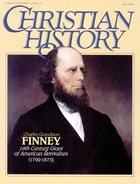
America has not been the same since the likes of Charles Grandison Finney. He is the giant of American revivalism between Jonathan Edwards and D. L. Moody. He was a powerful preacher and a commanding presence, even his enemies conceded as much. And what no doubt especially miffed his critics—and he had quite a few, and in high places—was the great popularity of the man. He has been called one of the most important figures in American history, and it would be impossible to understand the American religious experience without trying to understand him.
Finney has been likened to an Andrew Jackson of the pulpit. Comparisons between Jackson and Finney are understandable. James Johnson, in his biographical article Father of American Revivalism, tells us that if Jackson was America’s political folk hero, Finney was her religious one. And to many evangelicals today, Finney is still a hero (“imagine … 500,000 conversions!”). We have always been told (with some exaggeration) how Jackson was “for the common man.” Likewise, Finney did seem to grab the Gospel from the dry, stuffy practitioners of his day and take it to the common folk so they could scrape their boots, come in, and cast their own votes for heaven or hell. Yet Finney, interestingly, emphasized his impact on the professionals of his day, and liked to mention how he had converted scores of doctors, businessmen, and lawyers.
He was not a frontier ranter, but a child of the intellectual New England tradition, as it had moved west into upstate New York. He was described by his contemporaries as “frank, open, giving his opinion without solicitation, somewhat dictatorial.” “… the great actor of the American pulpit ,” with “glittering eyes, shaggy brows, beak-like nose, and expressive mouth.” One person is said to have remarked that for Finney’s stare to fall on you while he preached was to be lifted up and turned slowly over the fire. When Finney said hell, which he often did, the crowds it seems could smell smoke. He wanted them to. For, much to the anger of many in the “old establishment,” he called upon people to face the future options and decide for themselves their eternal bliss or torment.
It was inevitable that this law student-turned evangelist would set not only revival fires, but fires of controversy as well. The arguments flared up in his day and they still smolder. Many were deeply offended that he would reduce conversion to a mere human choice and thereby dismiss God’s sovereign grace in predestination. Arminians and Calvinists still square off on the matter. (Whether you shrink from such labels or not, they have important historical value. If this is a mystery to you, our glossary in this issue might help you see the important distinctions.) Finney represents great tensions in American religion after Jonathan Edwards. Issues of the nature of sin, human choice and predestination, holiness, and social change, all swirl around this: magnetic character. If, as has been said, American theological thought is a series of footnotes to Jonathan Edwards, American evangelistic practice could be called a series of footnotes to Finney.
This makes Finney a fascinating character, also a complex one. Just where he falls is no easy question. And as you will see from a few of our articles, historians have worked to understand the source of his ideas. Timothy Smith’s article The Blessing of Abraham, deals with Finney’s famous and controversial position on Christian perfection. Dr. Smith is one of this country’s finest historians and he has done extensive work on the 18th and 19th centuries. The influence of Wesleyan ideas on Finney and Finney’s influence on Holiness are of particular interest in his thought. Allen Guelzo is a historian with expertise in the area of Edward’s thought and its subsequent influence in American theology. In his article The Making of a Revivalist, he describes Finney’s connections within the Edwards tradition. He explains a continuity between Edwards and Finney that may make some Edwards enthusiasts pause a bit.
Garth Rosell’s article Sailing for the Kingdom of God will help you see how Finney took his revivals and ideas beyond America and had a large influence in the British Isles. Rosell and Johnson did doctoral dissertations on Finney and are known for their activity and expertise in the area.
It is hard to capture a character like Finney in a few pages, for his influence and importance touch many areas. For example, critics of modern revival methods consider him the great granddaddy of many modern pressure tactics. The manipulative methods some revival preachers have used to get folks to “decide now” in a fit of emotional instability are often said to have grown from the methods Finney used to confront his hearers with the ultimate choice. Though it is not accurate to credit him with inventing these methods, it is fair to ask if he should be held responsible for emphasizing debatable practices that are common in modern evangelicalism. He did deliberately scorn old ideas by his practice of calling for decisions on the spot, but it was not his style to whip crowds up into panic before popping the big question. Those who heard him preach reported he spoke calmly, persuasively—the lawyer logically arguing the case. Some followers were not so careful; one minister said, Finney had “imitators, who, as usual in such cases, [found] it easier to exaggerate his defects than equal his excellencies.”
Finney’s role in social change, especially in the areas of the antislavery movement and in women’s rights deserve special notice. We can only regret having limited space to devote to the subject. Any discussions of the role of evangelicals in opposing slavery and in fighting for women’s rights must give important credit to Finney and Oberlin College, where he taught. We must all admit, whether we agree with Finney’s ideas or not: He deserves credit for his influential stand on the dignity of all human beings. He was amazingly balanced amidst, on the one hand, radicals like William Lloyd Garrison, who were willing to blatantly twist Christian religion to their ends, and on the other hand, Christians who, tragically, used the Bible to defend slavery and to subordinate women. It’s hard for us to imagine: In Finney’s day most women were not allowed to even pray aloud in meetings with men present.
Rev. Lyman Beecher, a famous contemporary of Finney’s, said this when comparing Finney and Asahel Nettleton, the man whom Finney upstaged as America’s favorite revivalist: “The latter set snares for sinners, the former rode them down in a calvary charge. The one, being crafty, took them with guile; the other, being violent, took them by force.” Mainstream Jacksonian America was more a place for stampedes and fist fights than for subtle twists of cunning. When President Andrew “Old Hickory” Jackson died, it was said he still carried in his leathery hide eight bullets from duels (apparently they had been able to remove the others!). Finney was a tough customer too, but of a different sort. A man of spiritual fiber who dared grasp the moment, he may seem to many a maverick, brash, and even careless, in doctrine and in deeds. Maybe at times he was. But the winds of change were blowing hard, and he dared to roll up his sleeves and, regardless of the scoffing of many in ivory towers, enter the fight down on main street for the souls of men and women.
Copyright © 1988 by the author or Christianity Today/Christian History magazine.
Click here for reprint information on Christian History.

Support Our Work
Subscribe to CT for less than $4.25/month