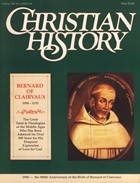
The Spirituality of St. Bernard of Clairvaux


The legacy of Saint Bernard of Clairvaux to 20th-century Christians, as multifaceted as it is, lies most significantly in his profound human psychology of self-esteem and self-awareness grounded in the mercy and love of God.
Bernard would be amused to find us talking about the characteristics of his spirituality, for his whole effort was directed at faithfulness to the traditional spirituality he had learned in school and at the monastery. This traditional medieval theology taught that men and women were created in the image and likeness of God, but that this image has been corrupted, tarnished, and distorted—but not destroyed—by sin. Because God shared our human nature in Jesus Christ, we can begin the journey from the “land of unlikeness” toward the “land of likeness,” toward the complete integration and reformation of the divine image from which we have fallen.
The journey will be complete only in heaven, but those who devote themselves to it with special intensity can, by the sheer grace and mercy of God, experience a fleeting foretaste of its heavenly destination on earth.
Monks and nuns give themselves to this reformation under the guidance of the monastic rule and the leadership of experienced spiritual directors. Precisely because they recognize their own limits and weaknesses, monks and nuns place the direction of their lives in the hands of others, who draw on the wealth of collective experience—tradition—to act as guides on the journey from the land of unlikeness.
Bernard belongs to this tradition. He was nourished and shaped by the language of the Bible. Monks understood their lives as a tasting of the sweetness of God’s Word as it came to them through “chewing on,” “rechewing” (ruminating), and “digesting” the honey of the Holy Scriptures and the writings of the past commentators on Scripture, the Church Fathers.
Guido II, head of the Carthusian monastic order (c 1176–1180) describes the process of reading (placing the grape of scripture in one’s mouth), meditating, or studying it in a variety of ways (crushing and chewing it), being drawn by the hint of its sweetness to beg God in prayer for an experiential encounter with the text, and finally, knowing Scripture’s Author in the loving embrace called contemplation. Contemplation, later called “mystical union,” is simply the experience of the love of God: the experience of God loving us, which in turn is what our love of God consists of.
Bernard is but one of the remarkable group of monastic authors from Benedictine, Cistercian, Carthusian, and other traditions, whose collective legacy places the 12th century alongside the fourth and 16th centuries as a truly outstanding epoch in Church history. Among Bernard’s Cistercian contemporaries, we should acknowledge Aelred of Rievaulx (1109–1167), whose writings, such as The Mirror of Charity, and On Spiritual Friendship, breathe a warm, humane, wise spirit that unfailingly moves the reader to a love of God and to human friendship.
We should also mention William of St. Thierry (c1085–1148), whose Golden Epistle, and The Nature and Dignity of Love, are only two of the profound explorations of the human soul and spirit from the 12th century. The insights into human psychology, and into the life of the spirit hidden in the mystery of Christ that are found in these writings can be studied and digested with profit by 20th-century Christians, if they are willing to slow down to thoughtfully read, ponder, chew, and savor these books until their wisdom melts in the mouth.
Though Bernard was very capable of writing “speculative,” or rational theology, such as his On Grace and Free Will, his favorite and more typical style of writing is running commentary on and explication of Scripture, rich with allusions, and with rhetorical, poetic imagery. This is perhaps best seen in his Sermons on the Song of Songs. However, even his meditative explications of themes from the spiritual life, as in On Loving God, and The Steps to Humility and Pride, are full of scriptural allusions and quotations. We shall look briefly at his outline of spiritual growth in On Loving God, and the first portion of his Sermons on the Song of Songs.
The Progress of Love
In On Loving God Bernard outlines a journey from self-love to self-love that meets us where we are and takes us where God wants us to go. [See the following article for an excerpt from On Loving God.] He begins with self-love because that is where we find ourselves as human beings, indeed, self-hatred is unnatural. From love of self for selfish reasons, we can, by God’s grace, begin to love God for the sake of God’s goodness to us in the wonderful world of nature, in the daily blessings God’s providence provides for us, and in the salvation God has given us in Christ.
Loving God for the sake of what he has done for us is, however, less than perfect. The next step is to love God for God’s sake alone. Simply because God is, we love him. Most of us would stop here; if we ever reached the point where we loved God for God’s sake alone, we would consider ourselves to have arrived at love of God. But Bernard does not stop here.
The final step is love of ourselves for God’s sake. While this is not the main point of the treatise, it is profoundly significant. One of the characteristics of Bernard’s spirituality is the movement from fear to confidence, from false self-esteem to healthy self-esteem. In harmony with the entire Christian tradition, Bernard insists that we find confidence in ourselves because of what God has done for us, first, by creating us in his image, and second, by redeeming us from our failure. Even natural self-love is by the grace of our creation in God’s image, and we are able, again by grace, to move from selfish self-love to self-love for the sake of God our creator and redeemer.
In this process we move from 1) a cringing fear of God, such as that of slaves who obey the master out of fear of punishment, to 2) hopeful obedience to God out of expectation of a reward, such as that of a hired servant, to 3) the disciplined obedience of a student to a teacher, to 4) the respectful obedience of a son who knows he is an heir, and finally to 5) the full loving devotion of a bride to her bridegroom (Sermons on the Song of Songs, sermon 7). The bride asks for a kiss from the bridegroom out of confidence, no longer out of fear. She has kissed his feet in repentance, kissed his hand in spiritual growth as the bridegroom guides her toward maturity, and now in confidence, she kisses his mouth and joins him in the sweet embrace of love (sermons 1–8).
A Holy Fragrance
In sermons 10 to 12 Bernard outlines another threefold process of spiritual growth, using the three perfumes that emanate from the breath of the bride and the bridegroom (Song of Solomon 1:1–2). The first perfume, or ointment, is that of repentance, or sorrow for sins. The second is that of devotion, of confident praise and worship of God. The third is that of compassion and mercy. The first one, signifying contrition and brokenness over our sins, is pungent and painful. The second adds the healing and soothing process of growth. Significantly, this second phase, in many ways the one that occupies most of our lives as wayfarers on earth, is essentially that of worship and praise of God. Healing comes through worship. For monks and nuns this took place in the disciplined daily round of liturgical prayer and praise-filled contemplative reading, as outlined above [see also Van Engen's article: The Bread of God's Book]. Bernard’s spirituality is grounded in the worship life of the church and is fed by the Eucharist.
The third perfumed anointing is the overflowing of mercy and compassion that comes from maturity in the spiritual life. It flows out of one’s own experience of pain and sorrow, and out of God’s healing goodness and mercy. It yields mercy toward and love of one’s neighbors—both friends and enemies. The closer we draw to God, the more we know of the loving embrace of God, fleeting as it may be here on earth. The more we know this embrace, the more we live in mercy and compassion. Our sinful wills are healed by God’s seeking of us, and in being sought and loved, we love God, our neighbor, and ourselves.
We cannot take ourselves too seriously, since we took our first steps in this process by a candid, honest, genuine self-awareness and sorrow for our sins. Yet neither can we denigrate ourselves because the process of repentance and self-discovery is made possible by, and makes possible, the healing of the sin-ravaged image and likeness of God as it is bathed in the compassion and mercy of God. It is out of this mercy, love, and compassion of God that we can confidently know who we are, and offer back to God the love he has shown us. It overflows in love and service to those around us, who, like ourselves, carry that image of God indelibly imprinted on their innermost spirit.
All of this occurs in the Church. No matter how far we progress in spiritual maturity, we remain aware of our shortcomings and failures. Are any of us worthy of the praise given to the bride? Individually, we are not.
“Yet there is one who truthfully and unhesitatingly can glory in this praise. She is the Church, whose fulness is a never-ceasing fount of intoxicating joy, perpetually fragrant. For what she lacks in one member, she possesses in another according to the measure of Christ’s gift (Eph 4:7) and the plan of the Spirit who distributes to each one just as he chooses (1 Cor 12:11)… although none of us will dare arrogate for his own soul the title of bride of the Lord, nevertheless we are members of the Church which rightly boasts of this title and of the reality which it signifies, and hence may justifiably assume a share in her honor. For what all of us simultaneously possess in a full and perfect manner, that each one of us undoubtedly possesses by participation. Thank you, Lord Jesus, for your kindness in uniting us to the Church you so dearly love, not merely that we may be endowed with the gift of faith, but that like brides we may be one with you in an embrace that is sweet, chaste, and eternal, beholding with unveiled faces that glory which is yours in union with the Father and the Holy Spirit for ever and ever. Amen.” (Conclusion of Sermon 12, Sermons on the Song of Songs)
Like all God’s servants, Bernard was human and failed his God and his Church at times. He would be the first to insist that he not take himself too seriously. His legacy to 20th century Christians, as multifaceted as it is, lies most significantly in the profound human spiritual psychology of self-esteem and self-awareness grounded in the mercy and love of God.
Bernard’s ideas and writings are accessible almost 900 years later because they are universal in style, humaneness, and natural imagery, and are simple and biblical in content. In such an essay as this we can merely introduce a corner of Bernard’s richness, yet from any corner of his thought we are led back always to the center, to the love of God.
Dennis Martin is a professor in the Associated Mennonite Biblical Seminaries (Goshen Biblical Seminary and Mennonite Biblical Seminary) in Elkhart, Indiana.
Copyright © 1989 by the author or Christianity Today/Christian History magazine.
Click here for reprint information on Christian History.

Support Our Work
Subscribe to CT for less than $4.25/month