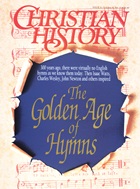
The Golden Age of Hymns: Did You Know?


Charles Wesley wrote 8,989 hymns (at least three times the output of poet William Wordsworth). Dr. Frank Baker calculated that Charles Wesley wrote an average of 10 lines of verse every day for 50 years! He completed an extant poem every other day.
John and Charles Wesley published 56 collections of hymns in 53 years.
“Amazing Grace”—Americans’ favorite hymn according to the Gallup Poll—was written by the former captain of a slave ship. That “wretch,” John Newton, eventually became an Anglican minister and worked to abolish the slave trade.
“Hark! The Herald Angels Sing” was originally written as “Hark! How All the Welkin Rings” (meaning “how all the heaven rings”). Thankfully, Charles Wesley’s popular Christmas carol was changed by his friend George Whitefield, the famous evangelist who sparked America’s Great Awakening.
Charles Wesley was an accomplished field preacher, who on occasion addressed crowds of 10,000 and 20,000 people. He experienced considerable opposition, sometimes from rock-throwing mobs. In fact, his well-known hymn “Ye Servants of God, Your Master Proclaim” was written “to be sung in a tumult.”
Eighteenth-century hymnbooks were usually only collections of texts—they did not include musical notes. The first American hymnal to join tunes with texts was not published until 1831.
The usual method of singing in church was by “lining out”—having a leader say one line, and the congregation repeat it. (This was done because hymnbooks were expensive, and many worshipers could not read.) People did not sing one line immediately after another, as they do now.
The singing of hymns was not officially approved in the Church of England until 1820.
Isaac Watts, who wrote such well-known hymns as “When I Survey the Wondrous Cross” and “Joy to the World,” was an accomplished writer in many areas. He wrote a textbook on logic that was used at Oxford. His children’s hymnal may be the most popular children’s classic ever published. Alice in Wonderland parodied some of its hymns (for example, “Tis the Voice of the lobster, I heard him declare.”)
John Wesley’s first two published books of tunes included only a melody line, because he held serious doubts about the propriety of singing in parts.
Throughout Charles Wesley’s life, his Methodist companions sang none of his hymns in Sunday worship. (Throughout Wesley’s lifetime, Methodists stayed in the Anglican church, which did not employ the new hymns in worship. Wesley’s hymns were sung in informal Methodist gatherings during the week. )
William Cowper, who wrote a classic hymn on God’s providence—“God Moves in a Mysterious Way His Wonders to Perform”—tried a number of times to commit suicide. He suffered from mental illness.
Many early hymns contained more than a dozen stanzas. Charles Wesley’s “Soldiers of Christ, Arise,” for example, originally boasted 18 stanzas. Brother John Wesley included only 12 of these in his 1780 hymnbook—and he divided them into 3 separate hymns.
In eighteenth-century England, many hymns contained rhyming words that no longer rhyme today. For example, join could rhyme with divine or thine; and convert could rhyme with art.
The first hymnbook of the Wesleys was published not in England but in America (in Charleston, South Carolina, in 1737). And it contained no texts by Charles Wesley. For his effort, John Wesley was “arraigned before a grand jury for altering authorized psalms and for introducing unauthorized compositions into church services.”
Peter Böhler, who helped lead John and Charles Wesley to experience conversions, once said, “If I had a thousand tongues, I’d praise Christ with them all.” Charles Wesley expanded this stray comment into lines that became the well-known hymn “O for a Thousand Tongues to Sing.”
Augustus Toplady, who wrote the famous hymn “Rock of Ages,” called John Wesley a “tadpole in divinity.” Wesley in turn called Toplady “the most rancorous hater of the gospel system.” Nevertheless, in Toplady’s 1776 hymnal, “Rock of Ages” stood next to Charles Wesley’s “Jesu, Lover of My Soul.”
There is evidence that Toplady plagiarized his most famous hymn (“Rock of Ages”) from his opponent, Charles Wesley!
Isaac Watts’s collection of psalms and hymns was still selling as many as 60,000 copies per year over 100 years after it was published. His Psalms of David went through 31 editions in its first 50 years, including a 1729 reprinting issued by Benjamin Franklin.
Augustus Toplady wrote 6 hymns; William Cowper wrote 68; John Newton wrote 280; Philip Doddridge wrote around 400; and Isaac Watts wrote 697. But Charles Wesley wrote 8,989.
Though not usually known for writing hymns, John Wesley did write several original hymns, and he translated many from German.
John Wesley often severely edited his brother Charles’s hymns, both for length and theology. When Charles wrote “Thou didst in love Thy servant leave,” John wrote in the margin, “Never!”
Dr. James Townsend is Bible editor at David C. Cook Publishing Co. and author of eight volumes in The Bible Mastery Series (Cook).
Copyright © 1991 by the author or Christianity Today/Christian History magazine.
Click here for reprint information on Christian History.

Support Our Work
Subscribe to CT for less than $4.25/month