Bonhoeffer's Costly Theology


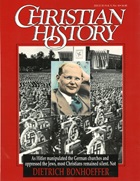
Dietrich Bonhoeffer first became widely known not for his thought but for his actions. He was talked about as the German Lutheran pastor and theologian who was executed by the Nazis for resisting the racial and military policies of Hitler's totalitarian regime. Only gradually did the church and world become aware of the rich theological legacy of this modern Christian martyr.
In May of 1924, Bonhoeffer had just completed a year of theological studies at Tübingen. That fall he began studies at Berlin University, including seminars under famous scholar Adolf von Harnack.
What Shaped His Theology?
Bonhoeffer's thought cannot be divorced from his life.
Turbulent Times: He grew up in Berlin during the era of the Weimar Republic. He lost a brother in the First World War. He experienced the rise to power of Hitler's National Socialists, and he helped establish the "Confessing Church" during the German church struggle of the 1930s. Finally, toward the end of the Second World War, he was hanged as a conspirator against Hitler. His theology was forged amid these turbulent times.
Cultured Family: Bonhoeffer's family deeply influenced his character and thinking. He and his twin sister were the sixth and seventh of the eight children of a prominent physician and his wife. His father was a neurologist and professor of psychiatry at the University of Berlin. Dietrich was reared in this educated, cultured family.
The Bonhoeffers embodied the best of the German liberal tradition that prized personal integrity and civic duty. Dietrich grew to combine the analytical objectivity of his father and the piety and practical realism of his mother. Nourished and supported by this loving family, he grew to love life. He valued honesty and self-discipline, rejoiced in human ties and human pleasures, and enjoyed literature, music, and art.
Varied Experiences: Often overlooked as significant influences on Bonhoeffer are certain life experiences, mainly outside Germany. A trip to Rome during university days quickened his interest in the church. He took an excursion to Islamic North Africa. He spent a year as a vicar in Barcelona and a year as a student at Union Seminary in New York. For a year and a half he served as pastor of two German-speaking congregations in London. These immersions into different cultures greatly widened his perspective on life.
For example, while at Union Seminary, Bonhoeffer encountered the black church in Harlem. Here he began to see things "from below," from the perspective of those who suffer oppression—a perspective that would later be his own when he was imprisoned.
Concrete, "This World" Revelation
Bonhoeffer's passion was for the concreteness of revelation—in Jesus of Nazareth, in the church. The Word became flesh, Bonhoeffer stressed, and dwelt among us: living, teaching, dying on a cross, being raised to new life, taking form in a new community. From the outset Bonhoeffer emphasized the "this world" quality of revelation.
Because God has entered human history, new relationships are engendered. Those who respond to this revelation bear a responsibility. Bonhoeffer insisted on the social intention of every Christian doctrine.
This became evident in his 1927 dissertation at the University of Berlin, The Communion of Saints. In it, Bonhoeffer used sociology and social philosophy to aid in his theological interpretation of the church. (This "social" emphasis also reflected the ongoing influence in Berlin of the liberal tradition; the same strand runs from Schleiermacher and Hegel to Troeltsch and Toennies.) Crucial to Bonhoeffer's social analysis is the concept that the transcendence of God is moral and social. Thus, it is not an abstract idea. God is as close as the nearest neighbor in need!
Christ and the Church
For Bonhoeffer, all true theology begins in prayer and is centered on Jesus Christ. Like Luther, Bonhoeffer could point to this one who was born in a crib and died on a cross, and say, "This man is God for me." Bonhoeffer, unlike prevailing liberal theologians, refused to separate the Jesus of history from the Christ of faith.
We meet the risen Christ who is present in the church's proclamation, he insisted. But the present Christ is none other than the historical Jesus who taught and healed, forgave sinners, and died on a cross.
As the incarnate One, Christ demonstrates God's love for the world. As the crucified One, Christ discloses God's judgment upon humanity's sin. As the risen One, Christ reveals God's will for the renewal of humanity. Like spokes that go out from the hub of a wheel, everything in Bonhoeffer's theology radiates from Christ the center. He is the center of human existence, of history, and even of nature.
In Bonhoeffer's theology, there is an intimate relationship between Jesus Christ and the church. In his letters from prison Bonhoeffer spoke of Jesus as "the man for others." And in parallel fashion he wrote that the church is truly the church only when it exists for others. Just as Jesus lived his life completely for others (even unto death on the cross), so the church is to serve God by serving the world of need.
The church represents that gracious realm of God where sinners are welcomed, the wounded are healed, the oppressed are set free, and the poor receive the good news of the gospel. In The Communion of Saints, Bonhoeffer defined the church as "Christ existing as community." He believed that through the work of the Holy Spirit, Christ actually takes form in this community as it lives for others. Christ is revealed not just through the preached Word and the administered sacraments, but through the Christian community itself.
Faith and Obedience
Lutheran theologians generally center their attention on the New Testament writings of Paul. The apostle champions their doctrine of justification by grace, through faith alone, and not by works of the law.
Bonhoeffer, however, loved the Old Testament (especially the Psalms) and its focus on the law (Torah). He drew upon its demand for righteous living within the realm of God.
In addition, already in the early 1930s Bonhoeffer was attracted to the Gospels—especially to Jesus' Sermon on the Mount. Bonhoeffer read this as his own serious call to discipleship as a follower of Jesus. He took to heart the claims that Jesus' teachings made on his life. The demands of the kingdom of God were to be obeyed. To Bonhoeffer, they were not given, as many Lutherans supposed, to show the impossibility of their fulfillment.
At the Finkenwalde seminary, where Bonhoeffer trained ministerial candidates for the "Confessing Church" during the Nazi period, he lectured on the Sermon on the Mount. These lectures became the heart of the book he published in 1937, The Cost of Discipleship. In the book he warned against "cheap grace," which is the grace we bestow on ourselves in order to live the Christian life as effortlessly as possible. Bonhoeffer called people to the costly grace of following Jesus and obeying his commands. He put his theological perspective into this sentence: "Only the one who obeys believes, and only the one who believes obeys." Although theologically, faith comes before obedience, faith and obedience can never be separated.
Christian Living and Ethics
After the Gestapo closed his "illegal" seminary in 1937, Bonhoeffer wrote Life Together. In it, he presented one example of how a group of Christians had tried to live "under the Word of God." The seminarians' life incorporated regular spiritual disciplines surrounding the day of work—and usually evenings of play! Bonhoeffer, an excellent pianist, would accompany their singing, or he would play records of Negro spirituals he had brought from New York. He insisted that Christian life together is always life in and through Christ, and it necessitates a rhythm of both "being together" and "being alone."
Bonhoeffer taught his students that self-justification and judging others go together. On the other hand, justification by grace and serving others also go together. He proposed to his students the ministries of holding one's tongue, meekness, listening to others, active helpfulness, bearing the burdens of others, and when timely, speaking God's Word to another. He also advocated oral confession in preparation for the Lord's Supper—not to a priest or minister, but to any Christian who lives under the Cross.
Following Life Together, Bonhoeffer joined the underground resistance against Hitler and became a civilian employee of the Abwehr (the German military intelligence service, whose officers were at the heart of the resistance). He began working on Ethics, an unfinished book that, along with Letters and Papers from Prison, was published posthumously. Basically, he considered Christian ethics to be an ethics of responsibility. Since the Incarnation, God and the world have been "polemically" united. A person cannot relate to the one without the other. This means that ethical thinking can no longer be done in terms of two spheres, one sacred and one secular. In their lives in the world, Christians are called to live responsibly by fulfilling certain divinely imposed and interrelated "mandates"—those of marriage and family, government, labor (or culture), and church. No mandate, wrote Bonhoeffer, is more "divine" than another. Now a Christian must make ethical decisions in the face of various demands that come from being a member of a family, a citizen, a worker, and a member of the church.
His Most Controversial Ideas
In 1943 Bonhoeffer was imprisoned. In uncensored letters from prison to his friend Eberhard Bethge, Bonhoeffer raised the burning question of "who Christ is for us today—really." How is Christ related to a world that has become more and more secular and that does not look to God for answers to its unsolved problems? Is there a "non-religious" understanding of Christian faith that fits a "world come of age"?
"Religious" people, contended Bonhoeffer, tend toward individualism (concern for saving one's own soul for another world), metaphysics (using a concept of "God" to fill gaps in knowledge or to solve personal problems), parochialism (relegating God to only a part of life), or arrogance (thinking God favors them over others). These "religious" views, wrote Bonhoeffer, are anachronistic in a modern, "religionless" world. And they do not accord with the Bible: In Jesus Christ, God lives and suffers with humans in the midst of everyday life. God becomes weak in the world in order that we might become strong and mature. Like Jesus, we are to be there for others in the joys and sorrows of mundane life.
Bonhoeffer's idea of "religionless Christianity" has been controversial (as has his statement, "Before God and with God we live without God"). By it, Bonhoeffer intended that all Christian doctrines be reinterpreted in "this world" terms. For example, the Resurrection is not only the answer to life after death; it sends us back into the world to live in a renewed way.
If the church cannot interpret Christian faith in language meaningful for the ordinary person in our secular world, then, Bonhoeffer believed, it must limit itself to two things: prayer and righteous action. Out of that it might be born again and discover a new language that would impress the world with its freshness and power.
The only way to find God, then, is to live fully in the midst of this world. Christians must participate in Jesus' living for others. They share in God's suffering on behalf of the poor, the helpless, and the oppressed.
Despite his sometimes jarring, controversial statements, Bonhoeffer has elicited a positive response from all types of Christians—liberals and conservatives—and from non-Christians as well. All these people find in Bonhoeffer's life and thought a challenging faith that is worth living for, and dying for.
Dr. John D. Godsey is professor emeritus of systematic theology at Wesley Theological Seminary in Washington, D.C., and author of The Theology of Dietrich Bonhoeffer (Westminster, 1960).
Copyright © 1991 by the author or Christianity Today/Christian History magazine.
Click here for reprint information on Christian History.

Support Our Work
Subscribe to CT for less than $4.25/month