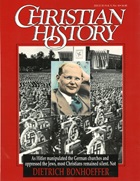
My Friend Dietrich


A man destined to fail, hanged as a 39-year-old, has now deeply influenced—perhaps troubled—Christianity for half a century.
The career in theology for which Dietrich Bonhoeffer was prepared opened with highly specialized works (The Communion of Saints and Act and Being). But then came books addressed to insiders of the church, who, like he, were fighting on the losing side in Germany (The Cost of Discipleship). Later, the Nazis prohibited Dietrich from speaking, printing, and writing. During this time only fragments of manuscripts, sometimes hardly decipherable, emerged (Ethics and Letters and Papers from Prison).
Forty-five years ago, the author of the Ethics fragments was prematurely torn away from his work by the Nazis. As one of Bonhoeffer’s closest surviving friends, I fulfilled an obligation to make the Ethics fragments readable and communicable.
This led to mediating the entire Bonhoeffer literary inheritance. The work almost became the primary occupation of the second half of my life.
Today about forty people are working to edit all of his writings into sixteen volumes. Already six volumes are on the market (at a price too high for most people’s pocketbooks), and the English edition is in the works. Introductions, commentaries, and painfully precise evidences by experts!
This scholarly output means that today’s readers of Bonhoeffer face a new challenge: they must examine their interpretation of him in light of firm sources. Some explorers of the religious Bonhoeffer must see if they have overlooked the political Bonhoeffer. Others, explorers of the worldly Bonhoeffer, must see if they have not devalued his spirituality.
Toning Down His Significance?
Now a new generation, with firm source material, examines the assertive strength of Bonhoeffer’s work, life, and death.
This man has forever become a monument—glorified, risen to the unreal as thinker, prayer, and doer. There seems to be a new tendency to bring him back to earth. Some seek to dismantle his possible overvalue, to tone down his significance.
Why? From my observation, two factors may contribute to this tendency.
The first comes from responsible theological teachers. Their students may show hasty enthusiasm for Bonhoeffer as a “doer” among theologians, someone who will release them from hard theological thinking and learning. Thus, teachers defend themselves against someone like Bonhoeffer who too quickly and too easily makes students into critics of old traditions.
Another contributing factor: Protestants have lacked for centuries the tradition, conception, and teaching about “martyrs.” Without this understanding, the phenomenon of Dietrich Bonhoeffer can be downplayed. We lack convincing works about the place and function of modern martyrs—and martyrs have been multiplied over all the earth in this century! Studies of contemporary martyrdom may shed light on the fragmented work of Bonhoeffer.
What Bonhoeffer Can’t Teach Us
I must now state, however, that the language, concepts, and thought paradigms of this man are a half century old and older. Their environment, motivations, and challenges are long past. Bonhoeffer was not even familiar with entire fields of language and experience that occupy our thinking today. We find in him no answers to many of our most pressing questions.
For example, he did not yet know the problems that nuclear physics has brought us. He was murdered before Hiroshima and Nagasaki. Ecology, ozone holes, climate shifts, and dying forests had not yet entered his mind. Genetic technology in agriculture and the breeding of humans touched no one then. Vietnam, the Gulf, and modern Israel all came afterward. Feminism did not disturb any level of his life and thought.
Some statements of his even sound odd, if not outright silly, coming to us today. In these specific dimensions, and probably some others, we are left to our own understanding. A look at Bonhoeffer helps us indirectly, at most.
What Bonhoeffer Can Teach Us
Nevertheless, Bonhoeffer’s thought remains unusually fruitful. Even after fifty years there are new discoveries in his life, even for me. His reactions to life situations, both typical and extraordinary; his observations of people in good and bad circumstances; his critique of himself and of church structure—they still help and stimulate.
Let me give one short example of a recent discovery I made. I am truly familiar with Bonhoeffer’s letters to me from Tegel [a military interrogation prison in Berlin where Bonhoeffer was held from April 1943 through October 1944]. However, in some places, whether from instinct or fear, I had perhaps long overlooked things.
His letter on July 21, 1944, the day after the failed uprising, is perhaps my favorite. [On July 20th, a group of German officers, some connected to Bonhoeffer, attempted to assassinate Hitler. That evening, Bonhoeffer heard over a radio in the prison’s sick ward that the attempt had failed. He knew his fate was sealed.] It contains a kind of account by Bonhoeffer about his life—which was to end by impending execution, an act of revenge by Hitler meant to be a death of disgrace. I had never really pondered what Bonhoeffer wrote there: “For this reason I thankfully and peacefully reflect on things past and things present.” For a long time I overlooked the words, “and things present”! This “things present” was, of course, the failure of that uprising the day before. “Things present” meant the shattering of all hope for himself, for the church, and for Germany. It meant the gallows, in shame. Why then did he write, “I thankfully and peacefully reflect on…things present”?
Because only when the July 20 assassination attempt failed was it revealed to all the world that Bonhoeffer and his friends, in any case, did not stand on the side of the murdering Devil. They stood rather on the side of the God-forsaken victims. As a German, Bonhoeffer had felt guilt-laden connections to his nation’s murder of the Jews. At last the terrible time of increasing guilt was over. The time of complicity with the perpetrators had ended. That is why Bonhoeffer could write “I thankfully and peacefully reflect on … things present.”
Suddenly this new insight opened up still other lines from Dietrich’s letters from those days. Even the world changed by half a century has not diminished, but rather expanded, the question of whether and how we are responsible citizens. Are we mature members of our society, states, corporations, and churches? We set embarrassing or helpful examples for those who follow. Unavoidably, we corrupt or renew the Christian claim and faith. Even in the nuclear, ecological, and feminist age, no one eludes the demands of citizenship with which Bonhoeffer struggled.
Disturbing Treasures
In this way Bonhoeffer’s theology and decisions continue to prove themselves treasures. They still come to us as disturbing critiques, but with persuasive power. They deal with individual and corporate piety; with theology and church; with political ethics.
Here it becomes clear how and why Bonhoeffer, among others, says something of value to today’s situation in South Africa. And he will trouble us further, if we in Europe and in the United States do not manage responsible analyses and decisions. How decisively he criticizes and motivates church renewal. How he urges us on to seek a biblically-oriented church and theology in the era after Auschwitz.
Dietrich Bonhoeffer remains one of the greatest inspirers of the century. As a martyr he testifies to God’s “no”—Christ cannot endorse slave holders in brutal societies. And he testifies to God’s “yes” to people who are victims of false imperial gods.
Dr. Eberhard Bethge is author of the definitive biography Dietrich Bonhoeffer: Man of Vision, Man of Courage (English edition: William Collins and Harper & Row, 1970). Translated by Phillip M. Hofinga.
Copyright © 1991 by the author or Christianity Today/Christian History magazine.
Click here for reprint information on Christian History.

Support Our Work
Subscribe to CT for less than $4.25/month