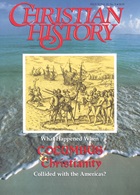
Why Did Columbus Sail?
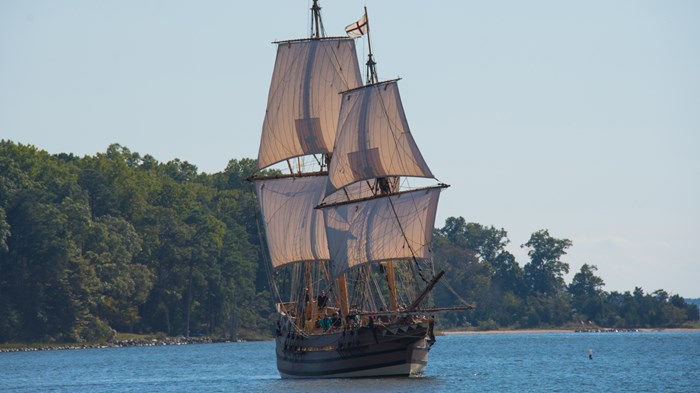


The bright noon sun beat down on the stone walls of the Church of St. George in Palos, Spain. Inside, in the cool quiet, knelt Cristóbal Colón, captain general of three small ships anchored in the town’s inlet below. With Columbus saying confession and hearing mass, were some ninety pilots, seamen, and crown appointed officials. Later that day they would row to their ships, Colón taking his place on the Santa María, a slow but sturdy flagship no longer than five canoes.
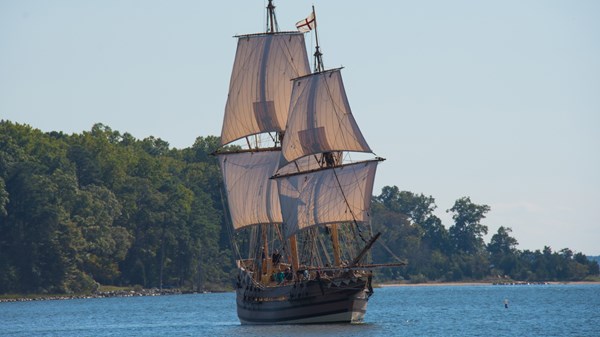
The next morning, Friday, August 3, 1492, at dawn, the Santa María and its companion caravels caught the ebb tide and drifted toward the gulf. Their sails began to fill, and the crosses boldly emblazoned on them caught the light. Their mission—the wild-eyed idea of their foreigner captain—was to sail west, away from all visible landmarks. They would leave behind Spain and Portugal, the “end of the world,” and head straight into the Mare Oceanum, the Ocean Sea.
In that Ocean of Darkness, some feared, the water boiled and sea monsters gulped down sailors so foolish as to sail there. Beyond—if they lived to see it—lay the fabled island of Cipangu. There, in the land of the Great Khan, houses were roofed with gold, streets paved with marble. And this was but one of 7,448 islands Marco Polo had said were in the Sea of China. But even if they reached the Indies, how would they get back, since currents and winds all seemed to go one way?
Why Take the Risky Voyage?
Commander Cristoforo Colombo (as he was known in his hometown of Genoa, Italy) was taller than most men; so tall, in fact, he couldn’t stand inside his cabin on the Santa María. He’d had “very red” hair in his younger years, but since he’d passed age 40, it had turned prematurely white. His face boasted a big nose and freckles.
Columbus, as we know his name today, was an experienced mariner. He had sailed the Mediterranean and traveled to parts of Africa, to Ireland, and probably even to Iceland. He boasted later in life, “I have gone to every place that has heretofore been navigated.” He knew the Atlantic as well or better than anyone, and he probably knew more about how to read currents, winds, and surfaces of the sea than do sailors today. “He [our Lord] has bestowed the marine arts upon me in abundance,” Columbus said.
For nearly seven years, the “socially ambitious, socially awkward” Italian had become a fixture at the Spanish court, ceaselessly lobbying for his crazy “enterprise of the Indies.” A royal commission in 1490 had judged “that the claims and promises of Captain Colón are vain and worthy of rejection.… The Western Sea is infinite and unnavigable. The Antipodes are not livable, and his ideas are impracticable.” Yet Columbus had pressed on, proving, as he said, “If it strikes often enough, a drop of water can wear a hole in a stone.”
Why? Why would someone, anyone, doggedly spend years getting funding for a death-defying feat?
The Misleading Textbook Answer
The textbook answer, as any schoolchild could recite, is that Columbus wanted to find a trade route to the Orient. Writer Robert Hughes expressed the conventional wisdom: “Sometime between 1478 and 1484, the full plan of self-aggrandizement and discovery took shape in his mind. He would win glory, riches, and a title of nobility by opening a trade route to the untapped wealth of the Orient. No reward could be too great for the man who did that.”
That’s true, but incomplete so incomplete it’s misleading. At least later, Columbus saw his voyage in much greater terms: “Who can doubt that this fire was not merely mine, but also the Holy Spirit who encouraged me with a radiance of marvelous illumination from his sacred Scriptures, … urging me to press forward?”
Columbus felt that Almighty God had directly brought about his journey: “With a hand that could be felt, the Lord opened my mind to the fact that it would be possible … and he opened my will to desire to accomplish that project.… The Lord purposed that there should be something miraculous in this matter of the voyage to the Indies.”
There may be many things we don’t know about history’s most famous mariner. We don’t know exactly what Columbus looked like. We don’t know the precise design of his three ships. And most bizarre of all, we don’t know—and will probably never know—the spot where he came ashore.
But we know beyond doubt that Columbus sailed, in part, to fulfill a religious quest. Columbus’s voyages were intense religious missions. He saw them as the fulfillment of a divine plan for his life—and for the soon-coming end of the world. As he put it in 1500, “God made me the messenger of the new heaven and the new earth of which he spoke in the Apocalypse of St. John [Rev. 21:1] after having spoken of it through the mouth of Isaiah; and he showed me the spot where to find it.”
Saint Christopher?
Columbus was visibly and verbally “an exceptionally pious man,” writes historian Delno C. West. “Throughout his journals and letters, we find him constantly in prayer, invoking the names of Christ, Mary, and the saints and solemnly giving praise to God.”
It was typical for Spanish crewmen daily to recite the “Our Father” and other prayers. Columbus’s men did, too. But Columbus went far beyond conventional practice.
His son Ferdinand wrote, “He was so strict in matters of religion that for fasting and saying prayers he might have been taken for a member of a religious order.” He knew his Vulgate Bible thoroughly, and he probably took it (or a collection of Scriptures) on his voyages. Whenever he faced a storm, a waterspout (tornado-like whirl of seawater), or rebellious crewmen, he made vows to God. “Religion was always his first refuge in adversity,” writes Columbus scholar Felipe Fernández-Armesto.
A main source for information about Columbus is his contemporary Bishop Bartolome de Las Casas. Las Casas fearlessly criticized many fellow Spaniards, yet he did little but praise the mariner: “He was calm and serious, friendly to strangers, gentle and kind to his family.… In nearly everything he undertook to plan or to accomplish, he would begin with ‘In the name of the Holy Trinity I will do this or look to that.’ … He fasted most observantly on all the fast days of the church; he participated frequently in confession and Communion; he prayed at all the daily canonical hours, just as the priests and monks; … He was extremely zealous for the honor and glory of God; with deep longing he yearned for the evangelization of these peoples and for the planking and flourishing everywhere of people’s faith in Jesus Christ.”
Medieval “Evangelical”
The overwhelming evidence has led Delno C. West to conclude that Columbus “is best viewed as an ‘evangelical’ Christian—not in the modern sense of the word ‘evangelical’ but in the sense of the Catholic tradition and church of the times.”
Evangelical? In 1501 Columbus wrote, “I am only a most unworthy sinner, but ever since I have cried out for grace and mercy from the Lord, they have covered me completely. I have found the most delightful comfort in making it my whole aim in life to enjoy his marvelous presence.” He constantly associated with reform minded Franciscans and spent perhaps five months at the white-walled monastery of Santa María de La Rabida. He may have been a member of the Franciscan Third Order (for lay people). At least once he appeared in public wearing a Franciscan habit and the order’s distinctive cord.
But he and his faith were wholly medieval. He died more than a decade before Martin Luther would post his 95 Theses protesting the abuse of indulgences. In fact, advances on indulgences helped pay for Columbus’s voyage. He read from the Vulgate Bible and the church fathers but, typical for his era, mingled astrology, geography, and prophecy with his theology. Columbus and his faith reflected, to use Alexander von Humboldt’s phrase, “everything sublime and bizarre that the Middle Ages produced.”
But only in the last 40 years—and particularly in the last 10 have scholars examined Columbus’s religious motivations. Not until last year was his most important religious writing—the Libro de las profecías, or Book of Prophecies—translated into English.
Columbus’s deep Christian faith still causes academic bewilderment. Some scholars attribute his recurring encounters with a heavenly voice to mental instability, illness, or stress. Others complain that Columbus’s biographers described him as more religious than he really was. Some protest that Columbus was greedy and obsessively ambitious, so he couldn’t have been truly religious, as if competing qualities cannot exist in one person.
But why explain away his intense religious devotion, when it was obvious to those who knew him and persistent throughout his writings?
Concludes Pulitzer-Prize-winning biographer Samuel Eliot Morison, “There can be no doubt that the faith of Columbus was genuine and sincere, and that his frequent communion with forces unseen was a vital element in his achievement.”
Reaching Land—But Where?
Columbus would need that vital element. The voyage was immediately beset by calamities a broken rudder, leaks so bad they needed immediate repair, and threatened capture by the Portuguese. A week after losing sight of the Canary Islands, the pilots discovered to their consternation that the compasses no longer worked right. (They varied a full degree at various fumes of the day, because of the rotation of the North Star, which pilots had thought was fixed in its location.)
On September 23, the ship hit a calm, causing the seamen to complain they’d never be able to get back to Spain. But later, the sea rose without the aid of any wind. This “astonished them,” and Columbus compared it to the miracles that accompanied Moses.
After going a month without seeing land, the men belly-ached about the endless voyage. But on October 11, the ship’s log records, they began seeing signs of shore: seabirds, bits of green plants, stacks that looked they had been carved, a small plank. At 10 that evening, Columbus saw a faint, flickering light like a candle in the distance. Few took it as a sign of land, but when the crew gathered to sing Salve Regina (“Hail, Queen”), Columbus instructed his men to keep careful lookout. He would give the first person to sight land a silk jacket and 10,000 maravedis.
Then the Pinta (“Painted One”), the fastest of the three ships, sailed ahead. At about 2 A.M., a crewman yelled “Tierra!”—land.
At daylight, the wide-eyed Europeans saw people “as naked as their mother bore them” and many ponds, fruits, and green trees. Columbus and his captains went ashore in an armed launch and unfurled the royal banner and two flags. Each was white with a central bright green cross flanked by a green F and Y for “Ferdinand” and “Isabella.” Columbus declared that these obviously inhabited lands now belonged to the Catholic sovereigns.
But what land was this? Where was he? The navties called the island Guanahaní. Columbus dubbed it San Salvador, “Holy Savior.” He probably figured he was, in one writer’s words, at the “gateway to the kingdom of the Grand Khan.”
Columbus had woefully miscalculated—by thousands of miles. Historian Jeffrey Burton Russell explains, “In six stages of calculations, Columbus had cooked the figures to suit himself and reduced the width of the Ocean Sea to 60 degrees, less than a third of the modern figure of 200 degrees for the distance between the Canary Islands and Japan.… Providence or fool’s luck—placed America in the middle of the sea to save him.”
Columbus said it was Providence. As he wrote to Ferdinand and Isabella late in his life, “I spent six years here at your royal court, disputing the case with so many people of great authority, learned in all the arts. And finally they concluded that it all was in vain, and they lost interest. In spite of that it later came to pass as Jesus Christ our Savior had predicted and as he had previously announced through the mouths of His holy prophets.… I have already said that reason, mathematics, and maps of the world were of no use to me in the execution of the enterprise of the Indies. What Isaiah said was completely fulfilled.”
Now here he was, standing in the distant isles of the Indies. So he called the Taino-speaking peoples of the Arawak tribes “Indians.” The name, though flatly wrong, stuck.
Good Christians, Good Slaves
Soon many natives gathered. They had coarse black hair—“almost like the tail of a horse”—with “handsome bodies and good faces” painted with black, red, or white paint. “I recognized that they were people who would be better freed [from error] and converted to our Holy Faith by love than by force,” Columbus concluded.
“To some of them I gave red caps, and glass beads which they put on their chests, and many other things of small value, in which they took so much pleasure and became so much our friends that it was a marvel.” The natives soon brought “parrots and cotton thread in balls and javelins and many other things,” which they traded for “small glass beads and bells.”
“They should be good and intelligent servants,” Columbus wrote, “for I see that they say very quickly everything that is said to them; and I believe that they would become Christians very easily, for it seemed to me that they had no religion. Our Lord pleasing, at the time of my departure I will take six of them from here to Your Highnesses in order that they may learn to speak.”
In other words, they would make good Christians and good slaves. The cross and sword had come together. The modern concept of separating church and state had never entered Columbus’s mind. His sovereigns were Christian princes; to extend his nation’s borders was to extend Christianity; to conquer and enslave new lands was to spread the gospel. Even when Columbus forcibly subjugated Hispaniola in 1495, he believed he was fulfilling a divine destiny for himself and for Aragon and Castile and for the holy church.
The “Christ-Bearer”
Indeed, he saw himself on an evangelistic mission. In the prologue to his account of the first voyage, Columbus wrote to King Ferdinand and Queen Isabella: “I had given [a report] to your Highnesses about the lands of India and about a prince who is called ‘Grand Khan,’ … how, many times, he and his predecessors had sent to Rome to ask for men learned in our Holy Faith in order that they might instruct him in it … and thus so many peoples were lost, falling into idolatry and accepting false and harmful religions; and Your Highnesses, as Catholic Christians and Princes, lovers and promoters of the Holy Christian Faith … thought of sending me, Cristóbal Colon… to see how their conversion to our Holy Faith might be undertaken.”
Columbus was the advance man for a mighty evangelistic campaign. He would open new worlds and unseen peoples to the gospel. In a sense, he would be like the legendary giant Christopher, who carried Christ on his back across a wide river. He also, a Christopher, a “Christ-bearer,” would carry Christ across the wide Ocean Sea to peoples who had never heard the Christian message.
In his later Book of Prophecies, he cited various Scriptures that validated that mission:
• John 10:16 “And other sheep I have, which are not of this fold: them also I must bring, and they shall hear my voice; and there shall be one fold, and one shepherd.”
• And especially Isaiah 60:9—“For, the islands wait for me, and the ships of the sea in the beginning: that I may bring thy sons from afar, their silver and their gold with them, to the name of the Lord thy God.” In Columbus’s mind, the islands were waiting for him; he would bring their sons to the Lord (and not incidentally, bring their silver and gold as well).
Las Casas agreed that “Columbus showed the way to the discovery of immense territories” and many peoples “are now ready and prepared to be brought to the knowledge of their Creator and the faith.” As a sign of that work, on every island he explored, Columbus erected a large wooden cross.
Voice in the Storm
After ten weeks of exploring the coastline of Cuba and Hispaniola, continually trading trinkets for gold, Columbus and his men hit a problem. In the wee hours of Christmas morning, a sailor decided to catch some sleep and left the tiller in the hands of a boy. The Santa María ran aground.
But what most would have viewed as a calamity, Columbus did not: “It was a great blessing and the express purpose of God” that his ship ran aground so he would leave some of his men. Yes, the ship was wrecked beyond repair, but now he had lumber—lots of it—for building the necessary fort. He left a small garrison of men with instructions: treat the natives well and don’t “injure” the women; explore for gold; seek a place for permanent settlement.
The Niña and Pinta sailed for home in January. On February 12, the ships encountered a frightening storm. Waves broke over the ships, sails had to be lowered, and soon they were driven by the wind until they were wildly lost. “I knew that my life was at the disposal of Him who made me,” Columbus wrote, “and I have been near death so often.… What made it so unbearably painful this time was the thought that after our Lord had been pleased to enflame me with faith and trust in this enterprise, and had crowned it with victory, … His divine Majesty should now choose to jeopardize everything with my death.… I tried to console myself with the thought that our Lord would not allow such an enterprise to remain unfinished, which was so much for the exaltation of His Church.”
The storm raged on. On February 14th, Columbus gathered his crew on the heaving and rolling deck to pray and make vows. They put chick-peas in a cap and had sailors draw to see which one picked the chick-pea with a cross cut into it. That sailor would go on a holy pilgrimage to a shrine of the Virgin Mary if they landed safely. Columbus drew the cross-marked bean.
Apparently, on that frightening day, Columbus also heard a celestial voice. In his youth, he felt God had promised him that his name would be proclaimed throughout the world. And at age 25, he had survived a shipwreck and six-mile swim—a sign, he told his son Ferdinand, that God had a plan for him. But this was different.
Although the words are recorded only indirectly, God spoke to Columbus and assured him that God would take him to safety. God had given him great favor in allowing him to accomplish this great feat. God would allow him to complete what he had begun.
The next day Columbus’s men spotted an island in the Azores; less than three weeks later they landed triumphantly on the Iberian peninsula.
“Communion with Celestial Joys”
When Columbus anchored the Niña in Palos, seven months after he’d left, shops closed and church bells rang. Columbus had forwarded a letter to Ferdinand and Isabella: “Our Redeemer has given this triumph… for all of this Christendom should feel joyful and make great celebrations and give solemn thanks to the Holy Trinity … for the great exaltation which it will have in the salvation of so many peoples to our holy faith and, secondly, for the material benefits which will bring refreshment and profit.”
Columbus was greeted in the Barcelona court as “Don Cristóbal Colón, our Admiral of the Ocean Sea and Viceroy and Governor of the Isles discovered in the Indies.”
According to Las Casas, “The King and Queen heard [Columbus’s report] with profound attention and, raising their hands in prayer, sank to their knees in deep gratitude to God. The singers of the royal chapel sang the ‘Te Deum laudamus’ … and indeed it seemed a moment of communion with all the celestial joys.”
Spain had now emerged, in one historian’s words, “as the greatest empire since antiquity.” In “a year of marvels,” to quote historian Carry Wills, three profound changes had occurred:
1. Ferdinand and Isabella, who had just united their kingdoms, soundly defeated the Moors, signaling the end of an Islamic presence in Europe.
2. The Catholic sovereigns had expelled all Jews and seized their assets. Columbus had used the port of Palós, in fact, because the larger Cádiz was flooded with thousands of fleeing Jewish refugees.
3. A Spanish pope had been elected.
And now this—a new gateway to the Indies. A new country, militantly united behind Christianity, had arisen and would dominate the world for a hundred years.
An End-Times Crusade
To Columbus, all this was a sure sign of the end times.
For years a prophecy had circulated that “the restorer of the House of Mt. Zion will come from Spain.” For hundreds of years, the holy sites of Jerusalem had been held captive by the infidel Muslims. But according to ancient prophecy, that day would soon end. And Columbus believed he would be part of making it happen.
Following St. Augustine’s teaching, Columbus knew that all history fell into seven ages—and he was in the sixth, the next to last. Furthermore, Augustine had said the world would end 7,000 years after its creation. That was a mere 155 years away, and much had to happen: all peoples of the world would convert to Christianity, the Holy Land would be rescued from the infidels, the Antichrist would come.
Columbus thought that Ferdinand and Isabella were God’s chosen instruments to recapture Jerusalem and place the Holy City under Christian control. This was not some sidelight in Columbus’s mind; it was a central passion. As scholar Pauline Moffitt Watts has written, “This was Columbus’s ultimate goal, the purpose of all his travels and discoveries—the liberation of the Holy Land.”
Not that he would personally lead the armies. No, he would help pay for the expensive crusade. The Crusaders’ Book of Secrets, written in the early fourteenth century, said it would take 210,000 gold florins to mount a crusade. If Columbus could find enough gold in the Indies especially if he could find the lost mines of Solomon, which were known to be in the East—he could pay for a Holy Land crusade.
When Columbus had left his men on Hispaniola in early January, he told them he hoped “in God that on the return … he would find a barrel of gold that those who were left would have acquired by exchange; and that they would have found the gold mine and the spicery, and those things in such quantity, that the sovereigns before three years will undertake and prepare to conquer the Holy Sepulcher.”
Columbus thirsted for gold; he was obsessed by it. When he says sincerely,“Our Lord in his goodness guides me so that I may find this gold,” we cringe. But writers who accuse Columbus of raw greed miss part of the point. Columbus wanted gold not only for himself, but also for a much larger reason: to pay for the medieval Christian’s dream, the retaking of the Holy Land. “The primary motivation in his quest for gold was spiritual,” argues Delno C. West.
As soon as Columbus had returned to Spain, he told Ferdinand and Isabella he would provide 50,000 soldiers and 4,000 horses for them to free Christ’s Holy Tomb in Jerusalem. “You are assured of certain victory in the enterprise of Jerusalem,” Columbus later wrote to them, “if you have faith.”
But much to Columbus’s disappointment, the longed-for crusade to recapture the Holy City was never undertaken. Although Ferdinand and Isabella made military strikes into Muslim-held North Africa, they never mounted a grand crusade.
High Point of His Life
Columbus was at the high point of his life. In his remaining 14 years, difficulties would only intensify the qualities in his life:
•His wanderlust. He took three more voyages across the Atlantic, each lasting several years and filled with harrowing storms, crew rebellions, illnesses (at one point his eyes bled), and encounters with native Americans.
•His passion for evangelism. In May 1493, he asked Ferdinand and Isabella to set aside 1 percent of all gold taken from the islands to pay for establishing churches and sending monks. They instructed him “to win over the peoples of the said islands and mainland by all ways and means to our Holy Catholic Faith” and sent 13 religious workers on his second voyage. In his will, Columbus instructed his son Diego to support from his trust four theology professors to live on Hispaniola and convert the Indians.
•His inflexibility. To his death he continued to argue (against other evidence) that he had landed in Asia. As a colonial governor, he ruled the farmers and settlers with such a heavy hand they rebelled. Columbus was arrested and shipped back to Spain in chains.
•His drive for titles and money. Columbus became absolutely wealthy, “a millionaire by any standard.” But he had driven such a hard bargain with the crown—hereditary titles and “the tenth part of the whole” of gold he found—that the monarchs continually had to limit his power and wealth. Columbus spent his last years in legal battles and worries that his estate would be whitled away.
•His encounters with the voice of God. Columbus had at least two more, both in dark hours.
In 1499, he said, “When all had abandoned me, I was assailed by the Indians and the wicked Christians the Spanish settlers who were rebelling against his inept administration]. I found myself in such a pass that in an attempt to escape death I took to the sea in a small caravel. Then the Lord came to help, saying, ‘O man of little faith, be not afraid, I am with thee.’ And he scattered my enemies and showed me the way to fulfill my promises. Miserable sinner that I am, to have put all my trust in the vanities of this world!”
In the Americas again four years later, he found himself alone. His worm eaten ship was trapped by low waters from getting out into the open sea. A local Indian cacique [ruler] had vowed to massacre the Spaniards. Some of Columbus’s men had been killed. Feverish and in deep despair, he wrote, “I dragged myself up the rigging to the height of the crow’s nest.… Still groaning, I lost consciousness. I heard a voice in pious accents saying, ‘O foolish man and slow to serve your God, the God of all! What more did he accomplish for Moses or for his servant David? From the hour of your birth he has always had a special care of you.’ ” The voice continued at length and closed with “Be not afraid, but of good courage. All your afflictions are engraved in letters of marble and there is a purpose behind them all.”
•His belief in his role in end-times prophecy. Late in life, with the help of a friend, a monk, Columbus assembled excerpts from the Bible and medieval authors. The unfinished work, titled Book of Prophecies, uses Scriptures to show that God had ordained his voyages of discovery and that God would be doing further wonderful things for the church. Some have criticized Columbus for the “providential and messianic delusions that would come to grip him later in life” and accused him of megalomania.
Columbus was often egocentric and, by today’s standards, loose in his hermeneutics. But he wasn’t the first or last Christian to read his personal destiny into a Scripture verse. Scholar Kay Brigham writes that he was “a man who had an extensive knowledge of God’s plan for the world, revealed in the Holy Scriptures, and of the particular role that he was to play in the fulfillment of the divine purposes.”
So why did Columbus sail? Certainly he sailed to “make a great lord of himself,” as his crew members grumbled. But he sailed for far more. As Samuel Eliot Morison wrote, “This conviction that God destined him to be an instrument for spreading the faith was far more potent than the desire to win glory, wealth, and worldly honors, to which he was certainly far from indifferent.”
Columbus concluded the log of his first voyage with one simple desire: “I hope in Our Lord that it [the recent voyage] will be the greatest honor to Christianity that, unexpectedly, has ever come about.”
Kevin A. Miller is editor of Christian History.
Copyright © 1992 by the author or Christianity Today/Christian History magazine.
Click here for reprint information on Christian History.

Support Our Work
Subscribe to CT for less than $4.25/month