

Lights in the Darkness


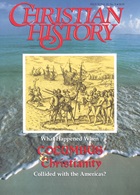
It was one of the bleakest times in the history of Christianity. In the name of Christ, thousands were slaughtered, millions enslaved, entire civilizations wiped out.
When the first Europeans settled in Hispaniola, there were some 100,000 native inhabitants on the island. Half a century later, there were scarcely 500. In Mexico, in seventy-five years the population declined from more than 23 million to 1.4 million; in Peru, in fifty years, from 9 million to 1.3 million. Military conquest, new diseases, wanton slaughter, forced labor, poor nutrition, and mass suicides contributed to these gruesome statistics. Behind all of it, as ultimate justification for the enterprise, stood the name of Christ.
In the name of Christ, natives were dispossessed of their lands by means of the Requerimiento. This document informed the native owners and rulers of these lands that Christ’s vicar on earth had granted these lands to the crown of Castile. They could accept and submit to this, or be declared rebel subjects and destroyed by force of arms.
In the name of Christ, the natives were dispossessed of their freedom by means of the encomiendas. The crown entrusted natives—sometimes hundreds of them—to a Spanish conquistador to be taught the rudiments of the Christian faith. In exchange, the natives were to work for the conquistador—the encomendero. The system soon became a veiled form of slavery. Even worse, some encomenderos left the natives underfed and overworked to the point of death.
It was also in the name of Christ that native women were baptized before being raped or taken as concubines against their will. After all, Saint Paul had clearly said, “Do not be unequally yoked together with unbelievers.”
The explorers and conquistadors were not hypocrites who pretended to have faith. On the contrary, they were sincere believers. Columbus himself was something of a mystic. Hernando Cortés attended mass regularly—and especially before taking military action against the natives. The last action of Francisco Pizarro, perhaps the cruelest of the major conquistadors, was to draw a cross with his blood so he could die gazing upon it.
From their perspective, they were serving Christ by bringing millions to faith in him. They were serving the church by expanding her boundaries as never before. If, in the process, some were made to suffer, that was nothing compared to the sufferings of hell from which the natives were being saved. If, in the process, those who were bringing such great benefits to these lands became masters of the lands and their inhabitants, that was not to be begrudged. After all, “The laborer is worthy of his hire.”
Protest Erupts
That, however, was not the total picture. Many, because of their faith and their commitment to Jesus Christ, saw things differently.
Foremost among these were the Dominicans in Hispaniola. Their order had been founded by Dominic (1170–1221), who saw voluntary poverty as a means to render credible his friars’ preaching. This attitude set apart his followers, when the Albigensians, among others, were cruelly being forced by the church to recant heresy. Now in Hispaniola, Dominic’s spiritual descendants came to the conclusion that the often-cruel encomiendas were not proper means to bring the natives to Christ.
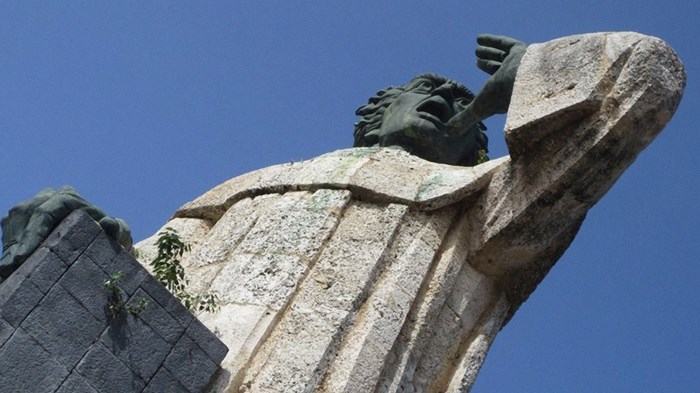
On December 21, 1511, Dominican Antonio de Montesinos mounted the pulpit. His text was Matthew 3:3, “A voice crying in the wilderness.” He said the conscience of the encomenderos seemed to be as sterile as a desert. But even in the desert the voice of God must be proclaimed:
“I have climbed to this pulpit to let you know of your sins, for I am the voice of Christ crying in the desert of this island, and therefore, you must not listen to me indifferently, but with all your heart and all your senses.… This voice tells you that you are in mortal sin; that you not only are in it, but live in it and die in it, and this because of the cruelty and tyranny that you bring to bear on these innocent people.
“Pray tell, by what right do you wage your odious wars on people who dwelt in quiet and peace on their own lands? [By what right have you] destroyed countless numbers of them with unparalleled murders and destruction? Why do you oppress and exploit them, without even giving them enough to eat, or caring for them when they become ill as a result of your exploitation? They die, or rather, you kill them, so that you may extract and obtain more and more gold every day.…
“Are they not human? Have they no souls? Are you not required to love them as you love yourselves? How can you remain in such profound moral lethargy? I assure you, in your present state you can no more be saved than Moors or Turks who do not have and even reject the faith of Jesus Christ!”
Montesinos’s audience sat almost too stunned to celebrate the Mass. Then they recovered their wits and angrily demanded a retraction. But the encomenderos soon learned that Montesinos’s sermon had been previously reviewed and signed by the other Dominicans in Hispaniola Furthermore, their vicar, Pedro de Cordoba, followed Montesinos’s sermon with harsher action: All encomenderos would be excommunicated until their Indians were freed.
The encomenderos protested before the crown. King Ferdinand was incensed. On March 20, 1512, he wrote to Columbus: “I have seen the sermon to which you refer … and although he [Montesinos] was always a scandalous preacher, I am much surprised by what he said, which has no basis in theology, or canon or civil law, as all the learned declare, and I agree.”
The Dominicans in Hispaniola did not flinch. Their provincial (immediate superior) in Spain ordered them to recant. They stood firm. Eventually, the matter came to a debate before the king, and Montesinos himself participated. As a result of that debate, a special commission issued seven principles for the treatment of the natives, and these principles became law in December 1512.
Given the settlers’ greed and the difficulty of communicating over long distances, these laws were never obeyed (or, as the Spaniards said at the time, they were obedecidas y no cuinplidas, “obeyed but not done”). Therefore, the protest continued.
Spreading Opposition
The best-known leader in this second stage of the protest was Bartolomé de Las Casas, also a Dominican. Las Casas had once owned an encomienda but had relinquished it to protest the system’s abuses. He lived almost a century and traveled repeatedly across the Atlantic, going before the royal court to plead the case of the natives. He attempted to obtain new laws and rulings, then returned to the colonies—only to discover the settlers had found new ways to disobey and continue their exploitation of the natives.
The fame of Las Casas has eclipsed that of others who took a similar stance. Decades later in Chile, for example, stood another Dominican, Gil Gonzalez de San Nicholas. Gonzalez declared that anyone who waged war against the natives (in this case, the Araucanians of southern Chile) in order to take their lands should be excommunicated and denied confession. His fellow Dominicans agreed with him, and the Franciscans followed suit. As a result, the war effort faltered for lack of soldiers, and the Araucanians had a brief respite. Eventually, Gonzalez was silenced through a subterfuge, being declared a heretic on an unrelated matter.
In Paraguay, when European settlers began invading to capture slaves, the Jesuits armed the Indians and even organized them into an army that won several important victories against the slave hunters. According to an unsympathetic witness, the attitude of these Jesuits cost the crown forty million pesos—the tax due if the settlers had been allowed to exploit the lands and the natives.
As a result, according to another witness, “[The settlers] hate the Fathers of the Company [the Jesuits], because they are convinced that it is the Jesuits that keep them from all the profit that they could obtain for their farms and settlements from [the work of] the Indians of Paraguay.”
The list could be prolonged endlessly. Many early saints of South America—Luis Beltron, Toribio de Mogrovejo, Francisco Solano as well as hundreds of lesser figures were noted for defending the natives. Later, with the coming of black slaves, another generation of saints came to their defense: Pedro Claver and Martin de Porres, himself a mulatto.
In Spain, the question of natives’ rights in the “Indies” gave rise to a vigorous debate. Foremost among those who participated was Francisco de Vitoria, a Dominican professor at the University of Salamanca, who defended the natives as legitimate owners of their lands and possessions.
Light in Darkness
It is said that Charles V, Holy Roman Emperor and the Spanish king, because of concern about Conquest abuses, considered abandoning the American enterprise. While that report is probably exaggerated, it indicates the impact of these voices of protest. Undoubtedly, some natives enjoyed a brief respite thanks to the work of the “lights in the darkness.”
Yet the Conquest continued. To this day the native inhabitants of these regions continue to be exploited and harassed out of their ancestral lands. The protest over the natives’ treatment was seldom translated into practical action, except in limited areas for a short time.
Still, the light shone in the darkness. It is true that the exploitation and immense cruelties of the Conquest were done in the name of Christ, but it is also true that some in the same Name chose to live in solidarity with the exploited, and they persisted in their denunciations even before kings and prelates. If it is true that the Spanish Catholic church generally acquiesced in and supported one of the most inhumane episodes in history, it is also true that it produced internal protest and self-criticism.
Protestant Europeans later launched similar colonial enterprises in the Western Hemisphere. They were similarly inhumane toward Native Americans. In those ventures, though, the earlier level of internal protest was never matched.
Dr. Justo L. González is adjunct professor of theology at Columbia Theological Seminary in Decatur, Georgia; and a member of the editorial advisory board of Christian History. Among his numerous books, in both Spanish and English is The Story of Christianity (Harper &Row 1985).
Copyright © 1992 by the author or Christianity Today/Christian History magazine.
Click here for reprint information on Christian History.

Support Our Work
Subscribe to CT for less than $4.25/month