The Missions Manifesto


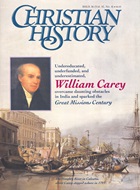
In 1792, with a subsidy from a friend, William Carey published the now-famous An Enquiry Into the Obligations of Christians, to Use Means for the Conversion of the Heathens. Many Christians of Carey’s day believed that “when God pleases to convert the heathen, he’ll do it without consulting you or me.” Carey argued instead that Christ’s command to “Go into all the world” was still binding and required action now.
As our blessed Lord has required us to pray that his kingdom may come, and his will be done on earth as it is in heaven, it becomes us not only to express our desires of that event by words, but to use every lawful method to spread the knowledge of his name.
In order that the subject may be taken into more serious consideration, I shall (1) enquire, whether the commission given by our Lord to his disciples be not still binding on us, (2) take a short view of former undertakings, (3) give some account of the present state of the world, (4) consider the practicability of doing something more than is done, and (5) the duty of Christians in general in this matter.
What Happened to the Great Commission?
Our Lord Jesus Christ, a little before his departure, commissioned his apostles to “Go,” and “teach all nations” (Matt. 28:19); or, as another evangelist expresses it, “Go into all the world, and preach the gospel to every creature” (Mark 16:15). This commission was as extensive as possible, and laid them under obligation to disperse themselves into every country to the habitable globe, and preach to all the inhabitants, without exception, or limitation. They accordingly went forth in obedience to the command, and the power of God evidently wrought with them.
Many attempts of the same kind have been made since their day, and which have been attended with various success; but the work has not been taken up, or prosecuted of late years (except by a few individuals) with that zeal and perseverance with which the primitive Christians went about it. It seems as if many thought the commission was sufficiently put in execution by what the apostles and others have done; that we have enough to do to attend to the salvation of our own countrymen; and that, if God intends the salvation of the heathen, he will some way or other bring them to the gospel, or the gospel to them. It is thus that multitudes sit at ease, and give themselves no concern about the far greater part of their fellow sinners, who to this day, are lost in ignorance and idolatry.
For Apostles Only?
There seems also to be an opinion existing in the minds of some, that because the apostles were extraordinary officers and have no proper successors, and because many things which were right for them to do would be unwarrantable for us, therefore it may not be immediately binding on us to execute the commission, though it was so upon them.
To the consideration of such persons I would offer the following observations.
First, if the command of Christ to teach all nations be restricted to the apostles, or those under the immediate inspiration of the Holy Ghost, then that of baptizing should be so too; and every denomination of Christians, except the Quakers, do wrong in baptizing with water at all.
Secondly, if the command of Christ to teach all nations be confined to the apostles, then all such ordinary ministers who have endeavored to carry the gospel to the heathens, have acted without a warrant, and run before they were sent.
Thirdly, if the command of Christ to teach all nations extend only to the apostles, then, doubtless, the promise of the divine presence in this world must be so limited; but this is worded in such a manner as expressly precludes such an idea. “Lo, I am with you always, to the end of the world” (Matt. 28:20).
Wait for Providence?
It has been said that we ought not to force our way, but to wait for the openings, and leadings of Providence; but it might with equal propriety be answered in this case, neither ought we to neglect embracing those openings in Providence which daily present themselves to us. What openings of Providence do we wait for? Where a command exists nothing can be necessary to render it binding but a removal of those obstacles which render obedience impossible, and these are removed already.
It has been said that some learned divines have proved from Scripture that the time is not yet come that the heathen should be converted; and that first the “witnesses” must be slain (Rev. 11:1–13), and many other prophecies fulfilled. But admitting this to be the case (which I much doubt) then it must be as bad to pray for them, as to preach to them; or else that none shall be converted in the heathen world till the universal down-pouring of the Spirit in the last days. But this objection comes too late; for the success of the gospel has been very considerable in many places already.
Too Dangerous?
[Carey reviews “Undertakings for the Conversion of the Heathen” from Pentecost to his own day. He then estimates that there are 731,000,000 people on earth, and of these, 420,000,000 are “pagans” and an additional 130,000,000 are “Mahometans.”]
The impediments in the way of carrying the gospel among the heathen must arise, I think, from one or other of the following things: either their distance from us, their barbarous and savage manner of living, the danger of being killed by them, the difficulty of procuring the necessities of life, or the unintelligibleness of their languages.
First, men can now sail with as much certainty through the Great South Sea as they can through the Mediterranean or any lesser sea. Yea, and Providence seems in a manner to invite us to the trial, as there are to our knowledge trading companies whose commerce lies in many of the places where these barbarians dwell.
Secondly, as to their uncivilized and barbarous way of living, this can be no objection to any except those whose love of ease renders them unwilling to expose themselves to inconveniences for the good of others.
It was no objection to the apostles and their successors, who went among the barbarous Germans and Gauls, and still more barbarous Britons!
Thirdly, in respect to the danger of being killed by them, it is true that whoever goes must put his life in his hand, but Eliot, Brainerd, and the Moravian missionaries have been very seldom molested. Nay, in general the heathen have showed a willingness to hear the word; and have principally expressed their hatred of Christianity on account of the vices of nominal Christians.
Fourthly, as to the difficulty of procuring the necessities of life, this would not be so great as may appear at first sight; for though we could not procure European food, yet we might procure such as the natives of those countries which we visit subsist upon themselves.
Fifthly, as to learning their languages, it is well known to require no very extraordinary talents to learn, in the space of a year, or two at most, the language of any people upon earth, so much of it, at least, as to be able to convey any sentiments we wish to their understandings.
How to Pay for It?
In respect to contributions for defraying the expenses, money will doubtless be wanting; and suppose the rich were to use in this important undertaking a portion of that wealth over which God has made them stewards, perhaps there are few ways that would turn to a better account at last. Nor ought it to be confined to the rich; if persons of more moderate circumstances were to devote a portion, suppose a tenth, of their annual increase to the Lord, there would not only be enough to support the ministry of the gospel at home, but to defray the expenses of carrying the gospel into the heathen world.
Many persons have of late left off the use of West India sugar on account of the iniquitous manner [slavery] in which it is obtained. This [resultant savings] would abundantly suffice.
What a “treasure,” what a “harvest” must wait such characters as Paul, and Eliot, and Brainerd, and others, who have given themselves wholly to the work of the Lord. What a heaven will it be to see the many myriads of poor heathens, of Britons among the rest, who by their labours have been brought to the knowledge of God. Surely a “crown of rejoicing” (1 Thess. 2:19) like this is worth aspiring to. Surely it is worth while to lay ourselves out with all our might in promoting the cause and kingdom of Christ.
Copyright © 1992 by the author or Christianity Today/Christian History magazine.
Click here for reprint information on Christian History.

Support Our Work
Subscribe to CT for less than $4.25/month