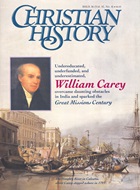
The Lasting Contributions of a Wretched Worm


Inscribed on Carey’s Tomb is his simple epitaph—“A wretched, poor, and helpless worm, On Thy kind arms I fall.”
Long before his death at age 73, Carey had become a famous, even mythic, figure. Some of his acquaintances in England began collecting relics from his youth and early life: a cup from which he had drunk, a pair of shoes he had made, a wooden board advertising his cobbler business.
Carey would have none of it: “The less said about me the better,” he declared . And when he lay dying in 1834, he summoned fellow missionary Alexander Duff to his side and whispered, “Mr. Duff! You have been speaking about Dr. Carey, Dr. Carey; when I am gone, say nothing about Dr. Carey. Speak about Dr. Carey’s Savior.”
In spite of Carey’s protestations, Christians have continued to be interested not only in Carey’s Savior, but also in Carey. More than 50 biographies of Carey have been published, representing many languages. Universities, mission societies, and publishing houses have been named for him.
Missionary Milestones
I believe Carey bears comparison with St. Francis or Martin Luther, persons of great faith who witnessed the death throes of one age and the birth pangs of another.
In particular, Carey and the Serampore Mission were catalysts for the Great Missions Century. Many of their initiatives have been imitated by missionaries since.
Systematic evangelization. Carey’s Enquiry into the Obligations of Christians to Use Means for the Conversion of the Heathens offered a concrete plan for world evangelization. Furthermore, he laid the foundations for the modern science of missiology with his comprehensive survey of the world (cataloging each country’s landmass, population, and religion). Carey’s Enquiry was a forerunner to the World Christian Encyclopedia and other indispensable modern resources for missions research.
Cultural sensitivity. Carey was a pioneer in cross-cultural communication. His willingness to translate the Bible into the vernacular and to translate Hindu writings into English showed remarkable respect for Indian culture. In addition, he established indigenous churches, trained native pastors, and cultivated “Bible women” to work among female hearers.
Education. Carey’s plan to evangelize India had three parts: preach the gospel, translate the Bible, and establish schools. This three-pronged strategy rose from Carey’s confidence in the Reformation principle of sola Scriptura [Scripture alone].
While the mission schools taught a wide range of subjects, Bible instruction was an integral part of the curriculum. By 1817 the Serampore missionaries had opened 103 schools with an average combined attendance of 6,703.
The crowning work of Carey’s educational career was Serampore College, which he co-founded in 1818. He knew English missionaries would never be able to evangelize the whole of India. Thus Serampore was founded to provide not only liberal arts, but also theological education, to Indians regardless of denomination or caste.
Social reform. Carey never lost sight of the individual, but he believed the Christian message also applied to sinful social structures. While still in England, Carey vigorously opposed slavery. In India, he urged legislation to curb the inhumane practices of infanticide and sati, the ritual burning of widows. He detested the wanton destruction wrought by war and prayed for peace among the nations of the world.
Also, Carey and his colleagues became doctors, teachers, botanists, translators, printers, and agriculturists. Even non-evangelistic activities such as these, Carey believed, could be “means for the conversion of the heathens.”
Bible translation. Carey and his associates translated the Bible into some 48 languages and dialects of India and the East. Carey himself was responsible for translating the entire Bible into Bengali, Oriya, Marathi, Hindi, Assamese, and Sanskrit, as well as portions of it into 29 other tongues. There is little doubt Carey belongs in the front ranks of Bible translators in Christian history, alongside Jerome, Wycliffe, Luther, Tyndale, and Erasmus.
By translating the Bible into the vernacular, Carey provided a potent weapon to new converts and missionary recruits. Like Wycliffe’s “poor priests,” the Lollards, who in the 1300s and 1400s carried snippets of the Scriptures into every comer of England, so Carey’s evangels moved among the rice fields and villages of northern India, leaving behind religious tracts and portions of God’s Word.
Little Accomplished?
Each year on his birthday Carey took stock of his life. In 1819 he wrote to his son Jabez, “I am this day 58, but how little I have done for God.” In 1831 he declared, “I am this day 70 years old, a monument of Divine mercy and goodness, though on a review of my life I find much, very much, for which I ought to be humbled in the dust.”
A modern historian, sympathetic to Carey, has asked, “How are we to reconcile his intense self-distrust with his great achievements?”
First, we would grossly misunderstand Carey if we attributed to him a false modesty or a lack of proper self-esteem. Those who knew him best, including some who differed with him most, testified that his life was marked by childlike simplicity and utter transparency.
In addition, few persons in the history of the Christian faith have had a more profound sense of the grace of God. “If ever I get to heaven,” he said, “it must be owing to divine grace from first to last.” Carey’s courage in the face of incredible difficulties and personal shortcomings was grounded in his unswerving confidence in the sovereignty of God.
The words of his friend John Newton, written some five years before Carey’s departure for India, make sense of this apparent paradox:
“When God has a work to accomplish and his time is come, however inadequate and weak that means he employs may seem to a carnal eye, the success is infallibly secured: for all things serve him, and are in his hands as clay in the hands of a potter. Great and marvelous are thy works, Lord God Almighty! Just and true are thy ways, thou King of saints!”
Dr. Timothy George is the founding dean of Beeson Divinity School at Samford University in Birmingham, Alabama. He is a member of CHRISTIAN HISTORY's advisory board and author of Faithful Witness: The Life and Mission of William Carey (New Hope, 1991).
Copyright © 1992 by the author or Christianity Today/Christian History magazine.
Click here for reprint information on Christian History.

Support Our Work
Subscribe to CT for less than $4.25/month