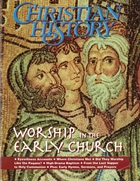
Worship in the Early Church: Christian History Timeline


The Early Church
c. 30 Distinctives of “Jesus People” in Jerusalem include daily temple worship, prayers, apostles’ teaching, fellowship, breaking of bread, baptism
c. 33 First “deacons” appointed in the church, later to become those who take Communion to the sick
c. 37 Christian worship spreads; a church established in Antioch
c. 55 Paul describes Lord’s Supper and informal worship in 1 Corinthians (ch. 11, 14)
c. 90–100 Jewish Christians virtually excluded from synagogue services
c. 95 “Book of Revelation” written, a Christian prophecy given “in the Spirit on the Lord’s Day”
c. 96 1 Clement (a letter from the church of Rome to the church of Corinth) echoes Communion prayers
c. 100 (or earlier) Didache, earliest church
service book, describes agape meal (and Communion?)
Scandalous rumors begin that Christians in their worship
practice cannibalism and incest
Ignatius, bishop of Antioch, in letters against the Docetists (those who say Christ only seemed human), stresses the “reality” of Christ’s flesh and blood in the Eucharist
c. 112 Pliny, Roman governor in Bithynia, interrogates Christians about their meetings
c. 125 2 Clement, the earliest extant Christian sermon
c. 150–180 Controversy over the proper day (Sunday or weekday?) to celebrate Easter (quartodeciman controversy)
c. 150–250 Development of “rule of faith,” a loose summary of Christian belief, especially for use against gnostics
c. 155 Justin’s Apology explains Christian worship to critics
c. 170 Melito, bishop of Sardis, writes sermon “On the Pascha.” First evidence of Christians’ venerating martyrs’ remains and celebrating anniversaries of their deaths (“birthdays”); Polycarp, bishop of Smyrna, martyred; memorials to Peter and Paul at Rome
c. 172 Montanist movement (which emphasizes ecstatic prophecy, the end times, and strict discipline) begins
197 In Carthage, Tertullian’s Apology explains conduct of Christian assemblies, and he writes the first exposition of Lord’s Prayer
c. 200 Eastern church begins to celebrate Christ’s
nativity and baptism on January 6;
frescoes in Roman
catacombs begin to depict agape/Eucharist (or heavenly banquet)
c. 200-240 Didascalia of the Apostles, a “church order” from Syria that uses Didache
c. 207 Tertullian describes Montanist-style visions received in worship
c. 215 Hippolytus of Rome writes Apostolic Tradition, a developed and influential set of guidelines for church practice
230-50 Origen’s homilies form first collection of Christian preaching
c. 232 Earliest surviving example of house converted for use in Christian worship, in Dura-Europos (in modern Iraq)
c. 255 Cyprian of Carthage insists that Communion cup contain wine (and water); he promotes priestly and sacrificial views of ministry and worship
260 Emperor Gallienus restores church property confiscated in recent persecution
321 Roman Emperor Constantine makes the first day of week a holiday as “the day of the sun”
325 Council of Nicea, first general council of church, affirms deity of Christ, sets date for celebration of Easter, and gives norms on liturgy
336 First evidence (at Rome) of December 25 celebration of Christ’s birth
c. 350? Addresses to newly baptized Christians in the Church of Holy Sepulcher, Jerusalem, by bishop(?)
Other Church & Empire Events
c. 30 Crucifixion of Jesus; Pentecost
35 Stephen martyred; Paul converted
c. 37 Temple of Divus Augustus for emperor worship consecrated
42 Apostle James beheaded
43 London founded by the Romans
46 Paul begins missionary journeys
48 Council of Jerusalem
49 Jews expelled from Rome (for disturbances with Christians?)
64 Nero persecutes Christians in Rome; Paul and Peter martyred
70 Temple at Jerusalem destroyed by Romans
79 Mt. Vesuvius erupts, destroying Pompeii
106 Rome conquers Dacia (Rumania); Empire reaches greatest size
110 Ignatius, bishop of Antioch, martyred
118 Population of Rome exceeds 1 million
132–135 Second Jewish War led by Bar Kokhba
140–160 Heretic Marcion and gnostic teacher Valentinus active
c. 160–180 Ptolemy studies astronomy and geography; findings remain useful until 16th century
164 Fifteen-year plague breaks out
177 Severe persecution at Lyons
c. 180 Irenaeus of Lyons (writing against the gnostics in Against All Heresies) emphasizes goodness of gifts of creation, including bread and wine
c. 212 Roman citizenship extended to every freeborn person
230 First Persian War
248 Goths attack Rome
250-1 First empire-wide persecution of Christians, by emperor Decius
257 Emperor Valerian hounds clergy
258 Cyprian martyred
c. 260 About 6,000,000 Christians in the Empire
c. 270 Antony, monastic pioneer, takes up life of solitude in Egyptian desert
285 Roman empire divided East and West
303-4 Emperor Diocletian begins the Great Persecution
312 Constantine converts to Christianity; Donatist schism begins
313 “Edict” of Milan gives Christians full toleration
324 Constantine becomes sole ruler of Empire
c. 318 Arian controversy begins
330 Constantinople made capital of Roman Empire
David F. Wright is dean of the faculty of divinity at the University of Edinburgh and a member of the editorial advisory board of Christian History.
Copyright © 1993 by the author or Christianity Today/Christian History magazine.
Click here for reprint information on Christian History.

Support Our Work
Subscribe to CT for less than $4.25/month