Heavenly Comet


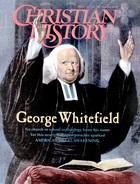
Perhaps no eighteenth-century religious figure was better known than George Whitefield. He was termed the “marvel of the age”—a preacher capable of commanding mass audiences (and offerings) across two continents, without any institutional support, through the sheer power of his personality. Whitefield wrote best-selling journals and drew audiences totaling in the millions. White and black, male and female, friends and enemies—all flocked in unprecedented numbers to hear the “Grand Itinerant.” Wherever he visited, people could do anything, it seemed, but stay away.
Yet time has not been so kind. Today few people have heard of Whitefield, or if they have, they have little sense of his significance. Whitefield founded no movement or denomination. No college or seminary bears his name. Indeed, he deliberately rejected all attempts to found a movement, preferring instead to serve alone as a self-confessed “fool for Christ.”
Who was George Whitefield? What was his significance?
Mother and Theater
We begin in the urban center of Gloucester, England, where Whitefield was born on December 16, 1714, the youngest child of Thomas and Elizabeth Whitefield. Whitefield’s father died soon after, and his mother remarried. The marriage proved disastrous and culminated in a divorce, leaving Elizabeth with seven children and ownership of the Bell Inn.
Of Whitefield’s childhood, two facts stand out: his mother’s influence and his infatuation with the English theater.
From his mother, Whitefield inherited a strong ambition to be “somebody” in the world, most likely in service to the established Anglican church. He recalled how his mother “endured fourteen weeks’ sickness after she brought me into the world but was used to say, even when I was an infant, that she expected more comfort from me than any other of her children. This, with the circumstance of my being born in an inn, has been often of service to me in exciting my endeavors to make good my mother’s expectation, and so follow the example of my dear Saviour, who was born in a manger belonging to an inn.”
From the stage, Whitefield inherited a dramatic presence that he would later take into the pulpit. As a boy he read plays insatiably and often skipped school to practice for his schoolboy performances. Later in life, though, he would repudiate theater as a false competitor of the church.
But beneath the rejection lay a born actor whose intrinsic need and special gift for dramatic self-expression never disappeared. He would apply the methods and ethos of acting to preaching with revolutionary results. More than any of his peers or predecessors, Whitefield turned his back on the academy to concentrate on perfecting what today we would call “body language.” Passion would be the key to his preaching of traditional spiritual truths.
Through the efforts of his mother, young Whitefield was granted a “servitor’s” spot at Pembroke College, Oxford: He would put himself through college by waiting on the wealthier Oxford students. The experience of being a mere servant proved humiliating, but Whitefield soon fell in with a group of pious “methodists” led by the Wesley brothers, John and Charles. Soon Whitefield was lost in the rigors of methodist devotions that culminated in a highly personal and emotional “New Birth.”
He determined to use the pulpit to bring others to a conversion experience. At Oxford it became clear to Whitefield he was no scholar, but equally clear he was a communicator without peer. With encouragement from the Wesleys he determined to be a missionary to the new Georgia colony.
Electrifying Delivery
In the summer of 1736, while waiting to embark for Georgia, Whitefield was ordained a deacon in the Anglican church and began preaching in and around London. Wherever he spoke, crowds materialized and hung on every word of the “boy preacher’s” dramatic delivery.
Though inexperienced in homiletics, Whitefield possessed dramatic sensitivity that quickly vaulted him into a class of his own. Tears, heightened emotions, agitated bodily movement—and above all, an intensely personal encounter with the New Birth—characterized his preaching and his hearers’ responses. A prodigious memory for character and dialogue enabled him to transform the pulpit into a sacred theater that represented the lives of biblical saints and sinners to his captivated listeners. Among the enthralled was great British actor David Garrick, who exclaimed: “I would give a hundred guineas if I could say ‘Oh’ like Mr. Whitefield.”
Soon Whitefield’s novel preaching and mass audiences came to the attention of the press. Whitefield possessed an instinct for publicity. He knew it mattered little whether journalistic items were written in praise or condemnation (and there was no shortage of the latter). In either case newspapers generated interest, and interest produced crowds, which produced still further journalistic comment.
To augment newspaper coverage, Whitefield published his first sermon in London in 1737: The Nature and Necessity of Our Regeneration or New Birth in Christ Jesus. The sermon’s theme was not new, but lying behind it was an electrifying delivery. Often Whitefield would employ his vivid imagination to bring home gospel truths.
Once, when preaching on eternity, he invited his startled listeners to imagine heaven: “Lift up your hearts frequently towards the mansions of eternal bliss, and with an eye of faith, like the great St. Stephen, see the heavens opened, and the Son of Man with his glorious retinue of departed saints sitting and solacing themselves in eternal joys, and with unspeakable comfort looking back on their past sufferings and self-denials, as so many glorious means which exalted them to such a crown. Hark! Methinks I hear them chanting their everlasting hallelujahs, and spending an eternal day in echoing forth triumphant songs of joy. And do you not long, my brethren, to join this heavenly choir?”
When Whitefield returned to London from Georgia in late 1738, he found many churches closed to him. He then experimented with outdoor, extemporaneous preaching, where no document or wooden pulpit stood between him and his audience. Whitefield did not invent extemporaneous preaching, but he did bring it to its highest art. Where others felt hesitant or at a loss with no notes, he discovered release.
Whitefield moved outside familiar church buildings and denominations and conceived of revivals as outdoor events staged to compete in the secular marketplace. Revivals could become, in effect, a product—part of a growing “Consumer Revolution.” Whitefield would “market” the New Birth not primarily in the churches, but in the public square.
Attracting America
On February 2, 1738, young Whitefield departed for Georgia, intending to follow the Wesleys and become a permanent missionary to the colony. This was not to be. Soon after arrival he concluded his calling was as an itinerant preacher to urban areas throughout the Anglo-American world.
Nevertheless, Georgia would remain important to him as the site of an orphan house he founded for wayward boys. That orphan house became Whitefield’s American home. Critics of Whitefield argued that the orphan house was merely a fund-raising excuse to invade the parishes of Anglican priests, but Whitefield showed genuine concern for the needy. Alongside Whitefield’s evangelical zeal was a powerful charitable instinct that would leave him personally broke but widely admired, even by skeptics like Benjamin Franklin.
In ways Whitefield never could have predicted, the London campaign of 1739 proved to be a dress rehearsal for even more stunning engagements in North America. His first preaching tour of the American colonies, in 1739–40, generated such response that later scholars dubbed it a “Great Awakening.”
Whitefield selected Philadelphia as his first American stop. It was a wise choice—a major port city with a thriving market economy, the most cosmopolitan city in the New World. On November 6, 1739, Whitefield read prayers and preached at Christ Church to a “numerous congregation.” Soon churches could not hold the vast crowds that came to hear him, and he took his ministry out of doors, where he was always at his improvisational best. Every stop along Whitefield’s trip from Philadelphia to New York and back was marked by record audiences, often exceeding the population of the towns in which he preached. From 8,000 in Philadelphia to nearly 5,000 in the village of Neshaminy, Pennsylvania, Whitefield garnered record audiences and unrivaled offerings for the Georgia orphan house.
In America, news traveled rapidly, and Whitefield was often surprised to discover how crowds “so scattered abroad, can be gathered at so short a warning.” The advance work of loyal assistants like William Seward and the cooperation of the Tennent ministers in Pennsylvania served him well. Not only were the crowds unprecedented in size, they were virtually spellbound. “Even in London,” Whitefield remarked, “I never observed so profound a silence.”
Whitefield also spoke often on the needs of the slave community. Despite his outspoken plea to legalize slavery in Georgia, and his employment of slaves at the orphan house, he increasingly sought out audiences of slaves and wrote on their behalf. Historian Gary B. Nash dates “the advent of black Christianity” in Philadelphia to Whitefield’s first preaching tour. Perhaps a thousand slaves heard Whitefield’s sermons in Philadelphia, often in private supplemental meetings.
They heard from him that they had souls as surely as the white folk who had enslaved them, and that their master owed them the freedom of religious conscience. Unlike the Wesleys, however, Whitefield was unwilling to concede their right to freedom in this life, showing the tragic limits as well as the noble extent of his charitable concerns.
Some of Whitefield’s greatest preaching triumphs were reserved for a whirlwind thirty-nine-day tour of New England towns. Attracted by printed itineraries in the New England press and by word of mouth, audiences grew.
In Boston, he filled the town common repeatedly. At seaport towns such as Marblehead and Salem, and in suburbs such as Charlestown and Roxbury, he generated an enthusiasm verging on panic as crowds “elbowed, shoved, and trampled over themselves to hear of ‘divine things’ from the famed Whitefield.”
On October 17, 1740, Whitefield preached in Northampton, Massachusetts, and stayed with the famed Jonathan Edwards. Edwards attended all of Whitefield’s sermons and repeatedly broke down in tears. Edwards’s wife, Sarah, an astute judge of pulpit manner, marveled: “He makes less of the doctrines than our American preachers generally do and aims more at affecting the heart. He is a born orator.”
The effects, she continued, were spectacular: “It is wonderful to see what a spell he casts over an audience by proclaiming the simple truths of the Bible. I have seen upwards of a thousand people hang on his words with breathless silence, broken only by an occasional half-suppressed sob.… A prejudiced person, I know, might say that this is all theatrical artifice and display; but not so will anyone think who has seen and known him.”
For his part, Whitefield was much taken with Sarah Edwards, whom he found “adorned with a meek and quiet spirit,” a model for the type of wife he hoped to find.
Unfortunately, Whitefield’s successes in the pulpit were not matched in his private family life. Like many methodist itinerants, Whitefield was suspicious of marriage and feared a wife would become a rival to the pulpit. When he finally married an older widow, Elizabeth James, the union never seemed to flower into a deeply intimate, sharing relationship.
Trans-Atlantic Awakening
Having conquered England and North America, all that remained for Whitefield was to complete a trans-Atlantic revival by awakening Scotland. In many ways, America and Scotland were kindred spirits in the eighteenth century. Both were Calvinist and perceived themselves on the margins of British civilization. Scotland’s principal city, Edinburgh, dwarfed Philadelphia and Boston, yet remained tiny in contrast to London.
Whitefield would make fourteen trips to Scotland and grow steadily in popularity. Of all the Scottish revivals in which Whitefield participated, the most dramatic came on his second visit. Throughout the spring of 1742, Whitefield received news of great spiritual enthusiasm from the small village of Cambuslang, outside of Glasgow.
On June 6, he arrived in Cambuslang just in time to catch the revivals at their peak. He began immediately to preach that morning and evening. His evening service attracted thousands and continued until 2:00 A.M. “There were scenes of uncontrollable distress, like a field of battle.… All night in the fields, might be heard the voice of prayer and praise.” Whitefield concluded, “It far outdid all that I ever saw in America.”
On Saturday, Whitefield, in concert with area pastors, preached to an estimated 20,000 people in services that stretched well into the night. On Sunday, at a special Communion service in the fields, more than 1,700 communicants streamed alongside long Communion tables set up in tents. Whitefield preached again in the evening—by many accounts, the most powerful sermon of the revival. Later he recalled that wherever he walked “you might have heard persons praying to, and praising, God.”
American Hero
Throughout his life Whitefield continued to itinerate widely, ignoring friends and doctors who urged him to protect his ailing body from the rigors of transatlantic travel. With every trip he became more popular. Indeed, much of the early controversy that surrounded Whitefield’s revivals disappeared, and former foes like Harvard and Yale Colleges or the Georgia legislature warmed to a mellowed Whitefield. Before his whirlwind tours of the colonies were complete, virtually every man, woman, and child had heard the “Grand Itinerant” at least once.
So pervasive was Whitefield’s impact in America that he can justly be styled America’s first cultural hero. Before Whitefield, there was no unifying intercolonial person or event. Indeed, before Whitefield, it is doubtful any name other than royalty was known equally from Boston to Charleston. But by 1750 virtually every American loved and admired Whitefield and saw him as their champion.
As colonial tensions with the Mother Country rose, Whitefield clearly sided with the Americans. When Benjamin Franklin appeared before Parliament, Whitefield attended every session and gave his old friend public support. Franklin would go on to win fame as America’s “representative man.” Time did not so honor Whitefield.
Final Cry of Thunder
Ignoring the advice of doctors, he continued his 1770 preaching tour in the colonies as if he were still a young itinerant. Late summer found him in New England, insisting to friends that “I would rather wear out than rust out.” He ignored the danger signs, in particular asthmatic “colds” that brought “great difficulty” in breathing. Instead of resting, he rode on, preaching more rather than less, depending on the moment of preaching to bring out a “good pulpit sweat” that would grant him one more day’s reprieve. The pace continued even after he was “taken in the night with a violent lax, attended with retching and shivering.”
On Saturday morning, September 29, Whitefield concluded another successful sermon at Portsmouth and immediately set out for the next stop at Newburyport. Eyewitnesses described him as nearly collapsing, being helped onto his horse, and then plodding on despite the entreaties of friends and admirers.
At a midday stop in Exeter, Whitefield was enjoined to preach, and he complied. One friend, on observing the “oppressive heavings of his bosom,” counseled, “Sir, you are more fit to go to bed than to preach.” Whitefield ignored the warning and answered with a prayer: “Lord, if I have not yet finished my course, let me go and speak for Thee once more in the fields, seal thy truth, and come home and die!”
Whitefield’s prayer was answered. His last discourse took place mid-afternoon in the fields, atop a hogshead [large barrel]. His text was “Examine yourselves, whether ye be in faith,” and his subject was the New Birth.
A listener recounted for the press, "He rose up sluggishly and wearily, as if worn down and exhausted by his stupendous labours. His face seemed bloated, his voice was hoarse, his enunciation heavy. Sentence after sentence was thrown off in rough, disjointed portions, without much regard to point or beauty. [But then] his mind kindled, and his lion-like voice roared to the extremities of his audience.
“He was speaking of the inefficiency of works to merit salvation, and suddenly cried out in a tone of thunder, ‘Works! works! A man gets to heaven by works! I would as soon think of climbing to the moon on a rope of sand.’ ” The exhortation would be Whitefield’s final public words. The following morning he died.
In Whitefield’s Wake
In seeking to understand the reasons for Whitefield’s success, several factors come to mind.
First, Whitefield’s revivals were a new religious form. They were not really a church, nor were they connected to local communities. Whitefield’s audiences defied the term congregation. They changed with every meeting and were routinely enjoined to support their local parishes. In effect, they were the first “parachurch”—a religious association, outside of denominational lines, premised on revival. And central to that revival was the highly personal experience of the New Birth.
Whitefield’s itinerant ministry taught him—and “evangelicals” in his wake—that rival churches with visions of national hegemony could be a thing of the past. They were old history—the history of a traditional, aristocratic, and hierarchical culture. A new religious history, fit for a new consumer age, would have to be voluntary, and this meant popular and entertaining. Whitefield’s revivals were just that. In them, churches were not supplanted so much as sidestepped to create larger, trans-local associations.
Whitefield’s mode of revivalism—theatrical, passion-based, non-denominational, international, experience-centered, and self-consciously promoted through media—outlived him. Whether or not they knew it, generations of evangelical revivalists, chaplains, youth and student parachurch leaders, and religious philanthropists followed a trail first blazed by George Whitefield.
Unlike many charismatic performers who followed in his footsteps, Whitefield remained undistracted by the allure of sex or wealth. Nor was he obsessed with fame and the need for a new denomination to bear his name. His character matched that of the biblical saints he portrayed, and his vast charitable efforts left him perennially near bankruptcy.
If Whitefield was a promoter, he was also a caring minister who directed his work first at the soul and second at charity, and never one without the other. In this sense, Whitefield was his own finest convert to the New Birth he proclaimed.
Dr. Harry S. Stout is Jonathan Edwards Professor of American Christianity at Yale University and author of The Divine Dramatist: George Whitefield and the Rise of Modern Evangelicalism (Eerdmans, 1991).
Copyright © 1993 by the author or Christianity Today/Christian History magazine.
Click here for reprint information on Christian History.

Support Our Work
Subscribe to CT for less than $4.25/month