








The Startling Puritan


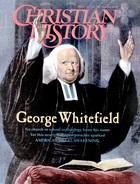
In 1829 an English publisher issued a compendium of George Whitefield’s sermons and letters titled The Revived Puritan—a very apt description, in fact, of what Whitefield was.
Whitefield was an intelligent, clear-headed, articulate communicator, but he was not original or innovative in his theology. Like all evangelical clergy in eighteenth-century England, he insisted that he taught the doctrines of the Church of England (defined in the Thirty-Nine Articles, the two Books of Homilies, and the Book of Common Prayer). The five-point Calvinism of his preaching came to him through the Puritans. His biblical interpretation followed Puritan Matthew Henry, whose Exposition of the Old and New Testaments was Whitefield’s lifelong companion. At every point the substance of his message was conventionally Protestant and Puritan—no less, no more.
Yet the things Whitefield took from this tradition came out in his own way, cast into a direct message calling for present response. His message consisted of five principal themes.
Face God
People live thoughtlessly, drifting from one day to another, never thinking of eternity. But God the Creator—mankind’s lawgiver and holy judge, the sovereign Lord who made us for himself and has us in his hands every moment—has revealed in Scripture that a day of judgment is coming when he will either welcome us into heaven’s eternal joy or banish us forever to hell.
Thus, Whitefield delivered urgent imperatives with agonized compassion for fellow mortals in dreadful danger: “Before ever … you can speak peace to your hearts, you must be brought to see, brought to believe, what a dreadful thing it is to depart from the living God.”
Know Yourself
G. K. Chesterton described original sin as the one Christian doctrine that admits of demonstrative proof, and that was how Whitefield presented it. From Genesis 3 and Romans 5 he analyzed it in the standard Reformed way: the sin of Adam was imputed to his posterity, and we all now share the penalties for his sin—physical decay, mortality, and a morally twisted disposition.
Whitefield testified, “Our first parents contracted [original sin] when they fell from God by eating the forbidden fruit, and the bitter and malignant contagion of it hath descended to, and quite overspread, their whole posterity.… All the open sin and wickedness, which like a deluge has overflowed the world, are only so many streams running from this dreadful contagious fountain.”
Before salvation can be known, “You must be made to see, made to feel, made to weep over, made to bewail your actual transgressions against the law of God.”
See Jesus
“Would you have peace with God?” Whitefield asked. “Away, then, to God through Jesus Christ, who has purchased peace; the Lord Jesus has shed his heart’s blood for this. He died for this; he rose again for this; he ascended into the highest heaven, and is now interceding at the right hand of God.”
Whitefield’s preaching, like his personal faith, centered upon the person of “dear Jesus,” the once-crucified, now glorified God-man, the gift of the Father’s love and the embodiment of divine mercy. Through plain biblical exposition, Whitefield set forth the Incarnation, Jesus’ friendship with sinners, his pity for the needy, his atoning death, bodily resurrection and ascension, his present heavenly reign and future judgment.
It has been said that nineteenth-century evangelist Charles Finney rode down sinners with a cavalry charge. Whitefield’s way, however, was to sweep them off their feet with an overflow of compassionate affection; as Christ’s ambassador he modeled his master’s goodwill toward the lost.
Understand Justification
By Whitefield’s time, Anglican minds had taken up with a moralistic, indeed legalistic, recasting of justification by faith. Faith had ceased to be self-despairing trust in the person, work, promises, and love of Jesus Christ. It had become, in the words of influential Bishop Bull, “virtually the whole of evangelical obedience”—a moral life of good works lived in hope of acceptance at the last day.
Through the cross, in Jeremy Taylor’s grotesque phrase, “Christ has brought down the market”—that is, made it possible to secure final salvation through a devotion that is not flawless. The effect of Christ’s death was thus to rehabilitate self-righteousness. Works were the way to heaven, after all.
This was in essence the theology of young John Wesley and the Holy Club in Oxford, which Whitefield had at one time imbibed. It produced a religion of aspiration, perspiration and, in sensitive souls, periodic desperation. Whitefield came to see it as blasphemous and destructive nonsense, the religion of the natural man masquerading as Christianity: “This is … the most common evil that was ever under the sun,” an evil that “cannot sufficiently be inveighed against.”
Whitefield focused not on human works but on the life and death of Jesus Christ: “Behold, what man could not do, Jesus Christ, the Son of his Father’s love, undertakes to do for him.” Thus, “The Lord Jesus Christ is our righteousness.… This, this, is gospel, this is the only way of finding acceptance with God.”
Grasp God’s Grace
The conversion process involved a change of moral nature called regeneration, or new birth. Psychologically, the praying and decision making that repentance and faith involve are human acts (done with the Holy Spirit’s help); theologically, one’s conversion should be understood as a work of the Holy Spirit from first to last.
Whitefield described God’s irresistible grace, which dissolves our resistance: “Never rest till you can say, ‘the Lord our righteousness.’ Who knows but the Lord may have mercy on, nay, abundantly pardon you? Beg of God to give you faith; and if the Lord give you that, you will by it receive Christ, with his righteousness, and his all.”
Whitefield admonished the converted to realize they were objects of God’s special, eternal love to his elect, and this love guaranteed their protection and preservation till they came to glory. “None, none can tell, but those happy souls who have experienced it,” he said, “with what demonstration of the Spirit this conviction comes—Oh, how amiable, as well as all sufficient, does the blessed Jesus now appear! With what new eyes does the soul now see the Lord its righteousness! Brethren, it is unutterable.”
To know this, Whitefield insisted, will prompt wholehearted holiness: “Those who live godly in Christ, may not so much be said to live, as Christ to live in them.… They are led by the Spirit as a child is led by the hand of its father.… They hear, know, and obey his voice.… Being born again in God they habitually live to, and daily walk with God.”
It was this mature Puritan orthodoxy that God blessed in Whitefield’s evangelistic and pastoral ministry.
“Other ministers could, perhaps, preach the Gospel as clearly, and in general say the same things,” wrote John Newton, “but … no man living could say them in his way.” That is fair: Whitefield was free of doctrinal novelties, while unmatched in application to the conscience.
All that George Whitefield ever preached, or desired to preach, was personal salvation and godliness, and for that Puritan orthodoxy served him superbly well.
Dr. J.I. Packer is a professor of theology at Regent College, Vancouver, British Columbia, and author of more than a dozen books, including A Quest for Godliness: The Puritan Vision of the Christian Life (Crossway, 1990).
Copyright © 1993 by the author or Christianity Today/Christian History magazine.
Click here for reprint information on Christian History.

Support Our Work
Subscribe to CT for less than $4.25/month