After the Revolution


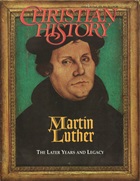
Martin Luther spent the early years of the Reformation battling the Roman Catholic establishment, defending his understanding of justification by faith alone. But 1524 and 1525 saw a major turning point in his life and career.
In the mid-1520s, Luther was forced to respond to the first major splits within the Protestant ranks. He faced a popular uprising known as the Peasants’ War. At the peak of the uprising, expecting imminent death, Luther decided to defy Satan further: he married. Then Luther became increasingly involved in building what became the Lutheran church. And in his final years, convinced he was living in the last days of the world, he issued violent treatises against all the enemies of God as he saw them—Catholics, “fanatical” Protestants, Turks, and Jews.
Luther’s later years may have been more difficult than this early ones. It is one thing to picture a new vision of the Christian faith. It is quite another thing to give this vision form so it may be passed to your children and your children’s children.
Modeling a Marriage
Luther began by giving the Protestant parsonage its first model. In 1525, the 41-year-old former monk married a 26-year-old former nun, Katherina von Bora. He married not out of love or sexual desire, he said, but to please his father, who liked the idea of grandchildren; to spite the pope, who forbade clerical marriage; and to witness to his convictions before he was martyred!
The Luthers had six children, four of whom survived to adulthood. Kate Luther took over the management of the former Augustinian cloister, where Luther lived. The Luthers welcomed and boarded hundreds of people over the years—students, orphaned relatives, and frequent guests.
From their inauspicious beginning, Martin and Kate developed love and respect for each other. Luther’s deep affection for his wife was aptly expressed when he called his favorite Pauline epistle, Galatians, “my Katherina von Bora.”
Creating a Church
To define Lutheran beliefs Luther issued the Small Catechism and the Large Catechism in 1529. They taught the fundamentals of Lutheran Christianity to a population distressingly ignorant of even the basics of Christianity. A great lover of music, Luther also wrote numerous hymns, many of which are still sung today.
In 1530, Luther’s colleague, Philipp Melanchthon, penned an enduring summary of the Lutheran faith, the Augsburg Confession. The Confession was meant to approach the Roman Catholic position as closely as possible without surrendering any crucial issue. It summed up the Lutheran position in 21 articles and then listed Catholic abuses that needed to be corrected (for example, prohibiting clergy to marry, and withholding the Eucharistic cup from the laity). The Augsburg Confession still defines the Lutheran branch of Christianity.
As the institutional church developed, politicians gained increasing influence. In 1531, the League of Schmalkalden, an alliance of Protestant princes, was formed to defend the Protestant states against possible Roman Catholic attack. In 1536, the Lutherans and southern Germans reached a concord on the Lord’s Supper. (The southern Germans acceded to the Lutheran insistence that Christ’s body and blood were received in the Lord’s Supper even by the “unworthy,” and Lutherans let drop the question whether this also applied to the “godless.”) Not incidentally, the agreement also regularized the military alliance between the northern and southern parties.
In 1539, Luther produced his masterwork, On the Councils and the Church. In it, he argued the church could not depend upon the fathers and the councils to establish its faith, but only upon Holy Scripture. Councils had no authority to introduce matters of faith or new works, but only to defend the faith and good works found in Scripture.
Meanwhile, in 1535 the papacy had announced a general council to settle the schism, though it took ten years before the council actually convened at Trent. This council was rejected by the Protestant princes for religious and political reasons, although their theologians, including Luther, argued that the princes should attend.
While Luther took part in these political and religious maneuverings, he continued his theological and pastoral labors. In 1534, he and his colleagues completed their German translation of the Bible, which has greatly influenced the development of German language and literature. Luther also lectured on both Old and New Testament books, helping the University of Wittenberg prepare the hundreds of new pastors needed to bring the Reformation to the grass roots.
Ordering Obedience
By his own admission, Luther was an angry man. Anger was his special sin. But when directed against the enemies of God, anger helped him, he said, to write well, to pray, and to preach: “Anger refreshes all my blood, sharpens my mind, and drives away temptations.”
Luther knew some were offended by his harshness and anger, but he explained, “l was born to war with fanatics and devils. Thus my books are very stormy and bellicose. I must root out the stumps and trunks, hew away the thorns and briar, fill in the puddles. I am the rough woodsman, who must pioneer and hew a path.”
The angry attacks of the older Luther began with the Peasants’ War of 1525. In 1524, some German peasants rebelled. Little by little, their uprising spread among their weary and oppressed comrades.
Luther was listed by the peasants as an acceptable arbiter of their demands. He attempted to mediate between the peasants and their rulers.
In his Admonition to Peace, Luther blamed the unrest on the rulers, who persecuted the gospel and mistreated their subjects. Many of the peasants’ demands were just, he said, and for the sake of peace, the rulers should accommodate them.
On the other hand, Luther warned the peasants they were blaspheming Christ by quoting the gospel to justify their secular demands. In fact, the gospel taught obedience to secular authorities and the humble suffering of injustice.
To Luther’s regret, the treatise calmed little. The unrest spread, and events swung Luther over to the side of the princes. In May 1525, he wrote Against the Robbing and Murdering Horde of Peasants, in which he urged the princes to “smite, strangle, and stab [the peasants], secretly or openly, for nothing can be more poisonous, hurtful, or devilish than a rebel. It is just as when one must kill a mad dog; if you do not strike him, he will strike you and a whole land with you.”
Luther had his way. The peasants were brutally suppressed, and Luther’s advocacy of their violent repression has remained controversial to this day.
Contending over Communion
Next, Luther used his angry pen in a controversy over the meaning of the Lord’s Supper. Other reformers—Ulrich Zwingli of Zurich, John Oecolampadius of Basel, and Martin Bucer of Strasbourg—denied Christ’s physical presence in the bread and wine. They acknowledged Christ was truly present, but this spiritual presence was not tied to the bread and wine; it depended upon the faith of the communicants.
Luther believed Christ’s words “This is my body … This is my blood … ” meant the Christian received the body and blood of Christ “in, with, and under” the bread and wine. For Luther, to call Christ’s words into question was to deny the promise of Christ and undercut the Incarnation. The essence of the gospel was at stake.
Luther and the other reformers gathered in Marburg in 1529 to hammer out an agreement. But no agreement was reached. Luther angrily denounced his opponents; he could no more accept their position than deny the doctrine of justification by faith alone.
Fighting for the Faith
In his concluding years, Luther issued several ferocious (and for admirers both then and now, embarrassing) treatises against his opponents. Why were they so fierce?
Luther’s reading of the Bible convinced him that practically from the beginning of the world, there had been a perpetual struggle between the true and false church. What happened to the prophets and apostles could and would happen to the church of his day. Thus, Luther concluded the papacy was the Antichrist. Protestant opponents were “false brethren,” like those who had plagued the true prophets and apostles. The Turks, who threatened Europe from the east, were a clear sign of the end times: they were Gog and the little horn in the Book of Daniel. Jews were a rejected people suffering God’s wrath for rejecting the true Messiah.
Behind all these members of the false church loomed the Devil, the father of lies. Often Luther directed his attacks not at his human opponents but at the Devil, whom he saw as their master. Of course, no language was too harsh when attacking the Devil.
It would be tempting to dismiss these writings as aberrations, as “medieval remnants,” or as the simple products of old age or ill health. But we cannot do this. These “last testaments” accurately express Luther’s views and are integral to his theology. Luther’s poor health and old age may have exacerbated his anger, but these attacks are consistent, in content and passion, with his earlier writings.
Declining in Health
In Luther’s later years, the emaciated monk gave way to the fat doctor. His health, delicate even as a monk, gradually declined. He suffered from constipation, diarrhea, hemorrhoids, dizziness, ringing in his ears, an ulcer on his leg, kidney stones, and heart problems. He also suffered from bouts of depression (battles with the Devil, he called them), and he was often gnawed by the question, “Are you alone wise?”
But his many maladies hardly slowed his productivity. Excluding Bible translations, Luther produced some 360 published works from 1516 to 1530. From 1531 to his death in 1546, he added another 184 publications to this incredible total. At the same time, he lectured regularly at the university, preached for long stretches in the parish church, wrote hundreds of letters, advised his princes in numerous memoranda, and closely followed the events of his day.
In a letter of January 1546, Luther described himself as “old, decrepit, sluggish, inactive, and now one-eyed,” hoping for a “well-deserved, rest” but still overloaded with writing, speaking, acting, and doing. A week later, Luther was off on “business” once again, making his third trip to Mansfeld to mediate a dispute between Mansfeld’s two rulers. On February 18, on this trip, he died in Eisleben. In his pocket were the beginning pages of a projected manuscript against Roman Catholics. To his last breath, the “rough woodsman” was resisting “Satan’s monsters.”
In another pocket, though, was found a slip of paper. Perhaps Luther carried it to remind himself of his limitations. The paper’s sentiments express the central conviction of Martin Luther’s life:
No one can understand Virgil in his Bucolics unless he has been a herdsman for five years.
No one can understand Virgil in his Georgics unless he has been a farmer for five years.
No one can fully understand Cicero in his letters unless he has spent twenty-five years in a great commonwealth.
Let no one think that he has sufficiently tasted Holy Scripture, unless he has governed the churches with the prophets, such as Elijah and Elisha, John the Baptist, Christ, and the apostles, for a hundred years.
Touch not this divine Aeneid.
Rather, fall on your knees and worship at its footsteps.
We are beggars, that’s the truth.
Dr. Mark U. Edwards, Jr., is a professor of the history of Christianity at The divinity School, Harvard University. He is author of Luther’s Last Battles: Politics and Polemics, 1531–46 (Cornell, 1983).
Copyright © 1993 by the author or Christianity Today/Christian History magazine.
Click here for reprint information on Christian History.

Support Our Work
Subscribe to CT for less than $4.25/month