Luther's Will and Testaments


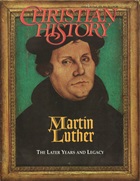
Thomas Carlyle once described Martin Luther as “great, not as a hewn obelisk, but as an Alpine mountain, so simple, honest, spontaneous, not setting up to be great at all; there for another purpose than being great at all!” That “purpose” was, in Luther’s mind, to preserve and proclaim God-given doctrine.
The thought never nested in Luther’s mind that the doctrine for which he stood was his own. “It is not my doctrine, not my creation, but God’s gift,” he declared in a 1531 sermon. “Dear Lord God, it was not spun out of my head, nor grown in my garden. Nor did it flow out of my spring, nor was it born of me. It is God’s gift, not a human discovery.”
Confession of God-given doctrine has characterized the church bearing Luther’s name ever since. Nine documents, or “symbols,” define the Lutheran Church and its theology:
1. The Apostles’ Creed
2. The Nicene Creed
3. The Athanasian Creed
4. The unaltered Augsburg Confession
5. The Apology of the Augsburg Confession
6. The Schmalkald Articles (and Tractate)
7. Luther’s Large Catechism
8. Luther’s Small Catechism
9. The Formula of Concord.
Lutheran churches commonly include a plank in their constitutions tying them to these symbols. Some churches, like the Lutheran Church-Missouri Synod, commit themselves to these “confessions” without qualification. Other Lutheran bodies refer to some confessions as historically important but not binding.
All nine documents have a connection—some more, some less—with the mind and spirit of Luther. What role did he play in each one?
Commending the Creeds
Martin Luther, of course, did not write the ancient Apostles’, Nicene, or Athanasian Creeds. But at a time when some reformers wished to do away with all things traditional, Luther saw the value in these creeds and embraced them.
As early as 1524, Luther wrote a hymn based on the Apostles’ creed:“We All Believe in One True God.” In a sermon preached on Trinity Sunday, 1535, Luther stated trenchantly: “As the bee collects honey from many fair and beautiful flowers, so is this [Apostles’] Creed collected, in appropriate brevity from the books of the beloved prophets and apostles—from the entire Scriptures—for children and unlearned Christians. For brevity and clearness it could not have been better arranged, and it has remained in the church from ancient time.”
Two years later, Luther wrote warmly on The Three Symbols or Creeds of the Christian Faith (1537). From the first, then, followers of Luther shared his creed consciousness.
Arguing at Augsburg
Soon the Lutheran movement was compelled to write a statement of its own.
Holy Roman Emperor Charles V summoned the dissident Protestant princes and leaders to a meeting at Augsburg on April 6, 1530. When Charles and his imperial retinue rode into town with the papal legate, a month late, Protestant Elector John and his allies stood upright, refusing to bow to receive the papal blessing.
The Lutheran party had worked feverishly to ready an apology, a defense of their faith. They had met with Luther on their way to Augsburg, though Luther could not join them at the diet [meeting], because a condemned heretic had no rights.
Their resultant Augsburg Confession contained two parts. In the first, the Lutherans wrote in twenty-one articles the essentials of Christian doctrine. In the second part, the Lutherans addressed areas of conflict: withholding the Communion cup from the laity; forbidding marriage for clergy; the Mass as sacrifice; obligatory confession to the priest; required feasts and fasting; irrevocable monastic vows; and the secular power of bishops.
Philipp Melanchthon, Luther’s gentler colleague, was the primary writer, but Luther guided the contents. Luther wrote, after receiving Melanchthon’s draft, “I know nothing to improve or change it,” though he admitted, “I cannot step so softly and quietly.” Later, Luther could rightly declare, “The Catechism, the exposition of the Ten Commandments, and the Augsburg Confession are mine.” As historian Philip Schaff concluded, “Luther was the primary author, Melanchthon the secondary author, of the contents.”
When the Lutheran group presented this confession to Charles V, the emperor appeared to listen attentively, though Spanish, not German, was his mother tongue. He began to nod during the two-hour-long reading, but this was no disrespect; he also drowsed when his papal theologians presented a rebuttal known as the Confutation.
But the Augsburg Confession had already made its impression. According to Schaff, “the [Catholic] bishop of Augsburg is reported to have said privately that it contained nothing but the pure truth.” The Augsburg Confession has become a standard for Lutheran theology, a document with the weight of a Declaration of Independence.
Augsburg’s Addendum
The conflict at the Diet of Augsburg led to a second document, known as the Apology of the Augsburg Confession.
Charles V had given the Protestant party until April 15, 1531 to accept the terms and the theology of the Confutation. This was unacceptable to the Lutherans, and Melanchthon wrote an Apology in response. (The Lutherans also saw the need for a defensive league in case the emperor brought military pressure against them.)
Luther had no direct hand in the Apology, which rebuts the Confutation and provides Melanchthon’s commentary on the Augsburg Confession.
Melanchthon, ever meticulous, continued to fiddle with both the Augsburg Confession and the Apology in the ensuing years. Luther deplored this indecisiveness, and he gave the original versions his unqualified support. Thus, the 1531 “unaltered” versions were used in the Book of Concord years later.
Opposing the Papacy
The next key Lutheran document, Luther’s Schmalkald Articles of 1537, set papal and Lutheran theology in sharp opposing positions.
Pope Paul III announced a church council for May 1537. The Lutheran princes and theologians decided they should be ready with a statement. Luther drafted initial articles, pointing to topics on which the Roman church had departed from the Word of God.
Lutheran leaders and theologians met in early 1537 at Schmalkald to discuss Luther’s articles. Melanchthon approved of them, though he disliked Luther’s sharpness about papal tyranny and his identification of the papacy as the Antichrist.
At the outset of the meeting, however, Luther became desperately ill. Then Melanchthon was able to maneuver the meeting to reconsider the Augsburg Confession and the Apology. Luther remained too ill to protest, and the result was that his articles were not publicly read.
The upshot of Melanchthon’s tactics, ironically, was that the princes pressed him (and other theologians) to compose a document called Treatise on the Power and Primacy of the Pope, known also as the Tractate. If anything, it even more strongly denounced papal tyranny and identified the papacy as the Antichrist. Melanchthon’s Tractate, which is spoken of as an appendix to Luther’s Schmalkald Articles, was included with them in the Book of Concord.
Ultimately, neither document was used in public debate, for the council called for 1537 never took place. Not until 1545, at Trent, was a general church council held.
Crafting the Catechisms
After visiting Lutheran churches, Luther became concerned about the laity’s ignorance of Christian doctrine. So he wrote, in 1529, his Large Catechism and Small Catechism.
Both treat the faith’s chief doctrines with uncomplicated clarity. The Large Catechism still stands as one of the finest summaries of Christian doctrine. The Small Catechism has been called “the gem of the Reformation” and “the layman’s Bible.” Thus, both were ultimately included in the Book of Concord as official confessions of the Lutheran church
Forming the Formula of Concord
The final Lutheran confession was born because difficult days followed Luther’s death. Pope Paul III managed to convene the Council of Trent which, among other things, launched a strong Catholic “counter Reformation.” Emperor Charles V defeated the Lutheran forces, even capturing Elector John Frederick and Philip of Hesse.
With Luther gone, the church that bore his name became torn by controversy. Disputes raged over the nature of original sin, the role of the human will in conversion, the place of faith and good works in a believer’s life, the presence of Christ’s body and blood in the Sacrament, eternal election, church rites, and more.
In l577 Elector August of Saxony gathered six theologians to settle the disputes and restore concord, or harmony, to the church. The resulting Formula of Concord is the most comprehensive of the Lutheran symbols, precise in definitions and careful in arrangement. Martin Chemnitz and Jacob Andreae are usually mentioned as the chief writers, and historian Schaff admits that Luther probably would have “heartily endorsed” their work. Writer Charles Porterfield Krauth has even wondered whether without the Formula of Concord, “Protestantism could have been saved to the world.”
Three years later, the Formula and other Lutheran documents were gathered in the Book of Concord, a work that continues to define Lutheran belief. For confessional Lutherans today, the Book of Concord was and is a bulwark for the faith.
Dr. Eugemne F.A. Klug is professor of systematic theology and Luther studies at Concordia Theological Seminary in Fort Wayne, Indiana, and author of Getting into the Formula of Concord (Concordia, 1977).
Copyright © 1993 by the author or Christianity Today/Christian History magazine.
Click here for reprint information on Christian History.

Support Our Work
Subscribe to CT for less than $4.25/month