Quest For Pure Christianity


Puritanism has become a label. For some, “what’s wrong with America” is that too much Puritanism survives to haunt and inhibit their country. Other Americans, though, believe the failures of our country result from the dilution of Puritan discipline and ideals.
Whether one thinks of Puritanism as bane or blessing, this is sure: no religious experiment in the New World has had a more enduring impact upon our nation’s education, literature, sense of mission, church governance, ethical responsibility, or religious vision.
This is the story of the Puritans’ mission, what they termed an “errand into the wilderness.”
Purifying the Church
American Puritanism has its beginning in sixteenth-century England. King Henry VIII (who reigned from 1509 to 1547) shook the Church in England loose from its Roman Catholic moorings. The two brief reigns that followed muddied the waters: during the reign of Edward VI (1547–1553) the nation veered sharply toward Protestantism; in the reign of Mary I (1553–1558), it veered even more sharply back toward Rome.
In the long reign of Queen Elizabeth I (1558–1603), citizens caught their collective breath and tried to determine, more precisely, the character of their new national church. It isn’t surprising that people differed—strongly, bitterly, and even bloodily.
Some passionately sought to make the Protestant Reformation a redeeming reality in all of English life and culture, thus purifying it. They came to be called Puritans. The Puritans wanted to rid the Church of England of all evidences of its historic Catholic connection, and to let the New Testament determine church order and worship. As petitioners to King James I (1603–1625) put it in 1603, the true church ought not to be “governed by Popish Canons, Courts, Classes, Customs, or any human invention, but by the laws and rules which Christ hath appointed in his Testament.”
But Puritans themselves soon split as to the method of purifying.
The Pilgrims
While some worked patiently to reform the church, moving it inch by inch and year by year, others gave up hope that such a political megachurch would ever change. So they separated from the national church in order to fashion a fellowship of their own, with the New Testament as their only guide.
One Separatist congregation meeting in secret in Nottingham (north of London) hoped that the new king, James I, would be more lenient in religious matters than Elizabeth had been. But those hopes were dashed when James declared that all dissenters must conform to England’s worship and submit to England’s bishops, or “I will harry them out of the land, or else worse.” “Worse” clearly meant “death,” for failure to conform to the Church of England was a capital crime. Yet to conform was impossible for these men and women.
In 1607 the group fled to Holland, where they could worship in a manner that did no violence to their consciences. After some years, however, they found that solution unsatisfactory; their children, burdened with difficult labor, were growing up as Dutch young people, not as English.
Aware of English claims in the New World, the Pilgrims (as these Separatists became known) conceived the ambitious and expensive plan to start a colony across the sea. They received a land grant from the Virginia Company of London and some promise of merchant support, though neither came easily. The Pilgrims had to prove they were not radical heretics; the merchants had to be assured that some return on their investments would be forthcoming.
Being “knit together as a body in a most strict and sacred bond and covenant of the Lord,” the group of about 100 sailed from Plymouth, England, on September 6, 1620. Two months later, the Mayflower arrived off Cape Cod in Massachusetts, where these settlers soon established their own Plymouth.
The Virginia Company’s patent extended no farther than 41 degrees latitude, roughly around the southern tip of Manhattan Island. The new arrivals thus realized they needed some instrument of civil government, especially since some of their number, not sharing the same religious fervor, had made “discontented and mutinous speeches.” The resulting Mayflower Compact, dated November 11, 1620, pledged the group, “solemnly mutually in the presence of God and one another,” to “covenant, and combine ourselves together into a civil body politic.” The good of the colony, not the interests of any individual, was to be the guiding principle.
Deathly Winter
During that first hard winter, death reduced the contingent by nearly half. Many continued to live aboard the ship. Only the intercession of the Wampanoag Indians, who taught them how to plant and fish, kept the mortality rate from growing worse.
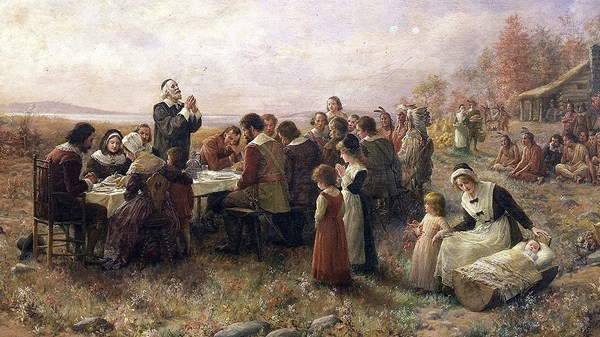
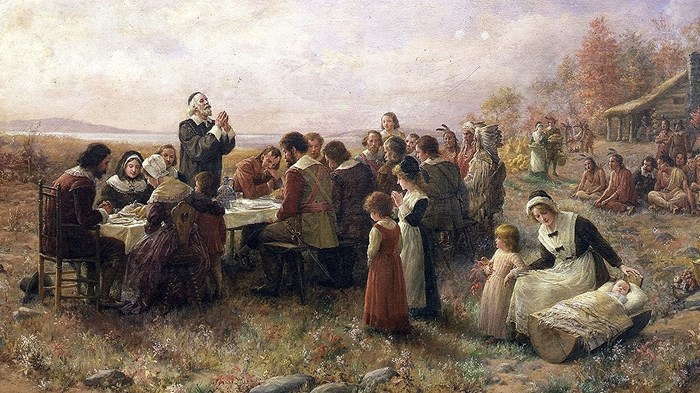
The Pilgrim migration consisted of men and women accustomed to labor in the field. So that first spring, crops were planted, houses built, and game successfully hunted. No prolonged “starving time” haunted Plymouth as it had the earliest settlers in Virginia. Nor did the Indians attack this vulnerable group; instead they assisted them, joining in their ceremonies and feasts, including the much mythologized first Thanksgiving.
William Bradford, who was elected governor thirty times between 1622 and 1656, proved to be a steady hand in directing the colony, as well as an able historian of its courage and trials.
Great Migration
England’s King Charles I, who ruled from 1625 to 1649, asserted his authority over Parliament, church, and people with even more vigor than his father, James I. His archbishop, William Laud, repressed all religious dissent. Those Puritans who had not separated from the Church of England now labored for reform with increasing difficulty, and they sensed the odds of success were against them. They faced the hard alternative of conforming, at great cost to their consciences, or defying, at great cost to their lives and fortunes. They likewise chose that other way out: migration to the New World.
When, in 1629, Charles dissolved a Parliament that tried to restrain his autocratic power, Puritans in the Church of England saw little hope. Just weeks before Charles’s action, some Puritans had applied for a charter under the name of the Massachusetts Bay Company. With such a document in hand, the time seemed ripe for a migration. John Winthrop—lawyer, Puritan, and soon-to-be first governor of the Massachusetts Bay Colony—noted that God “hath disposed the hearts of so many of his wise and faithful servants, both ministers and others, not only to approve of the enterprise but to interest themselves in it.”
The sheer number of people involved distinguished this colony from earlier English efforts. About 700 sailed with Winthrop in March 1630, another 300 followed soon thereafter, and another 1,000 before the year was out. The decade of the 1630s, producing what has been called the Great Migration, saw the population of Massachusetts Bay soar to nearly 9,000. Thus, the colony did not lack labor, skills, productive farmers, and infusions of new blood.
City Upon a Hill
What set Massachusetts apart from Virginia was its adherence to certain ideas that have been termed “the New England mind.”
In 1630, while still aboard the ship that brought them across the ocean, John Winthrop—though a layman—preached a sermon entitled “A Model of Christian Charity.” Just as one would avoid shipwreck at sea, said Winthrop, so they must avoid similar calamity on land. The only way to do that was to follow “the counsel of Micah, to do justly, to love mercy, to walk humbly with our God. For this end, we must be knit together in this work as one man.” If they would so conduct themselves, “the Lord will be our God and delight to dwell among us.” They were “entered into covenant with [God] for this work.”
Winthrop saw the Puritan venture as a way of demonstrating how nations could prosper and be blessed. God, Winthrop said, would “make us a praise and glory,” so much so that “men will say of succeeding plantations: ‘the Lord make it like that of New England.’ ” In short, “we must consider that we shall be as a city upon a hill, the eyes of all people are upon us.”
The weighty task of government, then, was to see that the covenant was not broken, that in both behavior and belief the Puritan settlers did nothing to offend God. The covenant bound them to know the will of God, as revealed in the Bible, and to follow that will as faithfully as human frailty would permit.
To help men and women follow God, ministers were chosen to interpret and enforce his will. Meeting houses were built in every town for collective praise and collective obedience. Church members, no less than pastors, must study their Bibles, examine their souls, and make straight their paths. The whole “fellowship of the saints” bore responsibility for the integrity of the church.
Each congregation, though, directed its own affairs, hiring or firing ministers and setting standards for church membership. Neither bishop nor synod ruled over them. Thus, the Puritans later assumed the denominational name of Congregationalists.
Sunday was a day not for recreation and sport (as James I believed), but for worship and meditation. Puritans, however, did not give attention to other holy days, or saints’ days, even Christmas, for these were lingering elements of the papal calendar. They did not kneel at the sacrament of the Lord’s Supper, for that suggested the bodily presence of Christ in the Communion elements. Nor did they hear confession or treat marriage as a sacrament.
Worship must be as simple at it is sincere. No priest or bishop should stand between the believer and his or her God; no altar should suggest that the sacrifice of Christ had to be repeated; no statues or pictures or stained-glass windows should distract the worshiper from concentrating upon God and the Sacred Word; no Book of Common Prayer should tell one what or how or when to pray.
Above all, no one should suggest that salvation could be earned: it was a gift of God’s grace, wholly unmerited and freely given to those whom God elected to save. In that, as in all other dimensions of life, the Almighty Creator, not the fickle objects of that creation, was in charge. This doctrine of predestination, often misconstrued as a mindless fatalism, was to the Puritans a comforting trust in the sovereignty of a loving God.
Christian Harvard
Literacy in New England was high (though many could not write, writing and “doing sums” being a more advanced stage of education). For Puritans, who put so much stake on the Bible, reading was fundamental to Christian education. Mothers were initially the chief teachers of reading and writing in the home. Soon every New England town had its grammar school for boys, while less formal “dame schools” watched over the education of the girls.
In an astonishing act of daring, the Puritans, even in the first decade of their colony, founded a college, which would soon take the name of Harvard. Patterned after Cambridge University, from which most Puritan ministers had graduated, Harvard College faithfully reflected the Puritan community. The “rules and precepts” of 1646 stipulated that every student “shall consider the main end of his life and studies to know God and Jesus Christ which is eternal life.” The Bible was to be read twice a day, with all students expected to be “ready to give an account of their proficiency therein.”
Harvard, though designed for the training of ministers, also offered education in the classics of antiquity, Renaissance languages, Aristotelian physics, and natural and moral philosophy. When a site for the infant college was selected across the Charles River from Boston, the town was called Cambridge, in memory of the Puritans’ English past and with large hopes for their American future.
The Puritans had left England to escape bishops and cleanse themselves of an impure worship. In Massachusetts Bay, the Puritans intended to recreate the New Testament church, to fashion what they had hoped the Church of England would turn out to be. They came not for freedom of religion in the abstract but for their freedom of religion in particular. They never intended to found a colony where all religious dissidents of whatever persuasion, or none, would flock.
Far from it, they did their best to keep “the New England Way” consistent, pure, undefiled. To do this, education was not enough; they sometimes had to purge, sometimes persecute, sometimes even hang.
Dangerous Dissent
Orthodoxy was never as complete as the clergy and the magistrates would have wished. From the beginning Baptists and Quakers lived in and around the colony. Banishments and hangings only slowed their growth.
In addition, many Puritans, like all Europeans of the time, practiced magic, followed astrological charts, and kept ancient superstitions alive—much as people do today. Such popular religion did not reject Puritan orthodoxy; it merely supplemented it. The supernatural world could not be confined to the prayers of the clergy or the explicit promises of Scripture. Signs and portents, visions and wonders, fortunes told and illnesses strangely cured, private rituals to ensure the fertility of fields and marriage—these lived side-by-side with Puritan orthodoxy.
Most troublesome were people who directly challenged Puritan orthodoxy. One such challenger, Roger Williams, argued that (1) the Puritan churches could not claim to be part of the Church of England while trying all the while to transform it; (2) the civil government had no business enforcing church rules or punishing its detractors; (3) all Puritan settlers were trespassers because they had not purchased the land from Indians.
Williams presented a bill of indictment so threatening that the General Court of Massachusetts determined in October 1635 that “the said Mr. Williams shall depart out of this jurisdiction within six weeks. ”
Winter Refugee
But where to go, with winter approaching, with a pregnant wife and a 2-year-old daughter? Williams eventually struck out on foot, walking south through January’s bitter cold, until he crossed the Bay Colony’s boundaries. For fourteen weeks, he wrote, “I knew not what neither bed nor bread did mean.” He accepted meager fare from the Narragansett Indians, whose language he had learned and whose confidence he had won.
At last, Williams came to Narragansett Bay, where he bought some land from the natives and named his settlement Providence, “in a sense of God’s merciful Providence unto me in my distress.” And so the colony of Rhode Island was born, one open to those of any religious persuasion or none.
Another dissenter, Anne Hutchinson, posed an even greater threat to Massachusetts Puritanism. A midwife and member of Boston’s congregation, Hutchinson wanted to take orthodoxy farther than it was willing to go. Salvation was by faith, not works, all agreed. But orthodoxy declared that after salvation, good works gave evidence of that salvation. Hutchinson challenged that assumption.
In doing so, Puritan leaders felt she broke the essential bond between morality and religion, thereby threatening to undermine the very foundation of Puritan society. She was branded an “antinomian,” literally one who is against the law.
Worse, during her trial, Hutchinson admitted to having heard “voices,” private revelations beyond the public revelation of the Bible. For Puritans, this was the ultimate presumption to be so arrogant as to claim that God spoke directly to her. She was denounced as an enthusiast—literally, one filled with God, or at least proudly pretending to be.
In 1637 the General Court brought Hutchinson to trial. John Winthrop, speaking for the Court, noted that she had “spoken diverse things … very prejudicial to the honor of the churches and the ministers thereof.” Moreover, she had “maintained a meeting and an assembly … that has been condemned by the General Assembly.” Furthermore, she had said things and done things not “comely in the sight of God, nor fitting for your sex.” The Court concluded, “She shall be banished out of our liberties and imprisoned till she be sent away.”
With her family and a significant number of supporters, Hutchinson fled to Rhode Island, where they continued to worry the authorities in Massachusetts. In 1643, after she and her family moved to Long Island, a marauding band of Mohawks abruptly ended her life.
Waning Zeal
As the decades passed, the Puritans’ original zeal began to wane. Ministers began preaching a type of sermon, the “jeremiad,” in which they lamented the loss of original fervor and exhorted people to amend their ways.
The issue of declining religious fervor came to a head in the 1660s over the issue of church membership. Initially, church membership in Massachusetts was limited to those who had a direct experience of the saving grace of God and who appeared before the church to tell of their wondrous conversion. By the 1660s, however, many of these converts’ children, who had been baptized as infants, failed to tell of such conversions. Thus they could not be full members allowed to participate in the Lord’s Supper.
Then, these people, though not full members themselves, brought their children to be baptized. To accept such a third-generation child for baptism was to relax the rigid rules of membership; on the other hand, to reject such an infant would reduce the scope and influence of the church over a growing society.
After much harsh debate, many churches adopted the so-called “Half-Way Covenant,” broadening the parameters of the church to include these children, but at cost to their pure principles.
By 1679, Massachusetts ministers were so concerned about declining faith, they felt that God had a controversy with his people, that he no longer looked with favor upon New England. They petitioned the General Court to call a “Reforming Synod.” There the ministers testified to Sabbath breaking, “Sinful Heats and Hatreds,” and most of all “A public spirit … greatly wanting in most of men.”
William Bradford’s compact and John Winthrop’s sermon seemed, if not forgotten, certainly forsaken.
When in 1691 the witchcraft episode at Salem erupted, it seemed to provide further evidence that Satan’s dominion was enlarging as the face of God turned away from New England.
A generation later, a wave of revivalism gave hope that the decline of Puritanism had been arrested or even reversed. This Great Awakening of the 1740s, recalling the vision and zeal of the 1630s, inspired many to confession of sin and godly repentance. But it was not enough.
Indeed, the Awakening, by dividing the friends of the revival from its foes, shattered the unity of the clergy and of the churches. The New England Way, which had held for more than a century, would henceforth be a personal option, but no longer a pervading social norm.
Dr. Edwin S. Gaustad is professor emeritus of history and religion at the University of California Riverside, and author of A Religious History of America (Harper & Row, 1990).
Copyright © 1994 by the author or Christianity Today/Christian History magazine.
Click here for reprint information on Christian History.

Support Our Work
Subscribe to CT for less than $4.25/month