





New England Dynasty


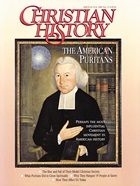
Mather. For many, the name conjures up Bible-thumping pastors, Puritan busybodies meddling in community life, and falsely accused “witches” made to pay for their alleged misdeeds at Salem in 1692.
But these images have little to do with reality.
For almost a century, the Mathers were leading lights in the Congregational firmament of colonial Massachusetts. Indeed, from Richard Mather’s arrival in 1635, through the long, fruitful pastorate of his son Increase, to the death in 1728 of his grandson Cotton, they were a spiritual dynasty.
Richard: Titan in Exile
“His way of preaching was very plain … aiming to shoot his arrows, not over the heads, but into the hearts of his hearers. Yet so scripturally and powerfully did he preach his plain sermons, that … he saw a great success of his labours, in both Englands [Old and New], converting many souls to God.”
These are Cotton Mather’s words, penned in praise of his grandfather Richard.
Born in 1596 near Liverpool, this patriarch of Puritanism came to faith while a teenager. His conversion experience was in the classic Puritan mold: self-righteous attempts to obey God’s law, despair as he compared his feeble efforts to those of seasoned saints, and finally a breakthrough. At age 18, in the words of his grandson, “the good Spirit of God healed his broken heart, by pouring thereinto the evangelical consolations of <wa>His great and good promises.” ’
After brief study at Oxford University, in 1619 Mather was ordained an Anglican minister. In more than a decade of pastoral ministry, he upheld Calvinist orthodoxy while keeping clear of the Anglican ceremonies he and other Puritans found objectionable.
After 1630, with William Laud’s installation as Archbishop of Canterbury, theological Arminianism was ascendant, and liturgical uniformity was increasingly enforced. In 1633 Mather was briefly suspended from his position; the following year he lost it. In 1635, Richard and his family took ship for Massachusetts.
Mather was soon installed as pastor of the fledgling parish in Dorchester, just south of Boston. Of his accomplishments, three stand out:
1. He persuaded his flock to require that applicants for membership provide a convincing account of their own conversion, the goal being a church composed of “visible saints.”
2. He composed the bulk of the Cambridge Platform (1649), a sort of Robert’s Rules of Order for the government of New England’s churches.
3. He ultimately argued for modifying the Platform to allow baptized non-members (who had not told of a conversion “experience”) to bring their infants for baptism. This so-called “Half-Way Covenant,” which eventually became nearly universal practice in the region, kept a foothold for the gospel in a rapidly secularizing community.
Richard died in 1669, one of the last of that generation of titans.
Increase: Voice for Orthodoxy
Richard’s son Increase has been hailed as “the greatest American Puritan” and even “the last American Puritan,” though the first is hyperbole and the second is simply not true. Still, Increase Mather was a dominant figure and the leading voice for orthodox Calvinism in an era when rationalism was beginning to undermine the Bay Colony’s religious foundations.
Increase attended Harvard College, receiving his B.A. in 1656. But instead of staying at Harvard to take his M.A., he enrolled at Trinity College, Dublin, from which he received the master’s degree in 1658.
He declined Trinity’s offer of a postgraduate fellowship in favor of service as a parish minister and military chaplain in Cromwell’s England. The restoration of the monarchy (and the re-establishment of Anglicanism) under Charles II, though, dashed his plans, and in 1661 he returned to Boston.
In 1664 Increase was called to the pastorate of Boston’s Second (“Old North”) Church, where he remained until his death. At first he had a reputation as something of a radical, opposing the Half-Way Covenant. Eventually, though, he came to embrace his father’s views.
A celebrated preacher, during his half-century at the helm of Old North he spent most of his waking hours in his study, preparing the biblically grounded, theologically sophisticated sermons his flock demanded. His delivery was free, his style plain and direct, his imagery vivid. Many of his sermons were eventually published.
Increase was appointed a (nonteaching) fellow of Harvard College and a member of the school’s corporation in 1675; ten years later he was elected president. He reorganized and revitalized the college, enlisting as resident (teaching) fellows the able John Leverett and William Brattle.
But Mather insisted on retaining his pastorate in Boston, and his absence at Cambridge meant these two men wielded unusual influence. Their flirtation with broad-church rationalism ultimately led more than one of their students into the Church of England. Too many others came to embrace a dry Christian moralism that made little room for the grace of Christ.
Increase raised his voice in defense of Calvinist orthodoxy, but his absence from the campus made it impossible for him to mount a sustained offensive. Finally, in 1701, the progressives forced his ouster. This was the low point of his ministry.
Its high point had come earlier, in 1688–1691, when Increase was dispatched to London to negotiate the return of the colony’s original charter, which had been rescinded by Charles II. Although Increase failed in this task, he greatly influenced the terms of the new charter granted by King William.
His death in 1723 marked the end of the middle era in New England Puritanism.
Cotton: Renaissance Puritan
Cotton Mather has been mocked as the last, dullest defender of New England’s dead orthodoxy and hailed as the unwitting herald of modern American secularism. Even in his day he aroused intense loathing in some and great loyalty in others.
Born in 1663, he was named for his maternal grandfather, the learned John Cotton. The young Mather showed intellectual prowess, mastering Latin, Greek, and Hebrew as a child and graduating from Harvard at the tender age of 15.
Having experienced conversion as a teenager, he followed his father and grandfather into the ministry. Although he received offers from a number of congregations, his most determined suitors were the parishioners at Boston’s North Church. In 1685 he was ordained and installed as his father’s associate.
Cotton shared his father’s commitment to evangelical Calvinism, taking great pains to maintain a united front with him against their adversaries. But where Increase’s sermons were plain and direct, Cotton’s were flowery and ornate, full of literary references and theological tangents.
Father and son also parted company in their pastoral priorities. While Increase focused on the pulpit and study, Cotton canvassed house by house across Boston, catechizing parishioners and evangelizing the unchurched. He even composed an instructional pamphlet to guide other pastors in this undertaking.
Cotton also organized lay societies, generally numbering a dozen or so members, which met in private residences once or twice a month to pray, study the Bible, and share one another’s burdens. Such groups contributed greatly to the vitality of North Church.
Regrettably, most closely associated with Cotton’s name today is the execution of nineteen alleged witches in Salem Village in 1692. Cotton, like most of his contemporaries, believed in witches, and he wrote in defense of witch trials. But he denounced, as did his father, the way the Salem trials were being handled, insisting on more objective proof. The united opposition of Boston’s clergy was crucial to aborting the trials and saving dozens from the gallows.
Cotton authored hundreds of books on topics ranging from theology and the supernatural to medicine and local history.
But his supreme achievement lay in drawings on the perspectives of English Puritans like Richard Baxter and German Pietists like August Hermann Francke to forge a distinctively American spirituality. This new piety would finally come into its own with the flowering of evangelicalism in the nineteenth and twentieth centuries. Mather’s ministry bridged the gap between what was and what was to be.
For years, Cotton Mather sought New England’s spiritual awakening, praying that God would again pour out his Spirit on its churches and communities. His death in 1728 brought an end to a spiritual dynasty, but within a decade came the answer to his prayers—the Great Awakening.
Dr. George W. Harper is professor of church history and theology at Alliance Biblical Seminary in Manila.
Copyright © 1994 by the author or Christianity Today/Christian History magazine.
Click here for reprint information on Christian History.

Support Our Work
Subscribe to CT for less than $4.25/month