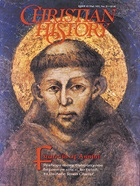
Francis of Assisi: A Gallery of Five Who Knew a Saint


Pietro Di Bernardone
(1155?–1220?)
Bewildered father
Pietro di Bernardone was a successful cloth merchant and considerable landowner, having orchards and farms in the plain below Assisi and on the slopes of nearby Mount Subiaso.
He was also a great enthusiast for things French; he was away in France on business, in fact, when his son Giovanni was born. Upon his return, he renamed the boy Francesco, “the little Frenchman,” and made sure his son learned to speak French.
As the boy grew, Pietro taught him the family business, and he was no doubt proud when his robust 21-year-old marched off to war with fellow Assisians to battle rival city Perugia. He was also no doubt alarmed when he heard that his son had been captured and imprisoned. He paid a handsome ransom to get him back. But his son was never the same after that. Francis went off once more to war, but his heart wasn’t in it; he returned saying he was seeking a different calling.
This new calling began to alarm Pietro when one day his son impulsively took fine fabric from the shop, rode to market, and sold it— along with the family horse he had been riding!
A month later, Pietro was informed that Francis was walking the streets of Assisi, begging for food and becoming a laughingstock. An enraged Pietro found his son and beat him. He dragged him home and locked him in a dark cellar, limiting him to bread and water, until his son came to his senses.
These then customary and legal means of enforcing parental authority did not bear fruit. As soon as Pietro was called away on business, Francis’s mother let her son go.
That’s when Pietro called in the authorities. He told the bishop that his son, divine calling or not, had no business stealing from the family. The bishop summoned Francis and instructed him to return what he had taken. Pietro and the bishop waited as an obviously shaken Francis stepped into an adjoining room. When the door opened again, Pietro saw his son walk out naked, carrying his clothes in a neat pile. He placed them at Pietro’s feet and said to all present, “Up to now, I have called Pietro di Bernardone father. Hereafter I shall not say, Father Pietro di Bernardone, but Our Father Who Art in Heaven!”
It is a scene full of wonder. Was Francis’s acceptance of his divine mission primarily a rejection of his father? If so, what personal issues divided father and son? Or did a life of poverty require forsaking his father, who would always represent the lure of Mammon, the life of ease and comfort?
We simply don’t know, for the historical sources remain silent. We can only watch as transfixed son and astonished father walk out of the cathedral, one on the narrow path of pilgrimage, the other on the wide path to his fabric shop—never, as far as we know, to have anything to do with each other again.
Giles of Assisi
(c.1190–1262)
Laborer, lover, and knight
Like many young men, Giles was no doubt filled with dreams of glory, daring, and great deeds. He observed the eccentric yet enchanting behavior of his fellow Assisian, Francis. Then, after two prominent citizens of the town forsook wealth and status to join Francis, 18-year-old Giles did the same. On Saint George’s Day, when churches across Europe honored the great knight’s dragon slaying, Giles presented himself to the “little poor man.”
Giles became a sort of spiritual knight, traveling to Rome, to Saint James of Compostela in Spain, to the Holy Land. His quest? To know his Lord as he visited holy places, and to make him known as he lived and preached the way of Francis.
As a boy, Giles knew well the sweat of the farm, and on his travels, he earned his room and board by chopping firewood, sweeping rooms, washing dishes, moving haystacks, cutting cane, fetching water. For Giles labor was never “common” but instead an uncommon opportunity for joy and moral purification.
Once he overheard a worker scold idle peasants, “Don’t talk, but do, do!” Giles, thrilled at this crisp summary, ran toward some friars he was with and, while still some distance away, shouted, “Just listen a bit to what this man is saying: ‘Don’t talk, but do, do!’ ”
Knight and laborer Giles was also a lover. The most extraordinary moments of his life came during prayer, in moments of ecstasy with God. From 1234 to his death, he forsook traveling and pursued a life of contemplation.
To that secluded spot near Perugia came people as poor as Giles and as great as Pope Gregory IX and as brilliant as philosopher Bonaventure, all to seek his advice or venerate him.
His sayings were colored with talk of life in the country: “Sins are like burrs that stick to clothes and are hard to pluck off.” Sometimes chivalry supplied the analogy: Whoever gives up prayer because of difficulties “is like a man who runs away from battle.” The good knight does not immediately leave the battlefield when he is wounded or struck by the enemy; rather he continues to battle vigorously to win.
Many of his sayings, collected in The Sayings of Brother Giles, are paradoxical charges: “If you want to see well, pluck out your eyes and be blind. If you want to hear well, be deaf. If you want to walk well, cut off your feet.”
This quest, begun at age 18 at the foot of Francis, absorbed Giles until his death at age 72. As he put it, “If a man were to live a thousand years and not have anything to do outside himself, he would have enough to do within, in his own heart.”
Anthony of Padua
(1195–1231)
Scholar and “wonder worker”
Today Saint Anthony is widely invoked for the return of lost property, for protection of travelers, and for the health of the pregnant. In paintings, we see him with a Bible or lily in hand, representing his knowledge of Scripture, or with a donkey, which supposedly knelt before the sacrament he once held aloft.
In history, though, we see another, more rugged side of Anthony.
Born in Lisbon to a noble family, he spent the passions of youth on Augustine: he joined and began studying with members of the Augustinian order at age 15. Ten years later, his life of quiet devotion was disrupted.
One day some relics passed through town: the remains of Franciscan friars recently martyred in Morocco. Anthony was electrified. Like many spiritual athletes of the times, nothing excited his blood more than the thought of dying for Christ. He sought immediate release from his order and joined the Franciscans. Appointed a missionary at his request, he boarded a ship headed for Morocco.
He never made it. Illness forced his return, and a storm forced the returning ship to Sicily. So he made his way to Assisi, where his life again became one of quiet prayer and work aimed at spiritual perfection.
Almost immediately, though, his quiet was interrupted. When he preached at his ordination, it was discovered that studious and passionate Anthony was learned and eloquent. Francis then appointed him to teach theology for the burgeoning Franciscan Order.
Some Franciscans were startled at this: Hadn’t Francis taught that study was to be avoided because it fostered pride? Perhaps this is why Francis wrote Anthony a now famous letter: “Brother Francis [sends his] wishes of health to Brother Anthony, my ‘bishop.’ It pleases me that you teach sacred theology to the brothers, as long as—in the words of the Rule—you ‘do not extinguish the Spirit of prayer and devotion’ with study of this kind.”
For the few next years, Anthony held various administrative posts—and he preached. He was phenomenally popular, sometimes attracting crowds of up to 30,000. He fearlessly denounced powerful men for their unjust treatment of the poor, and moneylenders for their profiteering. So successful was he at converting heretics in Southern France and Northern Italy, hotbeds for the infamous Cathari, he was called “The Hammer of the Heretics.”
He also became known as a “wonder worker” for the miracles he wrought, sometimes during his preaching. One story has it that, as he spoke at a gathering of Franciscans, Francis was “raised up into the air” and blessed the brothers. In another, as Anthony preached to an international gathering of clergy, all understood him as if he spoke in their own tongues—a new Pentecost.
From 1230 on, he spent the remainder of his life near Padua. His furious pace, though, brought about premature death at age 36. Within only six months, he was canonized.
He is considered to be the founder of all later Franciscan scholarship and is now called the “Evangelical Doctor”; for in 1946 he was named a Doctor of the Church for “the great advantage the church has derived” from his learning and holy life.
Gregory IX
(1170–1241)
Machiavellian friend
Pope Gregory IX doesn’t seem like the type of person who would be a friend of “the little poor man” of Assisi. Take, for instance, his handling of Holy Roman Emperor Frederick II.
When in 1227, Frederick balked about going on a crusade, the newly installed Gregory excommunicated him. When Frederick relented and left for Palestine, Gregory lifted the excommunication but had Frederick’s holdings in Italy attacked. He also told Frederick’s Italian subjects that they no longer owed Frederick allegiance.
When Frederick hurriedly concluded a treaty (giving the Muslims possession of Palestine) and returned to Italy to recover lost territory, Gregory excommunicated him again.
Years later, when Frederick called Gregory “wickedness … seated on the throne of the Lord,” Gregory didn’t quite turn the cheek: he called Frederick the “monster of slander.”
Take another instance: Gregory has the dubious distinction of founding the Inquisition. It was his way of combating heretic Waldensians and Cathari in France, Italy, and Spain. Though he gave the Dominicans responsibility for prosecuting heretics, he personally took on special cases. Punishments were not limited to excommunication but also included civil punishments: whippings, stocks, torture, and in extreme cases, hanging or burning.
Still, this Gregory was a man “afire with love” for Francis. While still Bishop Ugolino of Ostia, he had met Francis: “When he saw that Francis despised all earthly things more than the rest,” wrote an early biographer, “and that he was alight with the fire that Jesus had sent upon the earth, his soul was from that moment knit with the soul of Francis and he devoutly asked his prayers and most graciously offered his protection to him in all things.”
Ugolino soon became Cardinal Protector of the Franciscan Order, and as cardinal and as Pope Gregory IX, he fostered growth of the Franciscans and the Poor Clares. He encouraged the mission work of the Franciscans (and Dominicans), and he canonized men like Francis and Anthony of Padua in record time.
Some of this attention was no doubt politically motivated: it was to his advantage to increase an order that was directly subject to his authority. But in this fierce and wily politician there also seems to have been a humble reverence for the man whose life and teachings pointed to a better way.
Elias of Cortona
(c. 1180–1253)
Prodigal Franciscan
Elias was a man of remarkable gifts, possessing a character that, as one historian put it, “was a strange combination of piety and pride.”
He was a notary in the town of Bologna when he joined Francis, and he quickly became a trusted friend. Francis placed great confidence in him, perhaps because, as one historian wrote, “he admired gifts in this organizing genius which he himself did not possess.” Elias was appointed provincial of the friars in Syria, and in 1221, minister general of the entire Franciscan order.
Elias was close to Francis in his last years. According to one early biographer, he received Francis’s dying blessing: “You, my son, I bless above all and throughout all.” At Francis’s death, the grieving Elias gathered witnesses to verify Francis’s stigmata and wrote the letter informing friars of their founder’s passing.
Though no longer minister general, he was entrusted with building a church in Francis’s honor. To that basilica Francis’s relics were transferred in 1230, and, to prevent theft, Elias had them buried under gravel, bands of iron, and heavy stone.
Two years later, Elias was again proclaimed minister general of the order. To honor Francis, whom he loved dearly, he wanted the Order to be great and powerful. He failed to realize how paradoxical his efforts would be.
He completed the ornate lower church of the great basilica that today dominates Assisi, pressuring ministers and brothers to contribute. He also promoted missionary work in Syria and throughout Europe, and he enlarged study houses. Under his leadership, the Order grew in numbers and influence.
In appointing, transferring, and dismissing ministers, however, he relied on the almost unlimited powers granted him by the Rule of the Order. He also showed favoritism in his appointments.
His personal lifestyle scandalized some: on the grounds of health, Elias insisted on a personal cook, and he preferred to have his meals served by properly attired servants.
Conservatives finally orchestrated a coup in 1239, and Elias was deposed. When Elias joined up with Frederick II, the pope’s perpetual antagonist, Elias was excommunicated. A small body of friars followed him, and for them he erected a monastery at Cortona.
Fourteen years after being deposed, though, as he lay on his deathbed, Elias did penance, and he died absolved.
Mark Galli is managing editor of Christian History.
Copyright © 1994 by the author or Christianity Today/Christian History magazine.
Click here for reprint information on Christian History.

Support Our Work
Subscribe to CT for less than $4.25/month