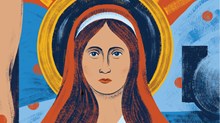
Francis’s Tenacious Lady
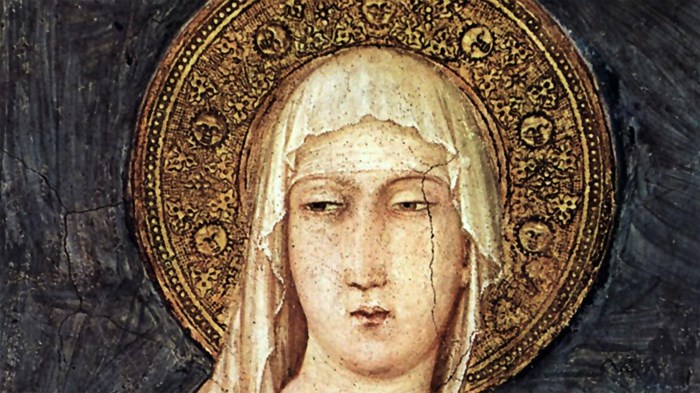


While praying before a cross in 1193, a woman named Ortulana of Assisi received a prophecy about the child growing within her womb: “Do not be afraid, woman, for you will give birth in safety to a light which will give light more clearly than light itself.” When the child was born, Ortulana named her Chiara, or Clare, “the clear one.”
In many ways, the light of Saint Clare, disciple of Saint Francis, has been hidden under Francis’s bushel—until now. Last year’s celebration of the 800th anniversary of her birth has sparked what a Minnesota newspaper described as “Clare mania.” And for good reason: Clare carved out her own unique, attractive way of being Franciscan.
Noble Family
Clare of Assisi was born into the noble Offreduccio family, which boasted seven great and wealthy knights. Her father, Favarone, was a count, who probably fought and died in a crusade. Clare’s mother made pilgrimages to the Holy Land, the tombs of Peter and Paul in Rome, and the shrine of Saint James of Compostela in Spain.
As a beautiful noble woman, Clare had many suitors, but she refused all marriage proposals because she had made a private vow of virginity. In addition, she divested herself of her inheritance and gave the money to the poor. In fact, her sister Beatrice tells us that Clare sold part of Beatrice’s inheritance, too!
During her early teen years, Clare prayed regularly with other women, including other noble women. Like her mother, Clare slowly earned a reputation for good works and virtue.
Following Francis
By this time, Francis had publicly rejected his father’s wealth and was enlisting help to rebuild the walls of the Church of San Damiano. Before Francis ever mentioned having a community of brothers, he prophesied at San Damiano that “ladies will dwell here who will glorify our heavenly Father throughout his holy church.”
Perhaps he was searching for women to fulfill this prophecy when he first visited Clare in her home. (Beatrice, though, later said Francis came because he heard about Clare’s holiness.)
Francis continued to visit Clare, and she “more frequently” visited him (both accompanied by their companions). Though Clare was already living a holy life in a community, Francis wanted her to start a new way of life. Then again, maybe Clare, having heard him preach, needed little persuasion.
In any case, on the evening of Palm Sunday 1212, Clare slipped through the door of her family home and made her way down the winding streets of Assisi, outside the city walls, through the dark olive groves, to the small chapel called the Portiuncula, where Francis and his brothers waited. She put on the drab garb of the Poor Brothers, and her hair was cut. Francis’s brothers then accompanied her to the Benedictine monastery in Bastia.
“After the news reached her relatives,” The Legend of Saint Clare notes, “they condemned with a broken heart the deed … and, banding together as one, they ran to the place, attempting to obtain what they could not [that is, Clare]. They employed violent force, poisonous advice, and flattering promises, trying to persuade her to give up such a worthless deed that was unbecoming to her class and without precedence in her family. But taking hold of the altar clothes, she bared her tonsured head, maintaining she would in no way be torn away from the service of Christ.”
After another relocation, and another attempt by her family to bring her home, Clare and her sister Agnes, who had joined her, moved to San Damiano, dedicating their lives to Francis’s way, as poor virgins in imitation of the poor Jesus.
Poor Ladies
Soon other noble women came to live and pray with Clare, including her mother and her sister Beatrice. They called themselves the Poor Ladies. (Today members of her order are known as Poor Clares.)
Their life together was austere: they ate food the brothers begged for them, wore simple clothing, lived from the work of their hands, and fasted often. Clare’s health, in fact, broke down as a result of her fasting. Nonetheless, she continued making cloth, providing altar linens to more than fifty churches around Assisi.
Clare called the Poor Ladies her sisters, rather than nuns, for she believed they equally shared in the humanity of Jesus. When she was 21, she reluctantly agreed to accept the role of abbess, though she never used the title during her forty years of service.
Nor did she ever ask her sisters to do anything she would not do herself, including, as one sister later wrote, “giving them water by hand, washing the mattresses of the sick sisters with her own hand, and even washing the feet of the serving sisters.” One account of her life adds that Clare washed the mattresses of the sick, “not running away from their filth nor shrinking from their stench.”
Clare’s reputation spread, and many sought her healing touch for themselves or others. The Legend of Saint Clare tells how Francis sent Brother Stephen to her because he was afflicted with madness. Clare made the sign of the cross over him and then permitted him to sleep in the place where she usually prayed. Shortly he arose, healed; he returned to Francis freed of his insanity.
Clare always made the sign of the cross over the person who needed healing, indicating from where she drew her miraculous power.
Clare and her Poor Ladies remained devoted to Francis and cherished his visits and teachings. When he died in 1226, they felt the loss deeply. Thomas of Celano described Francis’s funeral procession as it passed by Clare’s Monastery of San Damiano:
“Redoubling their sighs and looking upon him with great sorrow of heart and many tears, they began to proclaim in a restrained voice: ‘Father, father, what shall we do? Why do you abandon us in our misery? Or to whom do you leave us, who are so desolate? Why did you not send us rejoicing ahead of you to the place where you are going—us whom you leave in prison, us whom you will never visit as you used to?’ ”
Hunger Strike
In 1216, after much pleading, Clare had received from Pope Innocent III the right to live without communal property. But two years later, Cardinal Ugolino issued a new rule for her monastery, and it did not include this Privilege of Poverty. Clare objected, but without effect.
Then, after Francis’s death in 1226, a papal bull prohibited Francis’s brothers from serving as preachers to the Poor Ladies; there was concern about the possibility of sexual indiscretion.
At this point, Clare protested vigorously, refusing the food that the friars supplied her monastery. Her biography says, “The pious mother, sorrowing that her sisters would more rarely have the food of sacred teaching, sighed, ‘Let him now take away from us all the brothers, since he has taken away those who provide us with the food that is vital.’ ” In short, she went on a hunger strike.
When Pope Gregory heard of it, he rescinded this aspect of his rule. In 1247, another rule was imposed upon her order by Innocent IV. Clare, unhappy with this rule, wrote her own Form of Life, which was eventually approved.
Clare’s Way
Clare’s spirituality was profoundly influenced by two central mysteries of the Christian faith, the Incarnation and the Redemption.
Clare was impressed at how the Virgin mother carried Jesus in her womb. She concluded that she and her sisters had a similar mission: “As the glorious Virgin of virgins carried him materially, so you, too, by following her footprints, especially those of poverty and humility, can without any doubt, always carry him spiritually in your chaste and virginal body, holding him by whom all things are held together.”
The impoverished state of Jesus’ birth, life, and death became the basis of Clare’s poverty. In her Testament, Clare urged her sisters to always observe poverty “out of love of the God who was placed poor in the crib, lived poor in the world, and remained naked on the cross.” In addition to physical poverty, though, Clare sought spiritual poverty, emptying herself to make room for God.
For Clare, the Passion of Christ showed that temporal suffering is transformed into eternal glory. Urging Agnes of Prague, who had established a sister foundation, to persevere in poverty, Clare wrote, “If you suffer with him, you will reign with him. [If you] weep [with him], you shall rejoice with him; [If you] die with him on the cross of tribulation, you shall possess heavenly mansions in the splendor of the saints, and in the Book of Life your name shall be called glorious among [all].”
Death of a Saint
In August 1253, as Clare lay on her deathbed, her Form of Life was finally given papal approval, the first rule written by a woman to be so approved. Two days later, on August 11, she died and was buried in the church of San Giorgio, where her body remains today.
During her forty-year ministry, in spite of the many obstacles she had faced, Clare’s order had grown rapidly. It began as a single house in Assisi; by the time of her death, there were 147 houses of “Damianites” throughout Europe.
Like Francis, Clare was canonized rapidly, two years after her death, by Pope Alexander IV, a close friend of the Poor Ladies.
Ingrid Peterson, O.S.F., is a lecturer at the Tau Center, Sisters of Saint Francis, in Winona, Minnesota. She is author of Clare of Assisi: A Biographical Study (Franciscan Press, 1993).
Copyright © 1994 by the author or Christianity Today/Christian History magazine.
Click here for reprint information on Christian History.

Support Our Work
Subscribe to CT for less than $4.25/month