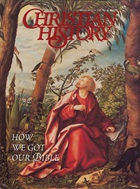
A Testament Is Born


“But Jesus bent down and started to write on the ground with his finger” (John 8:6).
Here, in the story of the adulteress, we learn that Jesus knew how to write. But Jesus was a teacher, not a writer—it was left to others to write down what he said. Yet literacy was something Jesus could take for granted. The ability to write fluently and intelligibly was widespread in ancient Israel, almost as widespread as the ability to memorize long and complicated texts.
In other words, Jesus could count on this: among his followers there would be a number of people capable not only of memorizing what he said, but also of writing it down.
Furthermore, Jesus and the people around him could use more than one language. Aramaic was commonly used in daily life, Hebrew in religious life, particularly in worship and the reading of Scripture (e.g., Luke 4:16–30).
But people were aware of a third language, that of the eastern Roman Empire: Greek. Recent investigations have shown that even orthodox Jews used Greek in everyday dealings with each other—we see it, for instance, in tombstone inscriptions and in handwritten notes passed between defenders of the Masada fortress.
Jesus himself used Greek: in the dialogue with the Greek-speaking Syrian Phoenician woman (Mark 7:24–30), and in the dispute about paying taxes to Caesar (Mark 12:13–17), which relies on a wordplay that works only in Greek.
But (and this is a fairly recent insight of scholarship) the first stages of a literary tradition may have been instantaneous with Jesus’ ministry—and they could have been surprisingly precise. Shorthand writing (“tachygraphy”) was known in Israel and in the Greco-Roman world. We find a first trace of it in the Greek translation of Psalm 45:1 (third century B.C.): “My tongue is the pen of a skillful writer”— literally, “a stenographer.”
Such a skill was highly necessary. Writing material was scarce: leather or parchment was highly priced; papyrus was dependent on import. Writers often were forced to use pot shards or wax tablets, which had limited room for detailed texts. Shorthand writing was the most practical remedy.
There was even a man among Jesus’ entourage who was professionally qualified to write shorthand: Levi-Matthew, the customs official. Indeed, if Levi-Matthew had heard the Sermon on the Mount before he was called by Jesus (and could react so swiftly to this call because he had already been convinced by that sermon), one may have in Matthew 5 through 7 a direct result of a shorthand protocol.
Whatever the exact reconstruction of the earliest stages may be, we do know from the prologue to Luke’s Gospel that there were more literary sources he could use than just the completed Gospels of Matthew and Mark: “Many have undertaken to draw up an account of the things that have been fulfilled among us, just as they were handed down to us by those who from the first were eyewitnesses and servants of the word” (Luke 1:1–2).
In sum, though there exist theological theories about the long and slow development of the Gospels in certain ancient communities, some historical evidence suggests the first followers of Jesus may have handed down his teaching in written form.
Christian Libraries
Early Christians soon gathered such writings. They were profoundly interested in the literary world. Occasionally, they talk about it with humor: “Jesus did many other things as well. If every one of them were written down, I suppose that even the whole world would not have room for the books that would be written” (John 21:25). Or they ask for writing material: “When you come, bring the cloak that I left with Carpus at Troas, and my scrolls, especially the parchments” (2 Tim. 4:13). Or they are seen in the process of writing: “Write on a scroll what you see and send it to the seven churches” (Rev. 1:11).
So well acquainted were they with a literary tradition, literature was used in symbolic ways: “The sky receded like a scroll, rolling up … ” (Rev. 6:14).
This advanced interest in writing had an obvious consequence: texts had to be collected in archives and libraries, and even in stores from which copies could be ordered and supplied. Christians from a Jewish background would have known the collected scrolls of the Torah, the Prophets, the Psalms, and so forth. Those of Greco-Roman background would have known the collections of philosophers and poets like Aratus, Cleanthes, Menander, Euripides, and others, to which Paul alludes in his letters and speeches.
The discovery of the Dead Sea Scrolls helps us to understand how Jews and Jewish Christians organized their libraries.
There were three types of books: copies of Holy Scripture (what we now call the Old Testament), commentaries on Scripture, and theological writings.
For Christians, the first Scriptures they thrived on were the Law and the Prophets. These were copied and distributed since they provided the sources for one vital ingredient of the Christian message: the suffering and redemption of Jesus the Messiah had been predicted many centuries earlier.
Collected Letters
But how should Christians interpret these sources? How should they put them into practice? How should they integrate them into the life and teachings of Jesus?
Interpretation, first of all, was given in major speeches—like those of Peter at Pentecost, and those of Stephen and Paul—collected and edited by Luke in the Acts of the Apostles, the sequel to his Gospel.
More important, there were the letters, all of which in one way or another interpret Old Testament stories, people, and prophecies. Some of them—like Paul’s letter to the Romans, the anonymous letter to the Hebrews, or the two letters of Peter and the letter of Jude—depend on a good knowledge of the Old Testament and other Jewish texts.
Early Christian letters, in fact, were the first documents distributed as collections. We find a trace of this in the New Testament itself. At the end of Peter’s second letter, we read, “Bear in mind that our Lord’s patience means salvation, just as our dear brother Paul also wrote you with the wisdom that God gave him. He writes the same way in all his letters, speaking in them of these matters.” The statement presupposes a collection of Paul’s letters, though not necessarily a complete collection.
Some recent scholarship has begun to “redate” 2 Peter to the lifetime of Peter (rather than regard it as a second-century work of one of Peter’s disciples); following that dating, an initial collection of letters would have existed in the mid-sixties of the first century. That makes sense: Paul’s surviving letters had all been written by then.
A few years ago, Young-Kyu Kim, a papyrologist at Göttingen University, demonstrated, I think conclusively, that p46 (an early collection of Paul’s letters) should no longer be dated about a.d. 200, as it has commonly been. Instead, Kim showed, with a variety of evidence, that it should be dated to the late first century—in other words, to the lifetime of people like John and other “survivors” of the first Christian generation.
The Final Four
And the Gospels? Again, more can be said today than a few years ago. Martin Hengel of Tübingen University, one of the world’s leading New Testament scholars, provided some new insights into the process of collecting the Gospels.
Look at a modern book on a library shelf—you glean the author’s name from the spine. In New Testament times, there were no spines, since books existed in scrolls. No matter how these scrolls were stored, you would merely see the “top end,” with a handle. In order to identify the contents, little parchment or leather strips (called sittiboi) were attached to the handle.
Since space was scarce, if there existed just one book on a given subject, only the title would be given. For the Gospels, as long as there was only one, the sittibos would have said, Euangelion, that is “Good News,” or “Good News of Jesus Christ.” But the very moment a second Gospel came into existence, differentiation became necessary; the first and the second Gospel would have carried the name of the authors—“according to Mark,” “according to Matthew,” and so on.
Thus, long before the end of the first century, there was—of necessity—a systematic approach to identifying the authors and cataloguing their works.
By the beginning of the second century, the number of the Gospels and the names of their authors were therefore well established. Our first literary source is Papias, writing at about A.D. 110. None of the later so-called gospels existed yet—neither the Gospel of Thomas, nor that of Nicodemus, of James, nor whomever. Papias knows and accepts the earliest Gospels, and he gives us some anecdotal information about their authors.
For instance, he calls Mark “stubble-fingered”—what on earth does that mean? What does he mean when he tells us that Mark was the hermeneutes of Peter? Interpreter? Translator? Editor? The word could mean all three.
Or what does it mean when Papias writes that Matthew compiled the logia (sayings) of Jesus en hebraidi dialecto (in Hebrew/Aramaic dialect)? In Hebrew/Aramaic style but in the Greek language? Could he have known about Levi-Matthew’s shorthand notes of Jesus’ public addresses (i.e., logia)?
The brief quotes from Papias’s works leave many a question unanswered. The gist of it, however, remains: Papias of Hierapolis knew about a collection of Gospels as early as the beginning of the second century—and this implies the existence of such a collection at an even earlier stage. In other words, he appears to corroborate what we now know about Paul’s letters from the redating of that papyrus codex p46.
Some seventy years later, about 180, Irenaeus offers one other item that has stimulated scholarly debate. He gives for the first time the order of the four Gospels as we have it today: Matthew, Mark, Luke, and John. In addition, he tells us that Mark’s Gospel was written after the “exodus” of Peter and Paul.
This word has been used as a tool for dating the Gospel; for if exodus means “death,” as the majority of critics have assumed, then a.d. 67, the probable date of Paul’s and Peter’s martyrdoms, would be the earliest possible date for Mark.
Exodus, however, can also mean “departure”—as in the title of the second book of the Old Testament. Does Irenaeus imply a departure of Peter and Paul from Rome some time before their eventual return and martyrdom?
Only a couple of years ago, an American scholar, E. Earle Ellis, provided an important part of the answer. He analyzed every single work of Irenaeus, and he discovered that Irenaeus never uses exodus when he means “death.” For “death,” he always employs the unequivocal Greek word thanatos. Thus, Mark’s Gospel was probably written not after the deaths of Peter and Paul but after their departure from Rome—some time before.
Other New Testaments
Much like today, early Christians had their favorite texts, and occasionally, letters or even whole Gospels remained unused in certain regions. Second Peter, for example, was read almost exclusively in its “target area,” northern Asia Minor. Clement of Rome, writing in about a.d. 96 (perhaps several decades earlier) is the first known author to have quoted from this letter. Communities elsewhere in the Roman Empire had not even heard of it, let alone read it initially. When it finally reached them, some uttered doubts about its apostolic authorship. (However, Origen, the third-century theologian and philologist, stated that Peter had proclaimed the gospel of Christ on “the twin trumpets of his two letters.”)
Or take Mark’s Gospel—it may, in all likelihood, have been the first full Gospel ever completed. But Matthew’s longer, story-and-speech Gospel soon became more popular, and thus we know of more manuscript fragments of Matthew than of Mark.
It isn’t surprising, then, that some people began collecting and arranging Christian writings in peculiar ways. A man called Marcion arrived in Rome in about A.D. 140 and developed a pseudo-Christian idea of God and Christ. That led him to exclude those early apostolic writings that highlighted the physical resurrection of Christ and the Jewish roots of Christianity. In the end, all he accepted was a severely condensed version of Luke (without the Nativity scenes and the detailed Resurrection appearances), and ten of Paul’s letters. Soon enough, he and his followers were condemned as heretics, and their movement eventually petered out.
Narrowing the List
Marcion, however misguided, did force the church to consider more formally which books should make up the New Testament.
In this process, the church never gave in to the temptation to “harmonize” the documents. The four Gospels—with their different emphases, narratives, speeches—were seen not as an embarrassing multitude but as complementary, as the God-given fullness of reports by human beings with their individualities. They were never seen, as Marcion saw them, as contradictory, and therefore in need of editing.
To give another example: early Christians were perceptive enough to notice that the letter of Jude had taken over large chunks from 2 Peter (or vice-versa). But they were also intelligent enough to realize that this provided an insight into the way letters were used and applied during the first generations.
Nor was Martin Luther the first to notice that Paul, with his emphasis on faith, appeared to see things in a different light from James, who stresses the importance of works. The early Christians preferred to see these themes as complementary. “Unity in diversity”—this may be a description of the yardstick applied to the collection that grew into our New Testament.
But where to end? How extensive should that diverse collection finally be? Which books and letters should be used in services? In particular, what about such writings as the second-century Didache, or the Letter of Barnabas, the Shepherd of Hermas, or the two letters to the Corinthians once attributed to Clement of Rome?
Eusebius of Caesarea, writing at the beginning of the fourth century, surveyed the state of things. He pretty much confirmed the contents of a fragmentary list from about a.d. 200, a list called “Canon Muratori.” Eusebius says that some texts are still under debate in some churches—the letters of James and Jude, the second letter of Peter, the second and third letters of John, and Revelation. Though he does not share such doubts himself, he is adamant that the Shepherd of Hermas, the Apocalypse of Peter, the Acts of Paul, the Letter of Barnabas and the Didache are “not genuine,” that is, not of truly apostolic origin.
A few decades after Eusebius, the Codex Vaticanus, a Greek volume of both Old and New Testaments, contained the complete New Testament as we have it today; but only slightly later, Codex Sinaiticus still included the Letter of Barnabas and the Shepherd of Hermas. Later still, toward the end of the fourth century, the Codex Alexandrinus excluded the Shepherd and Barnabas, but had the two letters of Clement instead.
In other words, even major, official codices, expensive to make and therefore produced with at least regional authority, continued to show a certain degree of freedom of choice beyond the agreed core of the 27 writings. It was an individual who finally helped clarify things.
Unshakable Consensus
In 367, Athanasius, Bishop of Alexandria, used the opportunity of his annual Easter Festal Letter (a letter to all the churches and monasteries under his jurisdiction) to explain what the Old Testament and New Testament should consist of. In terms of the New Testament, he listed the same 27 texts we have today, and he wrote, “These are the ‘springs of salvation,’ so that anyone who is thirsty may be satisfied with the messages contained in them. Only in them is the teaching of true religion proclaimed as the ‘Good News.’ Let no one add to these or take anything away from them.”
Athanasius then says that the Shepherd of Hermas and the Teaching of the Apostles (the Didache) are “indeed not included in the canon.” He does say, however, that they are helpful reading for new converts.
Athanasius’s list did not settle the matter everywhere. In the West, variations remained possible, and as we have seen, a codex like Alexandrinus could, decades after the Festal Letter, happily include two letters the bishop did not even mention. But by the early 400s, the consensus of tradition was more or less established.
In a letter in 414, Jerome appears to accept the New Testament books listed by Athanasius—a list that corresponds to today’s New Testament. But Jerome thinks the Letter of Barnabas should also be included, since the author was the companion of Paul and an apostle. But, and this is important, while agreeing to differ, Jerome accepted what had come to be the consensus. In other words, Jerome confirms that by the beginning of the fifth century, the canon of the New Testament had achieved a kind of solemn, unshakable status; it could not be altered, even if one had different opinions.
Since Jerome’s time, the canon of our New Testament has been approved by history, tradition, and worship. In spite of some scholarly attempts to exclude or add some books, these 27 books have remained a non-negotiable nucleus of Christianity worldwide.
Dr. Carsten Peter Thiede is director of the Institut Für Wissenschaftstheoretische Grundlagenforschung in Paderborn, Germany. He is also a member of the CHRISTIAN HISTORY advisory board.
Copyright © 1994 by the author or Christianity Today/Christian History magazine.
Click here for reprint information on Christian History.

Support Our Work
Subscribe to CT for less than $4.25/month