


Holy, 'Knock-'Em-Down' Preachers


In 1802, 26-year-old Jacob Young began a new Methodist preaching circuit along the Green River, a vast and growing region of central Kentucky. Knowing he could count on little help from his supervising elder (a millwright who divided his time between his craft and itinerant preaching), Young devised his own strategy for evangelizing the region:
“I concluded to travel five miles, as nearly as I could guess, then stop, reconnoiter the neighborhood, and find some kind person who would let me preach in his log cabin, and so on till I had performed the entire round.”
Near the end of one dreary day, Young came upon a solitary cabin in the woods. He spotted a woman in the doorway and asked for lodging, but the woman refused. Desperate, Young exclaimed, “I am a Methodist preacher, sent by Bishop Asbury to try to form a circuit.”
“This information appeared to electrify her,” recalled Young. “Her countenance changed, and her eyes fairly sparkled. She stood for some time without speaking, and then exclaimed, ‘La, me! Has a Methodist preacher come at last?’”
The family were North Carolina Methodists recently migrated to Kentucky. Their home soon became a regular preaching appointment on Young’s circuit.
This eager reception of a Methodist circuit rider was repeated over and over again in the late 1700s and early 1800s, so much so that Methodism experienced remarkable growth.
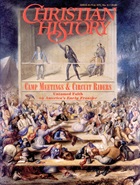
Early circuit riders were a different kind of clergy than had ever been seen in America, serving a rapidly expanding and spiritually hungry nation. They pursued their calling with remarkable zeal, forever changing the style and tone of American religion.
What was a circuit rider’s life like? And what was their collective impact?
Virtual Miracle
Along with the Baptists, the Methodists were among the fastest growing churches in post-Revolutionary America. Between 1770 and 1820, American Methodists achieved a virtual miracle of growth, rising from fewer than 1,000 members to more than 250,000. In 1775, fewer than one out of every 800 Americans was a Methodist; by 1812, Methodists numbered one out of every 36 Americans. At mid-century, American Methodism was almost ten times the size of the Congregationalists, America’s largest denomination in 1776.
Key to the Methodist success was a dedicated contingent of itinerant preachers, or circuit riders. In this era, most Americans lived on widely scattered farms or in tiny, often remote villages. In 1795, 95 percent of Americans lived in places with fewer than 2,500 inhabitants; by 1830 this proportion was still 91 percent. Itinerant ministry provided preaching, the sacraments, and church structure to communities that would not otherwise have been able to attract or afford a minister.
In 1790, the Methodist preacher Freeborn Garrettson noted that in New York, thousands “in the back settlements, who were not able to give an hundred [pounds] a year to a minister … may now hear a sermon at least once in two weeks; sometimes oftener”—thanks to the presence of Methodist circuit riders.
In many areas, the pace of settlement simply outran the resources of the older denominations. In 1770, the territories that would eventually become Georgia, Kentucky, Ohio, and Tennessee contained only about 40,000 people of European or African descent. By 1810, the combined population of these same regions was over 1 million. In many of these rapidly growing regions, the Methodists held the only religious services for miles around.
The Methodist Difference
In contrast to the mobility of the Methodist itinerants, New England clergy traditionally held lifetime tenure in a single parish. Of the 550 graduates of Yale College who entered the Congregationalist ministry between 1702 and 1794, a remarkable 71 percent ministered for their entire career in only one church. In colonial New England, both pastor and people saw ordination as a long-term commitment to a single congregation. Nothing could have been more foreign to the Methodist concept of an itinerant ministry.
Educationally and socially, the early Methodist preachers were cut from the same fabric as the farm and artisan families who made up the bulk of their audiences. Unlike their college-educated Congregationalist, and Presbyterian counterparts, the early circuit riders began ministry with a natural social affinity with their listeners.
The typical circuit rider was a young, single man who hailed from an artisan background, who himself had already moved several times from one village or town to the next, but whose life had been abruptly transformed by a dramatic conversion experience. Before turning to preaching, Bishop Francis Asbury (Methodism’s most influential early leader) had been a blacksmith, and most of the other preachers had been carpenters, shoemakers, hatters, tanners, millers, shopkeepers, school teachers, sailors, and so on.
In many cases, the only real distinction between a Methodist preacher and his audience was which side of the pulpit each was on. Almost none of the first- or second-generation itinerants had anything more than a common school education. Up to 1800, even a full-time itinerant’s salary was limited to a paltry $64 a year. In that year, it was increased to $80 a year for an unmarried preacher. By comparison, the average annual income of a Congregationalist minister in 1800 was $400.
Ministry on the Move
A typical Methodist itinerant was responsible for a predominantly rural circuit, 200 to 500 miles in circumference. He was expected to complete this circuit every two to six weeks, with the standard being a four weeks’ circuit. His partner, if he had one, usually did not travel with him, but either followed or preceded him on the circuit. Hence, on a four weeks’ circuit, the people could expect preaching about every two weeks, but only rarely from a circuit rider on a Sunday.
On rural circuits, the itinerants made preaching appointments for nearly every day of the week, sometimes both morning and evening, with only a few days per month allotted for rest, reflection, and letter writing. Circuit riders were urged to preach at 5:00 a.m. in the summer and 6:00 a.m. in the winter.
The itinerants usually met and examined the classes (weekly small-group gatherings of one or two dozen people) at each appointment—all of which could take three to four hours a day, apart from traveling. Quarterly meetings, held at a centralized location, added variety to this routine, and beginning in the early 1800s, camp meetings often replaced one of the quarterly meetings.
Boiling Hot Religion
Early Methodist sermons emphasized the practical, the immediate, and the dramatic. “People love the preacher who makes them feel,” observed Methodist preacher Thomas Ware. The typical circuit rider preached from a basic set of Scripture texts embellished with anecdotes and analogies from everyday life. The few expository skills he used were largely gleaned from the sermons of colleagues. But he also learned to preach with what the itinerant Henry Smith referred to as an irresistible “holy ‘knock-’em-down’ power.”
Nothing would have been more anathema to Methodist itinerants than the dispassionate reading of a prepared sermon. They preached extemporaneously, without notes or manuscript. As Bishop Asbury once urged one of his preachers, “Feel for the power; feel for the power, brother.”
Circuit riders were both familiar and frightening, homespun heralds of a gospel that was attuned to everyday life yet unsettling in its larger implications. This approach led one contemporary to call early Methodism “a boiling hot religion.”
The preaching of John A. Granade is an extreme but telling example. Born in North Carolina about the time of the American Revolution, as a young man Granade became “perfectly reckless,” rambling through Kentucky and the Cumberland country (an Appalachian region in Kentucky, Virginia, and Tennessee) before settling in South Carolina to teach school. Distressed over his spiritual condition, Granade made his way to Tennessee, where for two years he was plagued by “voices” and “tormenting whispers.”
Day and night, through snow and rain, during the winter and spring of 1797–1798, Granade wandered about the woods “howling, praying, and roaring in such a manner that he was generally reputed to be crazy.” Throughout the western states he was known as the “wild man.”
Finally converted at a camp meeting, Granade immediately channeled his spiritual energy into preaching. “I would sing a song or pray or exhort a few minutes,” Granade later recalled, “and the fire would break out among the people, and the slain of the Lord everywhere were many.” Crowds began to follow him from place to place, “singing and shouting all along the road.” Some claimed Granade had a secret powder that he threw over the people to enchant them, and others believed he worked “some secret trick by which he threw them down.” At one meeting, so many people fainted and “lay in such heaps that it was feared they would suffocate.”
Baptizing Common Places
American Methodists soon redefined sacred space. By 1785, only 60 Methodist chapels had been purchased or built, but there were more than 800 recognized preaching places. Meetings were held in homes (where the majority of weekday sermons were delivered), courthouses, schoolhouses, the meeting houses of other denominations, barns, or in the open.
While riding the St. Lawrence circuit in 1813, Benjamin Paddock regularly preached in a dry goods store in Potsdam, New York. Likewise, Robert R. Roberts once preached in a tavern in northwestern Pennsylvania, though not without difficulty. Partway through Roberts’s discourse, a drunkard in the audience awoke, calling out, “Landlord, give me a grog!” When Roberts protested granting the man’s request, the tavern owner replied, “Mr. Roberts, you appear to be doing well; I would thank you to mind your own business, and I will mine.”
Grueling Pace
The early circuit riders preached and traveled at a grueling pace. John Brooks, for example, labored so intensely during his first three years in the itinerancy that he reported, “I lost my health and broke a noble constitution.” During one tempestuous revival, Brooks lay “sick in bed,” but the people “literally forced me out, and made me preach.”
In 1799, itinerant Billy Hibbard rode the Cambridge, New York, circuit, a 500-mile, four-week circuit with up to 63 preaching appointments, in addition to the responsibility of meeting the classes. In one year on the Flanders, New Jersey, circuit, Thomas Smith estimated he traveled 4,200 miles, preached 324 times, exhorted 64 times, and met classes 287 times. Indeed, in many parts of the new nation, Methodist preachers suddenly seemed to be everywhere, leading one New Yorker to exclaim in 1788, “I know not from whence they all come, unless from the clouds.”
Circuit riders also frequently had to contend with poor or uncertain lodging. Most often the itinerants stayed with sympathetic families along their routes, though they sometimes lodged at inns or slept in the open.
At the end of one weary day in the North Carolina back country, the itinerant Thomas Ware sought shelter at the isolated cabin of a young couple.
“The man gave me to understand, at once, that I could not stay there,” recounted Ware. “I looked at him, and smiling, said, that would depend upon our comparative strength.” Unwilling to wrestle the Methodist preacher, the couple relented—and in the morning Ware baptized their children.
Bishop Francis Asbury set the standard for all early Methodist itinerants and left little doubt as to what he expected from his charges. During his 45-year career, Asbury, who never married, rode more than a quarter of a million miles on horseback and crossed the Allegheny Mountains some 60 times. He visited nearly every state once a year. One biographer estimates that Asbury stayed in 10,000 households and preached 17,000 sermons.
Common Heroes
Following Asbury’s example, the Methodist circuit riders transformed religious life on the early American frontier.
After devising a strategy for evangelizing central Kentucky, for example, youthful Jacob Young set out. On most days, he managed to find a place to preach. On one occasion, Young preached in a bar room. Several times he found groups already gathered, eagerly awaiting the rumored appearance of a preacher. Wherever possible, Young established weekly class meetings to carry on in his absence.
At a place called Fishing Creek, Young discovered a Methodist society under the leadership of an African-American slave named Jacob. With the assistance of several local women, Jacob preached regularly and had organized a class meeting. Young was impressed with what he saw. Though Jacob was illiterate, Young noted that he “could preach a pretty good sermon,” and that “his society [was] in excellent order.”
Within three weeks, Young had forged enough appointments for a four weeks’ circuit. By the end of the conference year, Young had taken in 301 new members, receiving all of $30 for his labors.
Once after Jacob had preached, a man began shouting at the top of his voice, “Young Whitefield! Young Whitefield!”—comparing him to the great eighteenth-century evangelist.
Recalled Young, “I thought I was one of the happiest mortals that breathed vital air.”
And so were the many families he ministered to—those for whom Methodism became a pillar of their lives.
John H. Wigger is assistant professor of history at St. Olaf College in Northfield, Minnesota.
Copyright © 1995 by the author or Christianity Today/Christian History magazine.
Click here for reprint information on Christian History.

Support Our Work
Subscribe to CT for less than $4.25/month