




Catholic Counterpoint


Most of us know about the English Reformation from the writings of those who triumphed, the Protestants. But to understand the English Reformation fully, we must also ask, what was it like to be a Catholic during this time of religious turmoil?
The question becomes more important because recent scholars of the English Reformation have argued that the English Catholic church was not as corrupt—nor the Protestant Reformation as pure—as many people believe.
To gain a broader grasp of this turbulent time, Christian History invited Catholic historian Dennis Martin, a Wheaton College graduate who teaches medieval and Reformation history at Loyola University in Chicago, to offer a Catholic perspective on the English Reformation.
On May 4, 1535, in London, three Carthusian monks and one Bridgettine monk were hanged until partially conscious. Then their bellies were cut open, their intestines wrenched out and tossed on a fire, and their hearts ripped out by hand. The bodies were beheaded and quartered, and the pieces were posted at various locations throughout England. As the executioner slit open his belly, John Houghton, prior of the London Carthusian monastery, said, “O most holy Jesus, have mercy upon me in this hour.”
This was the punishment for treason in sixteenth-century England. Their crime? Refusal to recognize “the king, our sovereign, to be the supreme head of the Church of England afore the Apostles of Christ’s Church.”
No one had ever questioned the piety, learning, and spiritual vitality of the Carthusians and the Bridgettines. Their monastic houses were frequented by devout lay people for prayer and spiritual growth. In fact, Archbishop Thomas Cranmer, who knew two of the victims personally, opposed the executions, but only because he hoped the monks could eventually be convinced to recognize the king as head of the church.
And that gives us a clue as to what many recent historians think is the real nature of the English Reformation.
Naked Power Grab
The conventional story of the English Reformation has been told by Protestants. It begins by describing the Catholic church as moribund and lacking popular support. Protestants triumphed over a decadent church that was in collusion with power-hungry political rulers. The incident above, and others like it, suggests another story.
Unfortunately, many historians have overlooked a significant fact: the Church of England’s victory over the Pope was possible only because the king and Parliament seized absolute control of English religion. Henry grabbed the power of the church for himself, and his regime systematically destroyed the symbols, institutions, and customs that had sanctified English daily life for a thousand years.
Historians Eamon Duffy (in The Stripping of the Altars) and Christopher Haigh (in English Reformations) have shown that the Reformation in England largely came from the top down. Protestants accused Catholic bishops and monks of manipulating the common folk to believe superstitions and practice idolatry, but some of the most blatant examples of manipulation and intimidation came from Henry VIII and Thomas Cromwell.
For instance, facing widespread defiance of royal efforts to eliminate veneration of the saints, in 1538 Vicar General Thomas Cromwell staged an elaborate set of demonstrations rigged to “prove” that miracles associated with images of saints were hoaxes.
Cromwell and Henry made sure the Bible was made available to the English people. But they soon became alarmed that, instead of leading to “meekness” among his subjects, Bible reading fostered arguments in taverns, churches, and ale houses. So in April 1539, Henry drafted a degree that forbade anyone but licensed graduates of universities and parish priests to expound the Scriptures.
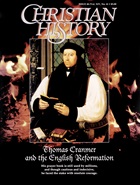
This desire to control the religion of the populace was not restricted to the king. Cranmer was a strong and persistent advocate of the king’s headship of the English church. In his homily at Edward VI’s coronation, he said to his new sovereign, “Your majesty is God’s vice-regent and Christ’s vicar within your own dominions.”
Nowhere is this absolutism clearer than in the decree of March 1551 that “for as much as the King’s Majestie had neede presently of a mass of money,” all the remaining precious metal and valuable church furnishings were taken by the government. Such church furnishings belonged to the parish, and they were cherished by descendants of the donors. This decree from on high struck at the heart of local religion and history.
Those who think the Protestant Reformation threw off the yoke of tyrannical church leaders and restored a New Testament church must realize that not Scripture but a sacralized king was in charge of the English Reformation from start to finish.
Attacking Practice
The Reformation in England was more an attack on religious practice than on doctrine, as Protestant, Catholic, and secular scholars alike realize today. According to Duffy, the fifteenth and early sixteenth centuries in England witnessed a massive effort to teach Christianity to the people: “The teachings of late medieval Christianity were graphically represented within the liturgy, endlessly reiterated in sermons, rhymed in verse treatises and saints’ lives, enacted in the Corpus Christi and miracle plays, which absorbed so much lay energy and expenditure, and carved and painted on the walls, screens, benchends, and windows of the parish churches.”
So it’s not surprising that with his Act of Supremacy in 1534, Henry intended to keep England’s religious practices largely as they were: Catholic. All he wanted to do was to change who was in charge of the church. Most elite members of society knuckled under or maintained silence, although even silence, as the case of Thomas More illustrates, could be costly.
Archbishop Cranmer, though cautious throughout the 1530s, tried to attack firmly Catholic religious practices. Other Protestants were less patient. Hugh Latimer did not stop at railing against Catholic “image-worship.” He presided in May 1538 over a “jolly muster,” as a traditional-minded friar, John Forest, was roasted alive over a fire made of a wooden statue of a saint hauled out of a pilgrimage church.
King Henry became alarmed at such anarchic iconoclasm and tried to apply the brakes from 1539 to 1547, but it was too late. The king had set in motion changes in 1534, and these changes made possible the success of the all-out assault on traditional religious practice under Edward (1547–1553).
Crushed with Stones
Still, during Henry’s and Edward’s reigns, support for Catholic religious practice remained strong, as popular rebellions in 1536, 1548, 1549, and 1554 show. But even after the Elizabethan settlement, when Protestantism ruled the nation uncontested, traditional Catholicism remained deeply embedded in all classes. Nowhere is the strength of lay devotion more evident than in the story of Margaret Clitherow.
Born about 1553 in a leading Protestant family of York, Margaret married a wealthy tradesman, John Clitherow, in 1571. Three years later, she became a Roman Catholic, although her husband remained Protestant.
In March 1586, when she was in her early thirties, she was arrested for harboring Catholic priests. She refused to plead guilty or innocent, lest her children and husband be compelled to testify against her. The penalty for refusing to plead was to be crushed to death under nearly half a ton of weights. Even her Protestant neighbors respected her and refused to testify against her.
Why did Margaret Clitherow turn to the Catholic faith, especially in Elizabethan England? Not because of birth or indoctrination, nor because she was hoodwinked by superstitious, semi-pagan, idolatrous beliefs. For Margaret, the church was an institution with historical continuity to the apostles and the incarnate Jesus Christ:
“I am fully resolved in all things touching my faith, which I ground upon Jesus Christ, and by him I steadfastly believe to be saved, which faith I acknowledge to be the same that he left to his apostles, and they to their successors from time to time, and is taught in the Catholic Church through all Christendom, and promised to remain with her unto the world’s end, and hell-gates shall not prevail against the same faith; for if an angel come from heaven, and preach any other doctrine than we have received, the Apostle biddeth us not believe him.”
Margaret was convinced that a mere change at the top, such as Henry VIII envisioned and Elizabeth was establishing with finality, actually constituted a massive betrayal of Christ’s Church.
On Annunciation Day (March 25) 1586, as the weights crashed down on the heavy oak door that covered her, as her ribs could be heard to crack, Margaret said, “Jesus! Jesus! Jesus! Have mercy on me.” Her body was left under the door and weights from 9 a.m. to 3 p.m., then stuffed secretly in a rubbish heap.
I have yet to encounter stories of the English Carthusians and Bridgettines or of Margaret Clitherow or John Forest in the pages of any standard textbook covering the Reformation in England. They shed a different light on the “glory” of the English Reformation.
Copyright © 1995 by the author or Christianity Today/Christian History magazine.
Click here for reprint information on Christian History.

Support Our Work
Subscribe to CT for less than $4.25/month