






Acrobat Theologian


After the Church of England broke from Rome in 1534, it needed to define what it uniquely believed. Conservatives, like King Henry VIII, wanted a church whose faith was Catholic in essentials. Many academics, particularly at Cambridge, wanted reforms that were clearly Protestant. How could these theological concerns be reconciled or balanced?
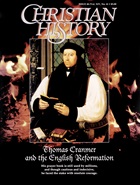
What eventually emerged was something in between, a theology that has come to characterize worldwide Anglicanism. In large part, this was the judicious work of Archbishop Thomas Cranmer, a pastoral theologian who had a genius for what we now know as the “middle way.”
The Way to the Middle
The document that most clearly articulates this middle way is called the Thirty-Nine Articles; these have become the foundation of Anglican theology. They are a statement of faith based on Cranmer’s Forty-Two Articles, and it can be reasonably claimed that Cranmer is the father of modern Anglicanism.
As early as 1535, agents of the king were negotiating with German Lutherans, who wanted the Church of England to subscribe to the Augsburg Confession of 1530. After months of deliberation, negotiations were broken off.
At the same time, Cranmer was busy working on a shorter statement of faith, known as the Ten Articles of 1536, which served as the basis of faith for the Church of England for the next few years. Out of them came a commentary, generally known today as the Bishops’ Book (1537), which explained the main points of the Christian faith, including the Ten Articles, to ordinary members of the Church of England.
In the Ten Articles, Lutheran influence is felt in many places. In Article 5, on justification, for example, Cranmer states, “Sinners attain this justification by contrition and faith joined with charity … not as though our contrition or faith, or any works proceeding thereof, can worthily merit or deserve to obtain the said justification, for the only mercy and grace of the Father, promised freely unto us for his Son’s sake, Jesus Christ, and the merits of his blood and passion, be the only sufficient and worthy causes thereof.”
On the other hand, Catholic practices like the veneration of images, the cult of the saints, and prayers for the dead were reaffirmed. And Article 4, on the Lord’s Supper, can be interpreted in either a Lutheran or a Catholic view of Christ’s presence in Communion.
This middle road took a turn toward Rome in the late 1530s, when the king decided the Church of England had gone too far in Luther’s direction. In 1539, Parliament passed an act that set out six points of traditional Catholic doctrine that Henry wanted the church to maintain. One of these articles clearly reaffirmed the medieval doctrine of transubstantiation—that the bread and wine become in substance the body and blood of Christ. Another rejected clerical marriage. Though the act did not expressly contradict the Ten Articles, its spirit was decidedly Catholic.
In 1543, Cranmer suffered a further reversal of his Lutheran sympathies when the king issued his own commentary on the church’s faith, the King’s Book, which was notably more Catholic in tone and an attempt to counteract the Bishops’ Book.
It was not until Henry died, in 1547, that Cranmer was free to develop his doctrinal ideas, but then there were pressing problems that demanded his attention—for one, reordering the church’s worship.
It wasn’t until 1553 that he was able to devote himself to a new statement of faith, consisting of forty-two articles. These articles, though, officially lasted only six months because Catholic Queen Mary I ascended the throne.
But after the accession of Elizabeth I in 1558, Cranmer’s Forty-Two Articles were rescued from oblivion and revised. They were published in 1563, and in a final form in 1571, as the Thirty-Nine Articles. In 1628 King Charles I declared that these articles would be the definitive statement of the church’s doctrine, and so they have remained ever since.
Middle Way on Predestination
The subsequent progress of Protestantism, and more detailed confessional statements like the 1647 Westminster Confession, have obscured the fact that in their own day, the Forty-Two Articles were the most developed and most systematic expression of Protestantism that had yet appeared. By comparison, the Thirty-Nine Articles occasionally appear to be less advanced. Yet on matters of deep and lasting controversy, the Thirty-Nine Articles strike a balance that clearly reflects Cranmer’s own judicious and cautious temperament.
An excellent example is the seventeenth article, which deals with the thorny subject of predestination. Cranmer states that “Predestination to life is the everlasting purpose of God,” thereby restating a doctrine that had been affirmed since Augustine (354–430). Cranmer continues, stating that this doctrine is “full of sweet, pleasant, and unspeakable comfort to godly persons, and such as feel in themselves the working of the Spirit of Christ.” For such people, he adds, it puts to death the works of the flesh, points them to heavenly things, establishes their faith in Christ’s salvation, and kindles their love of God.
At the same time, Cranmer knew the serious consequences this doctrine has: “For curious and carnal persons, lacking the Spirit of Christ, to have continually before their eyes the sentence of God’s predestination is a most dangerous downfall, whereby the Devil may thrust them either into desperation or into a recklessness of most unclean living, no less perilous than desperation.” What comes across more than anything else is Cranmer’s immense pastoral sensitivity, a feature often sadly lacking in other Reformed discussions of this issue.
The revision of 1563, however, drops Cranmer’s warning that “The decrees of predestination are unknown to us”—an unfortunate omission that later generations have had cause to regret.
Another omission from the text of 1563 is the Article on Grace, originally published as Article 10:
“The Grace of Christ, of the Holy Ghost by him given, doth take away the stony heart and giveth an heart of flesh. And although those that have no will to good things, he maketh them to will, and those that would evil things, he maketh them not to will the same; yet nevertheless he enforceth not the will. And therefore no man when he sinneth can excuse himself, as not worthy to be blamed or condemned, by alleging that he sinned unwillingly or under compulsion.”
Few statements about the will are more carefully phrased. In it we find the grace of God that directs the will of the converted without forcing it, and yet each person remains responsible for his or her sins. It is possible to say more on this subject, but it would be difficult to say less—or to say it this well!
The Sacramental Center
Another example of Cranmer’s pastoral sensitivity can be found in Article 25 (or 26, as it was in the Forty-Two Articles), which touched on the sensitive matter of the sacraments. These were a continual bone of contention, not only between Protestants and Catholics but also between Lutherans and Reformed Protestants.
In explaining so delicate a matter, Cranmer begins with the principle that Christ instituted the sacraments as a means of binding his people together. As he puts it, “Our Lord Jesus Christ hath knit together a company of new people with sacraments, most few in number, most easy to be kept, most excellent in signification.”
He then expresses a Protestant view by saying that they do not work ex opere operato (“by the work having been performed,” meaning by the priest simply having said the correct words in the liturgy, as some medieval theologians had taught). Instead, they must be received in the right spirit. Here Cranmer is very firm indeed, following the New Testament itself: “They that receive the sacraments unworthily purchase to themselves damnation, as St. Paul saith.”
But having made this point, he goes on to stress what is right in Catholic theology, and what he felt some Protestants were in danger of ignoring: the sacraments “be not only badges or tokens of Christian men’s profession, but rather they be certain sure witnesses and effectual signs of grace towards us.”
There is no room in his mind for superstition, but neither did Cranmer believe the sacraments could be reduced to what he might call “mere symbols.” Once again, we see the middle way at work.
In regard to transubstantiation (in Article 29, now Article 28), he rejected it: “Christ was taken up into heaven, and there shall continue to the end of the world, a faithful man ought not either to believe or openly to confess the real and bodily presence … of Christ’s flesh and blood.”
This was also the view of St. Augustine and therefore enjoyed the authority of the greatest doctor of the Western church. Even in the open dispute with Rome then, Cranmer was careful to anchor his thoughts in the deeper tradition of the Fathers, which all sides in the debate acknowledged.
Balancing Act
Cranmer left to the Church of England a balanced and careful expression of Christian truth, stating what is necessary but avoiding extremes. At its best, Anglicanism continues to hold that balance and to reach out across the Christian world. Like Cranmer, Anglicans faithful to his legacy look for the middle way between extremes, and seek to find in it an authentic response to the challenge of the Word of God.
Gerald Bray is Anglican professor of divinity at Beeson Divinity School, Birmingham, Alabama. He is editor of Documents of the English Reformation (Fortress, 1994).
Copyright © 1995 by the author or Christianity Today/Christian History magazine.
Click here for reprint information on Christian History.

Support Our Work
Subscribe to CT for less than $4.25/month