The Word Made Visible


Many Christians think of the Middle Ages as the “dark ages,” when learning came to a halt and the truths of Scripture were largely lost to the common man and woman. This picture, however, doesn’t take in the medieval church’s great intellectual activity and artistic creativity.
And despite widespread illiteracy, the Bible played an important role in the faith of the ordinary believer. It wasn’t the printed word that imparted the key events and teachings of Scripture, but the visual word: mosaics, paintings, book illuminations, dramas, stained glass, and sculptures.
Illuminated Manuscripts
For those who could read, Bible manuscripts were available in Latin, some containing beautiful “illuminations” or illustrations of Bible stories and characters. Earlier manuscripts were the work of monks, but urban workshops of illustrators developed later when wealthier individuals began to demand their own copies of Bibles and other religious works.
Some of the most well-known examples come from the eighth-century Book of Kells (probably from the island of Iona), which has illustrations of biblical stories as well as portraits of the four evangelists. The Paris Psalter (Psalm book) of the tenth century includes an illustration of David’s repentance.
In the English Winchester Bible (1150–80), Saul’s death in battle is illustrated inside the large capital F, which begins the book of 2 Samuel. In the late Middle Ages, large Bibles and psalters were produced, filled with illustrations of characters and events.
Drama
One popular means of showing Bible stories was through drama. Three types were performed.
Mystery plays began as mini-plays that presented biblical topics during Easter. The Creed play, for instance, was divided into twelve pageants, each of which dramatized a phrase from the Nicene Creed; the phrase about forgiveness of sins, for example, was illustrated by the story of the woman taken in adultery.
As these mini-plays became longer and began using local languages (rather than Latin), they were moved to the church steps and yard. Eventually they were performed by theater guilds, lay brotherhoods, and even entire towns.
Subjects were drawn from the Old and New Testaments: the Creation, Adam and Eve, the murder of Abel, and the last judgment. In England, one well-known play was Noyes Fludde (Noah’s Flood). Most mystery plays, however, were grouped around Christ’s life and passion, his resurrection, and his ascension.
Usually these plays kept closely to the biblical narratives, but they sometimes elaborated on scenes such as Balaam and his donkey or the visit of the shepherds to the child Jesus. Some plays were organized into cycles requiring 25 to 50 productions. In France a single play, The Acts of the Apostles, included 494 speaking parts and 61,908 lines of rhymed verse. It took 40 days to perform.
Morality plays were allegories: the characters represented vices, such as greed or gluttony, or virtues, such as truth or temperance. In York, England, the Pater Noster (“Our Father”) play was designed to set forth “the goodness of the Lord’s Prayer,” linking the petitions of the Lord’s Prayer to the seven virtues and the seven deadly sins. The petition, “Give us this day our daily bread,” for example, might have a play illustrating the dangers of sloth, with the point that we shouldn’t take for granted the Lord’s provision.
Miracle plays depicted the lives of saints, some of which were biblical subjects such as Mary Magdalene or the conversion of Paul.
The medieval play could be elaborate. In France and Italy, a drama might take place in the town square on a stage 100 feet wide or in an old Roman theater. Paradise was represented above the stage and hell beneath it, with earthly scenes on the stage itself. In England, these plays were usually performed on wagons by traveling companies. The stage sets used trap doors and other mechanical devices to produce special effects such as flying angels, fire-breathing monsters, floods of water, and realistic-looking crucifixions.
Eventually, irrelevant, humorous, or satirical elements were introduced into the story line, so that by the end of the Middle Ages, the church no longer supported this art form. By the time of the Reformation, drama had became completely secular.
Stained Glass
American visitors to western Europe are thrilled by tours of the great cathedrals erected in the later Middle Ages. Most of them are in the Gothic architectural style, characterized by emphasis on vertical lines and pointed archways.
The “flying buttress,” an external stone support, made it possible to build walls of great height with less massive masonry than the older Romanesque architecture. Consequently, there was more space for windows, and slowly, the art of stained glass became an important way to represent biblical scenes and teachings.
The famous Cathedral of Chartres, near Paris, was begun in 1145 as the result of a revival that swept through Normandy. Its windows, remarkable for their rich blue and red colors, depict the infancy of Jesus, his life, and his crucifixion. They testify to the deep devotion people had to the person of Jesus Christ.
A window in the Cathedral of Canterbury, England, created in the thirteenth century, shows Lot and his daughters being led to safety while his wife looks back upon the destruction of Sodom; another depicts Moses striking the rock, which pours forth water.
Ivory, Metal, and Cloth
Carving in wood or ivory was another medium used by medieval artists. An ivory book cover for a Psalter of Queen Melisende of the Crusader Kingdom of Jerusalem (from the 1100s) depicts acts of charity in obedience to Jesus’ words, “Whatever you did for one of the least of these brothers of mine, you did for me” (Matt. 25:40).
Metalwork was another medium used. From Cyprus come two plates in raised silver showing scenes from the life of David; it is the work of Byzantine craftsmen from around 600. The bronze doors of the Cathedral of Monreale, Sicily, installed in 1186, have panels showing biblical episodes such as Abraham’s sacrifice, the murder of Abel, and Noah’s ark.
An example of textile work comes from Angers, France: a set of seven tapestries representing scenes from the Book of Revelation, including the harlot Babylon, a woman riding on a seven-headed beast. These tapestries were made by master weaver Nicolas Bataille in the late 1200s.
Sculpture
During the Middle Ages, sculptors preferred bas-relief (versus free-standing statues), in which panels of scenes were carved in stone. Sculpture decorates the tympanum, or semicircular panel, over the main doorways of many Gothic cathedrals, and biblical characters such as kings or prophets often appear on either side of the doors. As they entered the house of worship, people were reminded of scriptural passages.
The judgment of Christ was a favorite theme for the central doorway, and the doorway of Cathedral of Notre Dame in Paris (from the 1200s) is a well-known example. Other biblical themes used over doorways include the mission of the twelve apostles as well as Christ with the symbolic beasts of the four evangelists.
At Chartres, the central doorway is flanked by large, column-like figures of Melchizedek offering bread and wine, Abraham with Isaac, Moses with his tablets, Samuel sacrificing a lamb, and David the ancestor of Christ.
Many medieval cathedrals and churches have friezes (a horizontal band) representing biblical events. At Notre Dame in Paris, the reliefs by Jean Ravy, executed in 1300–1350, form a frieze in the choir area. One side shows scenes from the life of Christ, the other, appearances of the risen Christ. The dramatic scene of Christ being led to crucifixion, from the Burgos Cathedral, Spain, is another example.
Mosaic
Mosaic is the art of creating pictures by embedding small tiles of colored glass or stone in plaster. Important in the ancient world, mosaic reached its peak of development in Christian art and architecture of the Byzantine era, the early Middle Ages. It was used especially in the eastern Mediterranean, in that branch of the church now known as Eastern Orthodoxy.
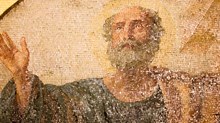
Byzantine art tended to make physical form seem less material, and in these mosaics the beautifully robed figures of biblical characters or saints often seem to hover before a golden background.
The richest surviving early Byzantine mosaics are found in the church buildings of Ravenna, Italy, and date from the fifth and sixth centuries. A mosaic in the church of Sant’Apollinare Nuovo depicts Christ in judgment, separating the sheep from the goats; others illustrate the visit of the Magi and Jesus’ Parable of the Pharisee and the Publican.
The rulers of Sicily in the 1100s and 1200s employed Byzantine artists to decorate their churches. The walls of the Monreale Cathedral are covered with excellent examples of Byzantine mosaic, including a majestic version of Christ Pantocrator (“ruler of all”) in the dome over the main altar. Other mosaics of the era show Jesus healing the lame and blind, raising the daughter of Jairus, and multiplying the loaves and fish.
Many of the mosaics in Constantinople, the center of Byzantine civilization, were destroyed in the controversy over icons in the eighth and ninth centuries. The iconoclasts, “image-breakers,” believed that veneration of icons of Christ or the saints was idolatry.
Eventually the Orthodox Church approved the use of icons, doing so on the basis of the Incarnation—since God became human in Jesus Christ, he assumed all human characteristics, including visibility. The icon, it is argued, partook of the spiritual essence of the figure it represented and thus served as a point of contact between the human and the divine.
Other early Byzantine mosaics were lost when Crusaders from western Europe raided Constantinople, and others still were plastered over when Muslim Turks captured the city in 1453.
The impressive Hagia Sophia, or Holy Wisdom church, in Istanbul (the modern name for Constantinople), was converted into a mosque by the Turks. But in 1933, American experts restored some of its Christian mosaics after it became a museum. In a scene probably executed in the 1200s, the skill of the Byzantine artists is displayed in one larger-than-life figure of Christ flanked by the Virgin Mary and John the Baptist.
Fresco and Painting
Artistic standards changed over the centuries, and mosaic did not suit the new tastes, which wanted to see more spatial depth. Thus frescoes (painting on wet plaster) became more popular, partly because they were less expensive to produce.
Frescoes from the Middle Ages portray a variety of biblical scenes. The church of Santa Maria Antigua, Rome, contains an eighth-century painting of the crucifixion, and the holy family’s flight into Egypt is the subject of a fresco in the church of Santa Maria Foris Portas, Castelseprio, Italy.
The earlier fresco painters worked anonymously, but later painters were identified, and many have become important in the history of art. Between 1305 and 1315, Giotto painted episodes from the life of Christ for the interior of the Arena Chapel in Padua, Italy. He used color strikingly, as in the clash of harsh colors in the scene of Christ’s betrayal by the kiss of Judas.
Duccio, like Giotto, continued to paint in the Byzantine style. His Maestra (1308–11) is a panel in the Cathedral of Siena, Italy; one side is covered with scenes from the life of Christ, including the temptation, the calling of Peter and Andrew, and the entry into Jerusalem.
Icons
When Vladimir, the ruler of Kiev, converted to Christianity in 988, he chose Eastern Orthodoxy over the Catholic Church for his people’s faith. Consequently, Russian and Ukrainian artists developed a tradition of icon painting in the Byzantine style.
Russian icons, painted on wood panels, portray scenes prescribed by church tradition. The most common biblical themes are portraits of Christ or of the Virgin Mary, called “Mother of God,” with the infant Jesus.
Another common theme is the “Old Testament Trinity,” which depicts Abraham’s three angelic visitors (Genesis 18) seated around a meal that represents the Eucharist.
Key to Medieval Faith
These examples illustrate the extent to which Christians in the Middle Ages were exposed to the events, characters, and teachings of the Bible, even when few of them could read it. In both worship and daily life, events from the life of Christ and other biblical scenes were present in sculpture, mosaic, and stained glass, in books, in drama, and in architecture.
These works of art show why historian Henri Daniel-Rops claimed that the first and most fundamental characteristic of medieval religion was the influence of Holy Scripture.
Richard C. Leonard is president of Laudemont Ministries. He was Scripture editor for "The Complete Library of Christian Worship" (Abbott Martyn, 1993).
Copyright © 1996 by the author or Christianity Today/Christian History magazine.
Click here for reprint information on Christian History.

Support Our Work
Subscribe to CT for less than $4.25/month